Categories
Travelogue USA

USA Part 32 – The first whale

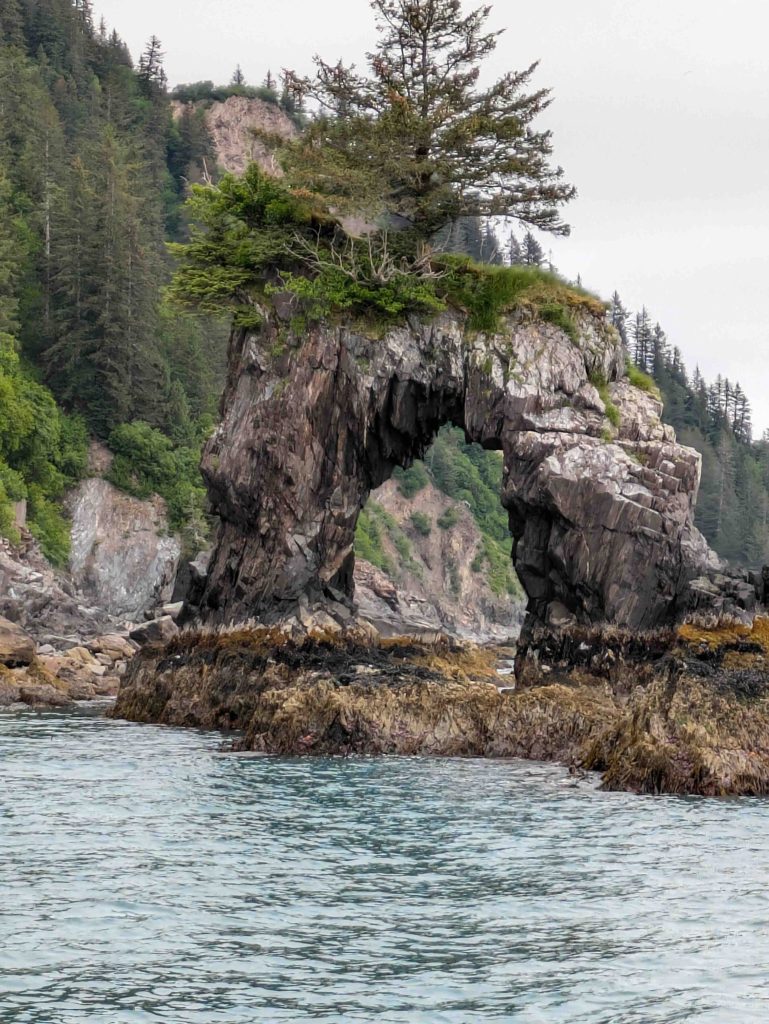
I went all over the boat to check out all the decks and viewing areas. There was something charming about being in a boat in the waters – I felt that when going out with my colleague on his boat, and felt the same over here in this much larger cruise boat as I watched us moving further away from land. Even when you aren’t spotting any wildlife, the coastal scenery was beautiful (shades of green, brown, grey, white, blue). 


“And we have a Dall’s porpoise near our boat. They are really fast. They can swim at 35 miles per hour, while we are currently going at 25.”
We all stepped out onto the deck again. 
“There’s just one, it seems like.”
This one was hard to get a clear glimpse of because it was like a dolphin popping to the surface, then diving back under. So you’d just have a moment to view it. 
“They do sometimes like to play around the boat. We’ll see if this one wants to play or not.”
The captain waited a few minutes, but there was no sign of it again.
“It’s probably gone in search of food. But we may see them again later.”

Around 9:30 am, Rajesh dozed off in his seat. 
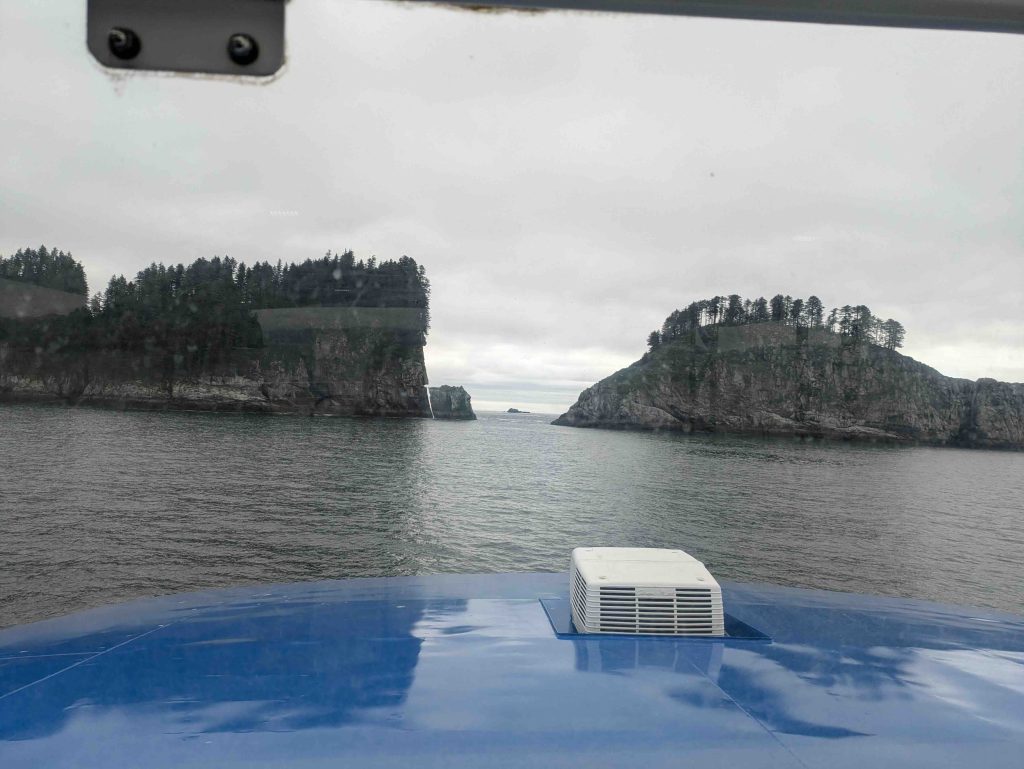
“We are heading into Aialak Bay. The name Aialak means dangerous or eerie. Dangerous because there are 3 water currents that converge here, and so the sea is confused at this point. The natives used a kayak to travel here.”

A little while later, the captain said that there’s a whale in our neighbourhood on the starboard (right side). He brought up the topic of perspectives again. “When a humpback whale comes up to the surface, you are only seeing one-third of the animal’s body. It’s very similar to you and me when we swim, we don’t bring our whole body out.”
As per the information notice I saw earlier, a humpback whale can be around 60 feet long. 


He went on to describe these whales – they have something called ‘baleen’, which is like teeth but more of a filtering mechanism; it’s like plates with hairs on the end of them; they filter the water to get small bait fish, which is their food. 
“We need to look all around the boat. You know what we are looking for – that spout, the puff of smoke which rises above the surface of the water.”
We were standing on the starboard side of the boat, but the captain said, “I  still think it might come up on the port side after swimming under our boat.”


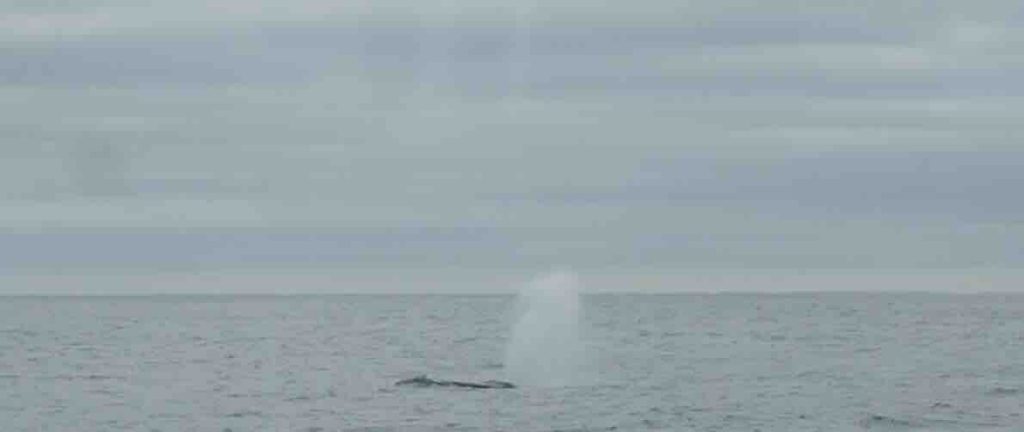
Three things you see: the spout, which I first thought was the whale blowing water out, but it’s actually the whale breathing out; and when the warm air from the whale meets the cold air outside, condensation occurs, leading to the formation of small droplets. Second, you see a part of the body, and finally, you’d see the flip of the tail. 

“Oh yeah – look out at 11 o’clock.” I think the caption saw a spout.
I had focused my phone cam on a patch of water that seemed to be a different colour.
“Oh, look at that,” the captain said. And then I discovered it wasn’t the place I was looking at, but further ahead. We saw a part of its body coming above the water, and the captain went, “Here comes the tail, here it comes. Wow.”
We could clearly see the underside of the tail, which was mostly black, but had a patch of white – later read that this is a distinct sign of a humpback whale. We were at some distance from the whale, but it was still visible to the human eye – the binoculars, of course, gave you a sharper and closer look – but one challenge is that the field of vision is limited in binoculars; so you have to be focused on the right spot, else you would miss them. 
“The underside of the humpback whale’s tail is unique – it’s like fingerprints for humans. And we can identify the whale using it. My staff says that the one we saw was…”
I couldn’t catch the name, but it sounded like Morgan something.

That was my first whale sighting. Don’t expect to see their face – don’t think many whales will be jumping out of the water for us to get a glimpse of that!
When I went down to the second-level deck, a staff member asked me if she could borrow my binoculars for a while. She went around looking at the seas and then returned it to me. The staff were probably assisting the captain by letting him know if they spotted anything. In this case, it was likely a whale. 

It was 10 am, and people were crowded on the port side of the boat. The captain was describing the orcakiller whales. Seemed like he had spotted something. 
“There are 3 ecotypes of the killer whale in Alaska – resident, transient and offshore. There are differences in their appearance and even in their diet. Like the offshore is known to feed on sharks.”
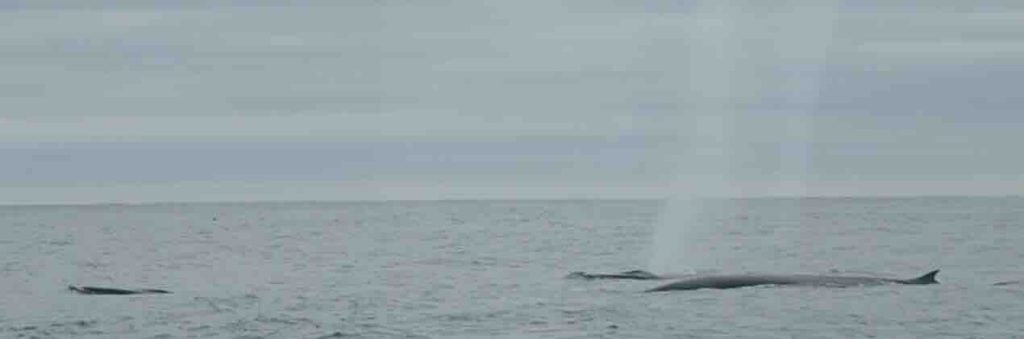
And a little while later, we could see a fin sticking straight up above the water.
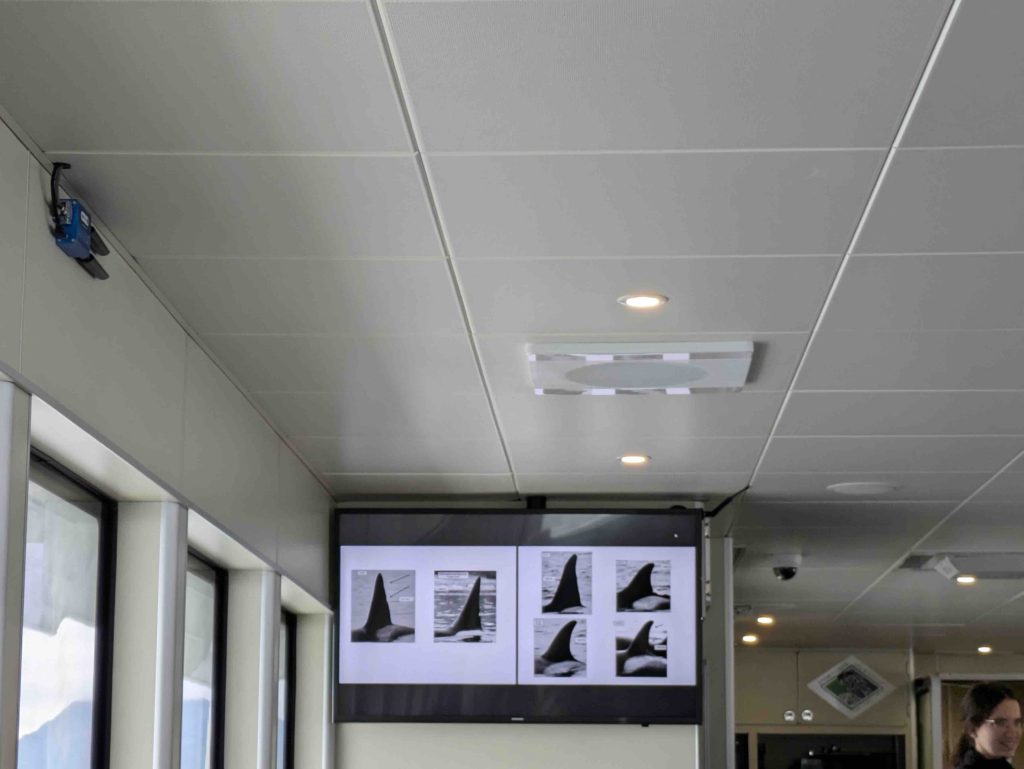
“This is such a cool animal. The tall dorsal fin is a male. You will see their tail fin first. Their dorsal fin is about 5 feet.”
We saw a couple of fins pop above the water – there was more than one killer whale out there.
“Let’s just keep watching them.”
He said that we weren’t even halfway through our trip yet, and we had already come across a bunch of whales. 
“Oh wow, they’ve moved further away. Everybody, come over to the port side to get some more views.”
We could see the fins, and a part of their upper body came above the water for a second, then went below multiple times. Orcas actually belong to the dolphin family – we couldn’t see their full body, but if you see snaps, the black and white colour will remind you of dolphins. But these even eat whales, and that’s why their name is more like killer of whales; they are apex predators (no predator above them!) As per the length chart pasted in the cabin, these were only about 20 feet in length, a lot smaller than the humpback whales.
“We saw the dall’s porpoises earlier, and they may have been avoiding the killer whales.”

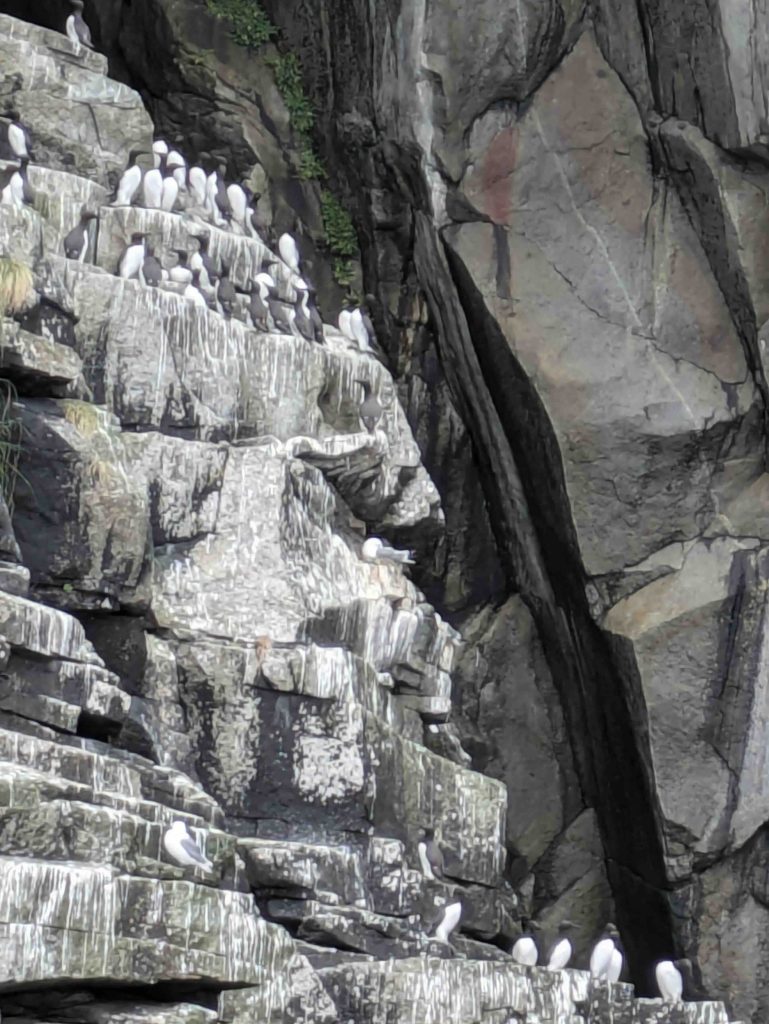
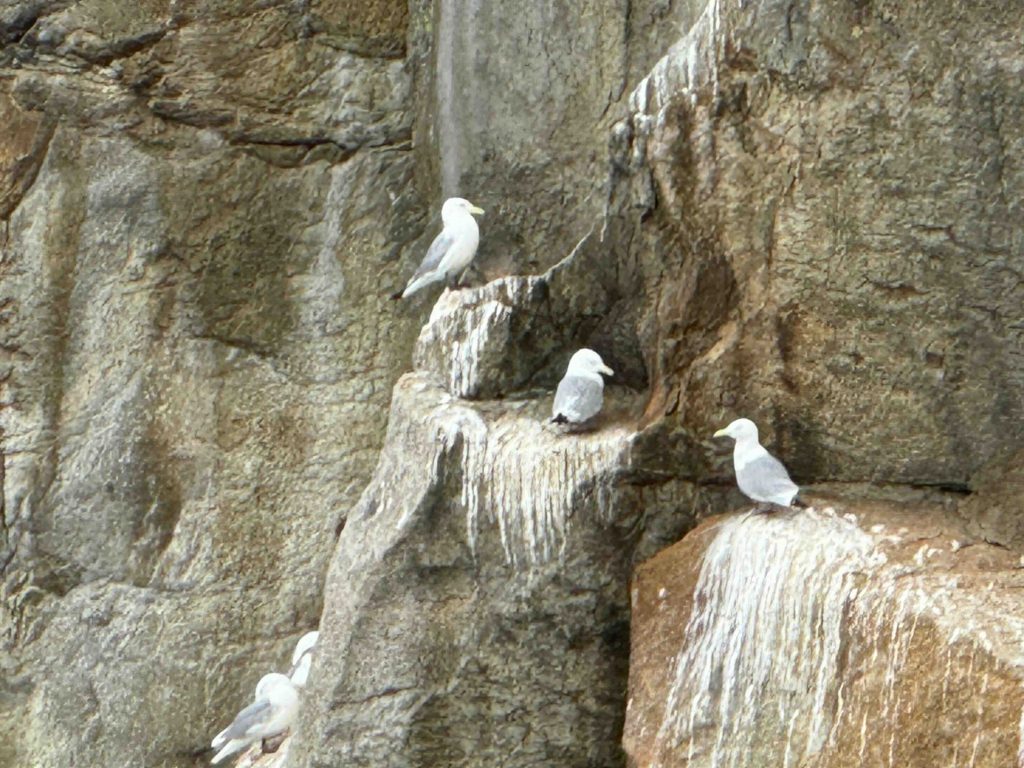
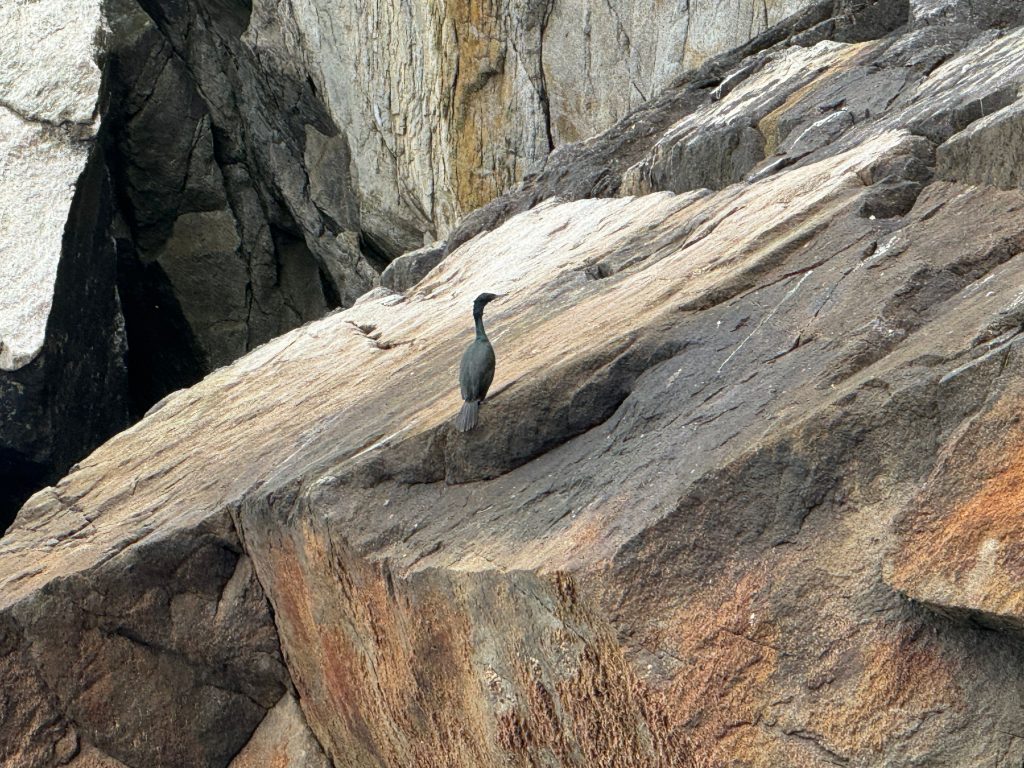
A few people pointed to the boat’s rear end, thinking those were also whales. But the staff nearby clarified, “Some birds, when they expand their wings, will also look like a fin.” The staff was guiding people on where to look.

For those wanting to read about the whales:
https://www.fisheries.noaa.gov/species/killer-whale/overview

Categories
Travelogue USA

USA Part 31 – The cruise begins

The captain continued, “As we travel over the next few hours, there will be things we spot along the way. To make it easier to reference the direction of the sighting, I’ll use clock directions. So 12 o’clock means looking straight ahead, 3 o’clock is to my right, which is also called the starboard side, 6 o’clock is behind us, and 9 o’clock is on my left or what we call the port side.”
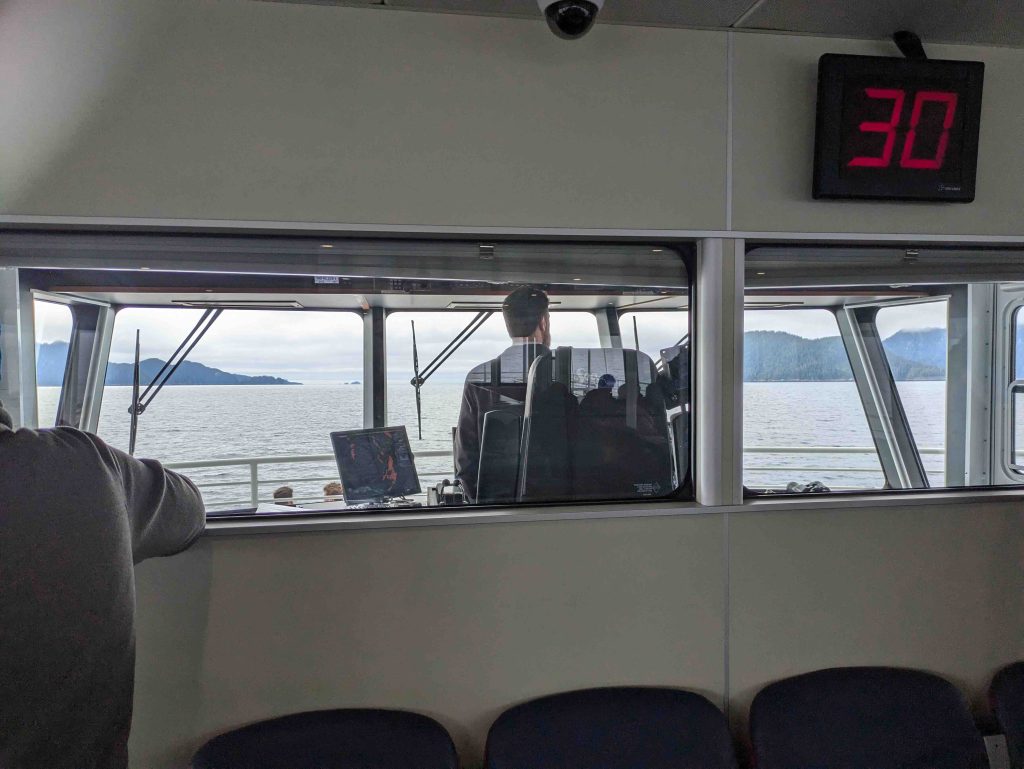
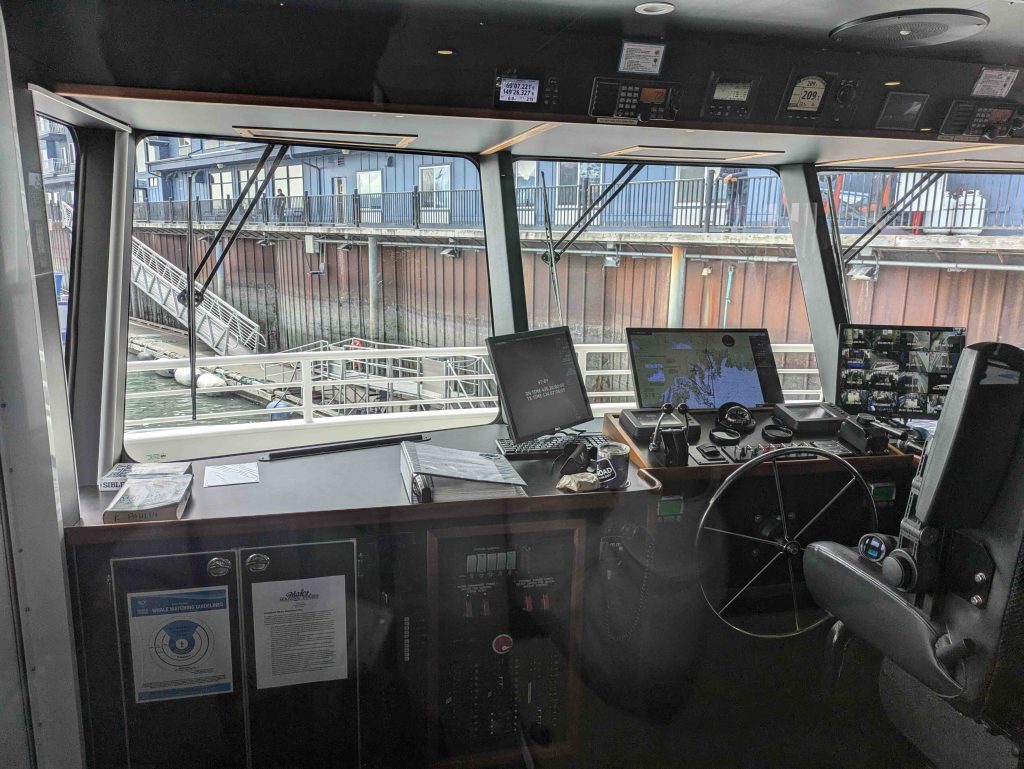
The captain was sitting in a glass-enclosed cabin on the second level (technically called second deck), which gave him an elevated view of the waters  – the place he sits is called a wheelhouse.  
The perimeter of the boat on all floors had a railing – so when you stood outside, you had something to hold on to. The boat set out, taking a path to exit Resurrection Bay. 


“And there we have our first sighting of the trip. The bald eagle at 1 o’clock.”
It was visible from inside, and we were able to get good shots without stepping out. It was perched on top of a pipe in the harbour. 

“We’ll slow down to get a good view of it.”
Moorthy got a good snap on his pro cam. 
It had been just a couple of minutes since the boat had begun moving.
“This is a glacier cruise, but along the way, if we get to see wildlife, we’ll slow down to spot them in their natural habitats.”
“Now, the bald eagle is native to the US. What makes them amazing is that they have great eyesight, a lot more powerful than ours. They have two retinas in each eye. Lately, I’ve been wondering about perspective, and the bald eagle has a 340-degree field of view. Perspectives differ based on your viewpoint.”
The captain went on a little philosophical note on perspectives, which I found a little odd – didn’t really gel with the narrative, and maybe, this was just a little too soon in the trip to talk philosophy. Anyway, within a minute or so, it seemed like the bald eagle was aware that many eyes were looking at it, and it took off elegantly. 

A few minutes later, the captain mentioned a sea otter. “You can see it in the water. Goes in and comes up. I’ll slow down a bit, while you all can take a look.”
This was not easy to spot; I stepped out and picked up a pair of binoculars on the way. The door was tight, and you really had to put a lot of force to get it open, and once open, it would snap shut quickly unless you held it. Outside, it was a little breezy, and I tried to focus the binoculars in the direction of the sea otter – it was quite a sight; it was like the sea otter was playing in the ocean! The binoculars gave an amazing view of the animal.

The binocular model was the Nikon Aculon A211. It gives you an 8x or 10x zoom. Many people stepped out; some with pro cameras trying to capture a shot. I gave up on taking snaps since there was no way my phone’s zoom would capture this.
Moorthy did manage to get a decent zoom on his iPhone from inside the cabin.
“You guys should get the binoculars. Check it out.”

Inside the cabin, on a wall, there were posters with details of marine life in the Seward area. Sea otters apparently eat up to 20-30% of their body weight daily!

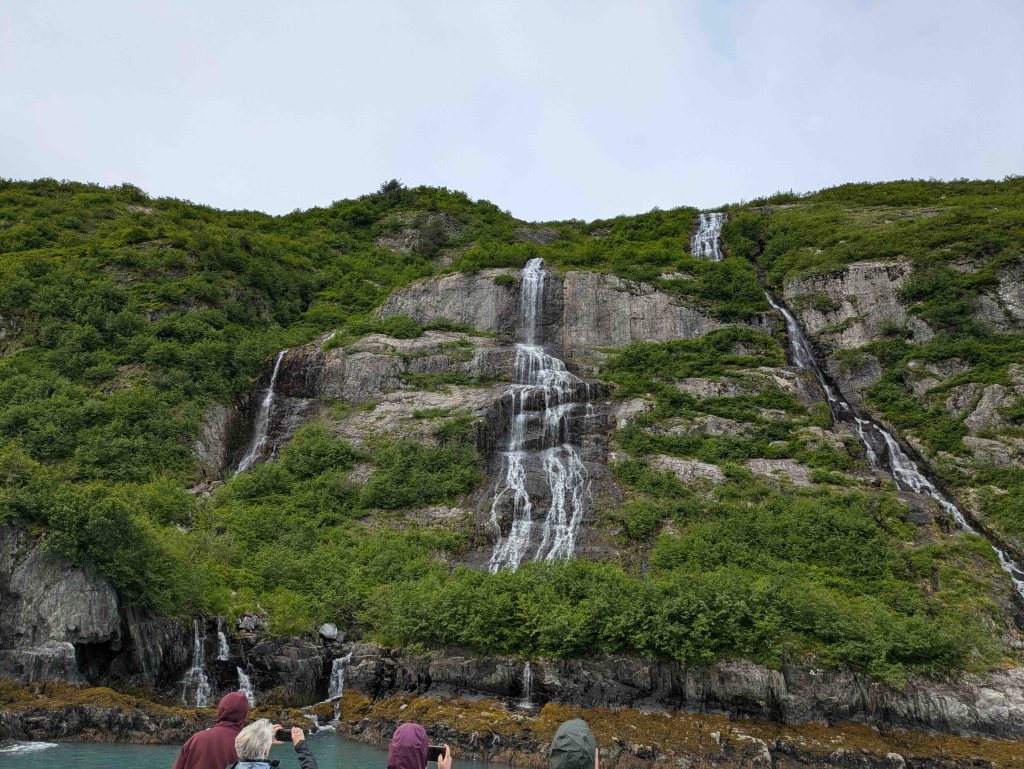
There was a scenic cliffside view along with a waterfall on it, and then, we came across a harbour seal that was stationary – in fact, it was like a white puff among the rocks. 
“Harbour seal on the port side.”
Outside the first deck, there were extra railings to hold on to, in case you didn’t feel comfortable holding the railings on the edge of the boat. 


“Harbour seals can drop their core temperature and dive deep into the sea. They may not move elegantly on land, but they make up for it in the sea.” They can go down some 500 meters and stay underwater for 20 minutes. “They can swim through the waters pretty effortlessly.”
Though the waters were fairly calm, as we motored along, you may still feel a rocky motion, and you may not feel stable without holding on to a rail or some support.


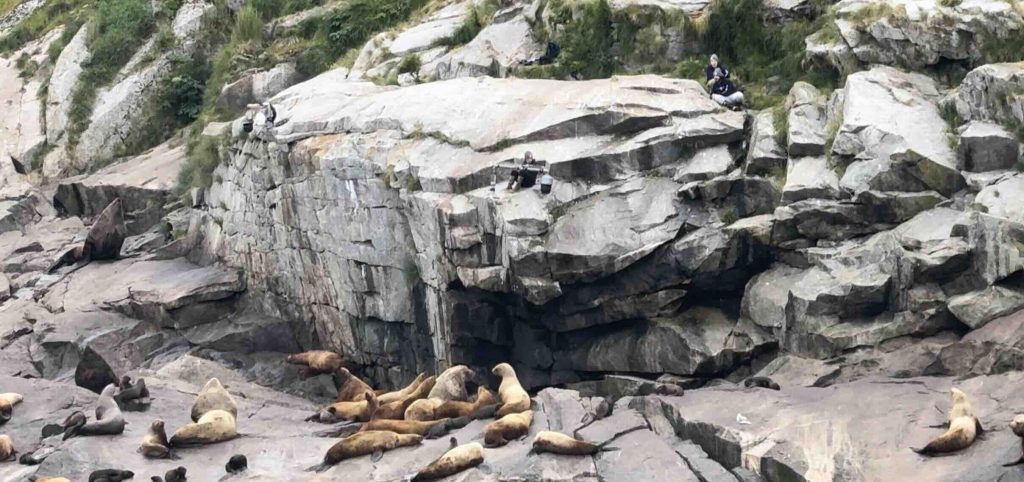
One of the seals was lying down on a solitary rock, while a couple of others were on the coastline nearby.
We had a little booklet that described the route we’d take and listed some key wildlife and birds we might see along the way.
“Already seen 3 listed here,” I commented.
The last page of the booklet described the 4 cruise options. “The 4-hour cruise just goes around the bay.” That was the shortest one and was meant to view wildlife alone. The 6-hour one onwards were the ones going to the glaciers – there were 3 of them; in our cruise, we’d get to see one.

“Starboard 2 o’clock. Mountain goats.”
We ran out again to see if we could spot the goats. This was quite a struggle to spot – these are white.
“The main reason I respect them is that while most of our animals migrate, these are one of the rare few that do not migrate or hibernate.” They live on the steep cliffs on the coast. 
Moorthy felt he saw them, but I still couldn’t; eventually, I did spot it thanks to all the other people on the deck, some of whom had powerful zoom cameras, and looking in the direction they were focusing on helped me spot them – there were a couple of goats facing each other, extremely still, and appeared like a couple of cotton balls! You’d think it was an inanimate life form unless you knew what you were looking for!

“What you see at a distance as we pull away from Resurrection Bay is the Bear Glacier. This is a massive expanse of ice. The only ways to reach Kenai Fjord are by boat, plane, or kayak. It is hard to hike to get here.” 

Categories
Travelogue USA

USA Part 30 – The cruise

Morning was a bit of a rush with all of us getting through our bathroom routine and preparing to leave. There was only 1 bathroom, so we had to take turns. 

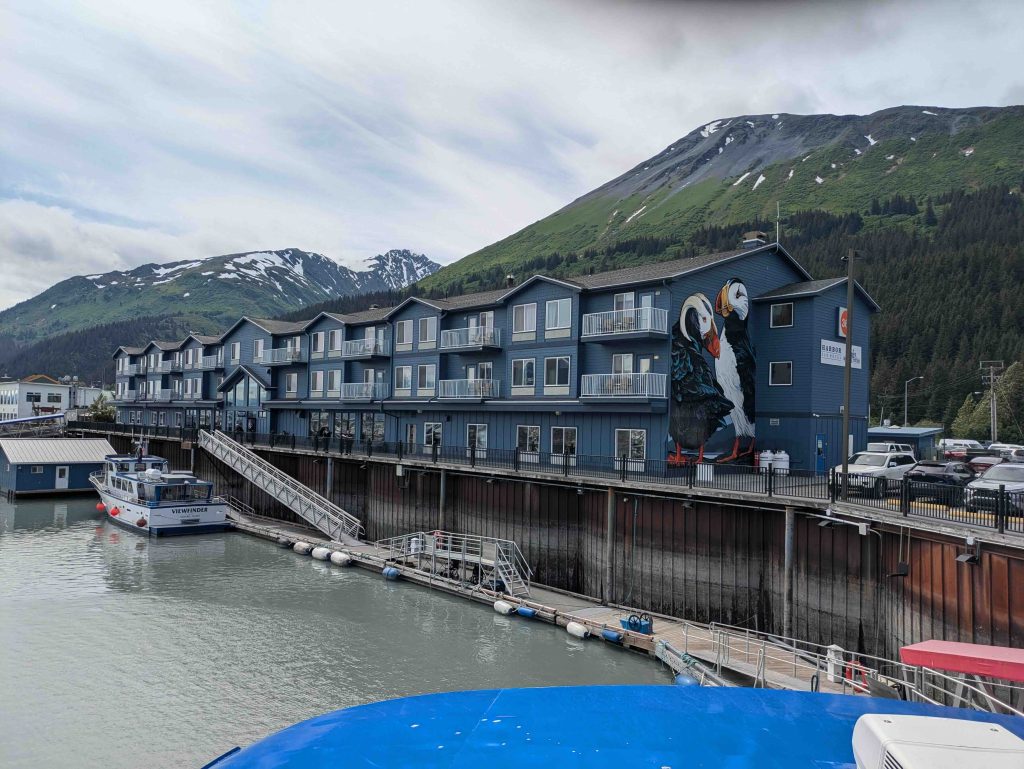
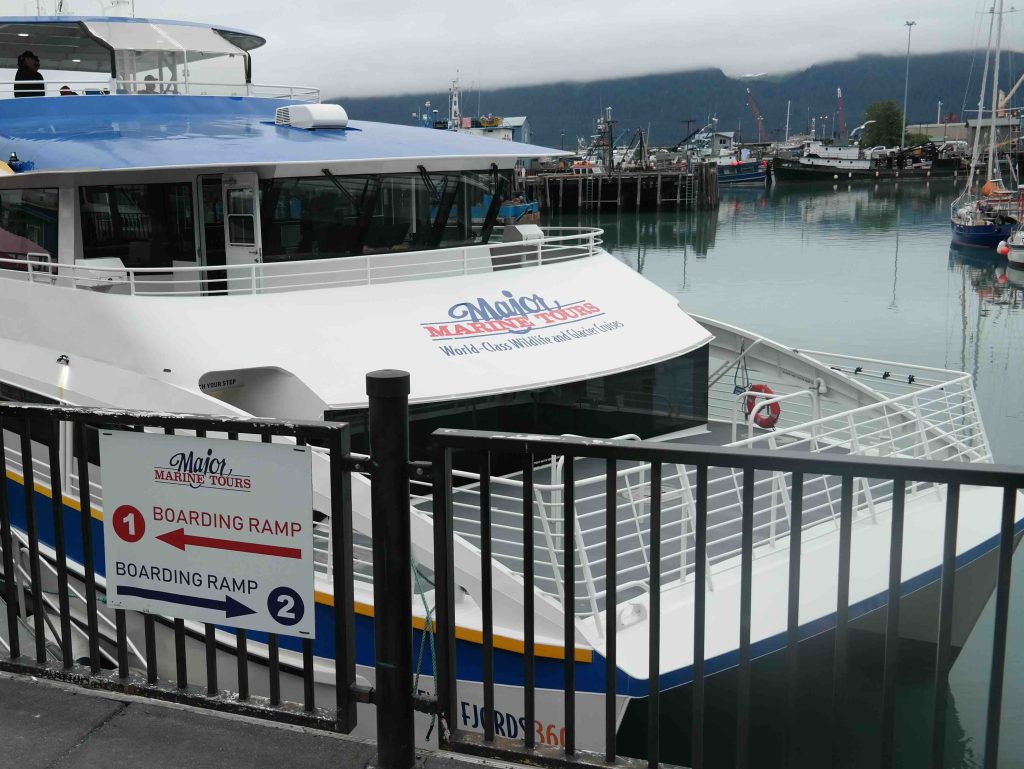
We arrived at the Harbour 360 Hotel at 7:35 am; this was the check-in location. While Moorthy and I were checking in, Rakesh and Raghav wandered around the area to pick up coffee. The staff directed us to the exit door. Basically, the backside of the hotel led to the harbour area. We were allowed to bring our own snacks on the boat – so I had a bag with our onion rings and chocolate chip cookies. There were signs directing us to the “Major Marine boarding ramp.”
We could see people in the hotel having breakfast; later, I found that the Harbour 360 hotel is owned by the same tour operating company.
“You can go to the ramp number 1,” the staff had told us. There are some 4 cruise choices – variation was the route they took and the time duration. We had booked the 6-hour cruise. There are also 4-, 7.5-, and 8.5-hour cruises.
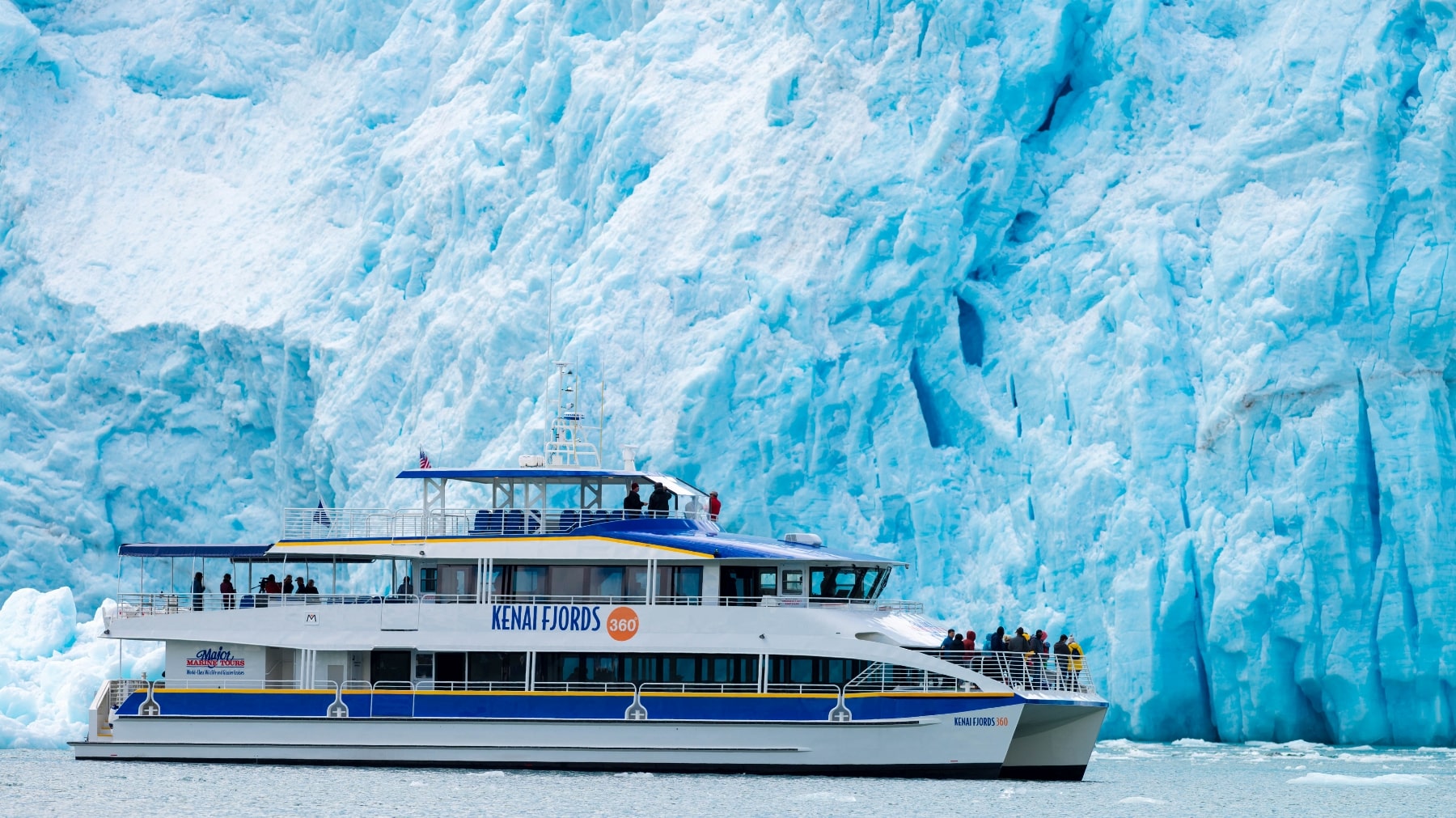
As we got to the ramp, we could see our boat – it had 2 levels for indoor seating and a third level that was like a terrace with a roof on top. We were also given a table number on check-in. 

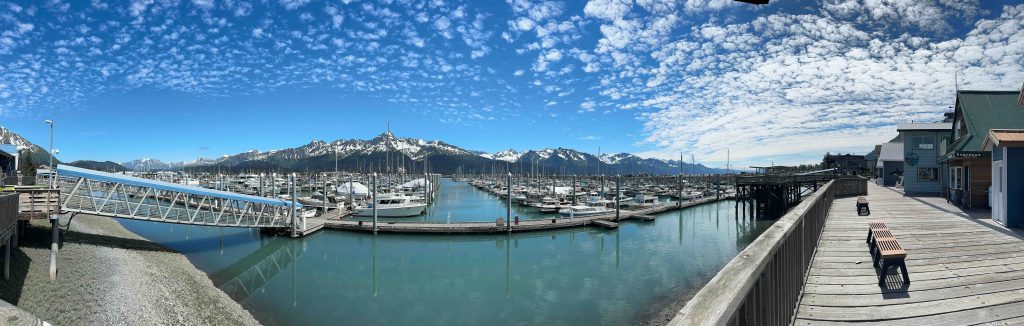
Moorthy and I took some snaps of the dock. There were so many boats in the still water. It was a cloudy morning. We saw people boarding the boat – there was a lady staff member at the entry point, validating tickets against a list before letting people through.

It was 7:45 am, and our boys were still not back. Moorthy gave Rakesh a ring, and he said they’ve placed the order and should get it soon. He gave instructions on where to come to, so that they could get here quickly.
5 minutes passed, and still no signs.
“Let’s check on the time.” We went to the staff and showed our ticket.
“There are 4 of us. 2 of them have gone to get coffee.”
“That’s ok.” The staff found our names on the list. 
“How many people are on the cruise today?” I asked.
“We have 102.”
“Everyone has come?”
“Not yet – right now we are at 94.”
This sort of reminded me of the airport check-in; you check in, and then at the boarding gate, they keep an eye on how many people are yet to board. As the flight nears take-off time, the staff go around checking if there’s anyone else waiting to board.
I was trying to make some small talk with the staff till our boys arrived, but still no signs. And then I saw a family of 4 heading our way.
“Now I think we are the only ones left.”
The family boarded, and that meant the count was 98 – the last 4 were us.
“What if they start the cruise?” I asked Moorthy.
“Oh man, we’ll get in. We shouldn’t miss the cruise.”
Would be quite a fun tale to tell people that we missed a cruise because of coffee!
“We have coffee on the cruise as well,” the lady mentioned.
“Oh okie.”
“But it’s nothing fancy like what you’d get in cafes. You want to call again and check.”
Moorthy gave a ring, and this time Rakesh didn’t pick. Raghav’s phone was typically unreachable in the US unless he was on wifi, and it was unlikely he was connected to any wifi in this area right now.
“I think they may be on the way.”


Moorthy managed to get Rakesh on the line, and he said they are on the way.
“How many people can the cruise accommodate?” we continued making small talk as if that might help our cause.
“Around 150 to 200 on a cruise.”
The clock had touched 8am. Right now, the 4 of us were holding up the whole cruise. The staff were still patient and polite – I had the feeling they had a 5-minute cut-off. Fortunately, we didn’t have to test whether they did or not, because just before 8:05 am, we saw Rakesh and Raghav fast walking towards us with 3 cups of coffee in their hands.
“There they are – the two of them.”
“Ok.”
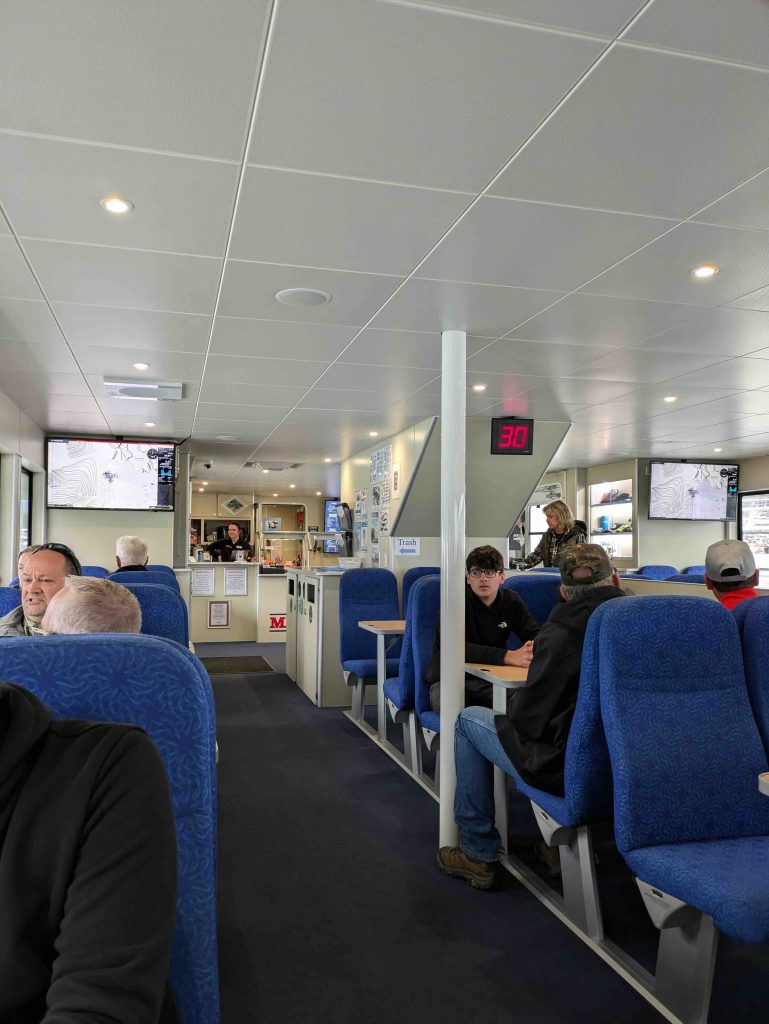
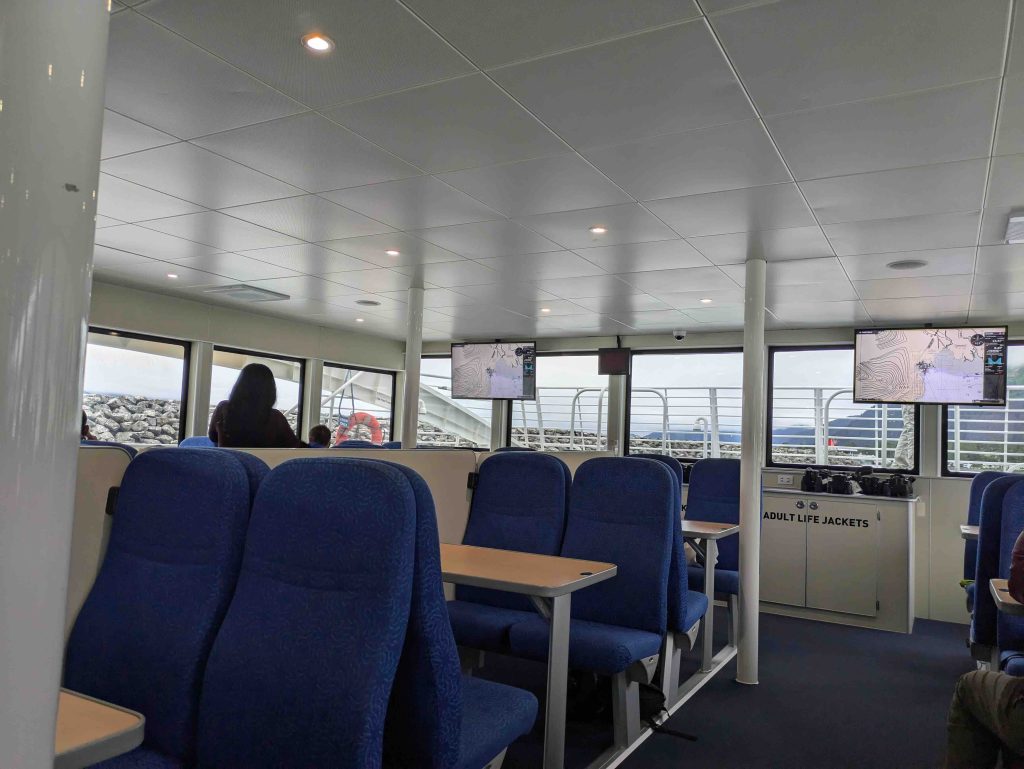
And quickly boarded the cruise boat and got onto the deck on the first level – there is an outdoor area along the perimeter of the deck, while the central section is fully covered. The tables with seating areas are within the indoor space. We located table number 27 and settled into our seats. The set-up was the 4-seater set-up; seats on either side of the table facing each other. And since everyone had a designated table, there was one place where you could just leave your stuff while moving around.
“We didn’t think it would take that long. We even said that we had to get to the cruise, but they still took their time.”
“Oh, it’s the Kaladi Brothers coffee here also.”
“Yeah.”
There were a few tables free near us, and I left my backpack on the neighbouring table.
There was a loudspeaker system through which we could hear the captain and staff making announcements. They started with the safety briefing. A couple of interesting ones: always ensure that you have 3 points of contact when on the boat; so if you are standing outside on the deck, then both feet on the ground count as 2 points of contact, and in addition to this, holding a rail with one hand would be the 3rd point of contact. They added that you shouldn’t count holding a person as a contact point!
“In case you get sea sickness and feel like throwing up, then aim for the farthest point.”
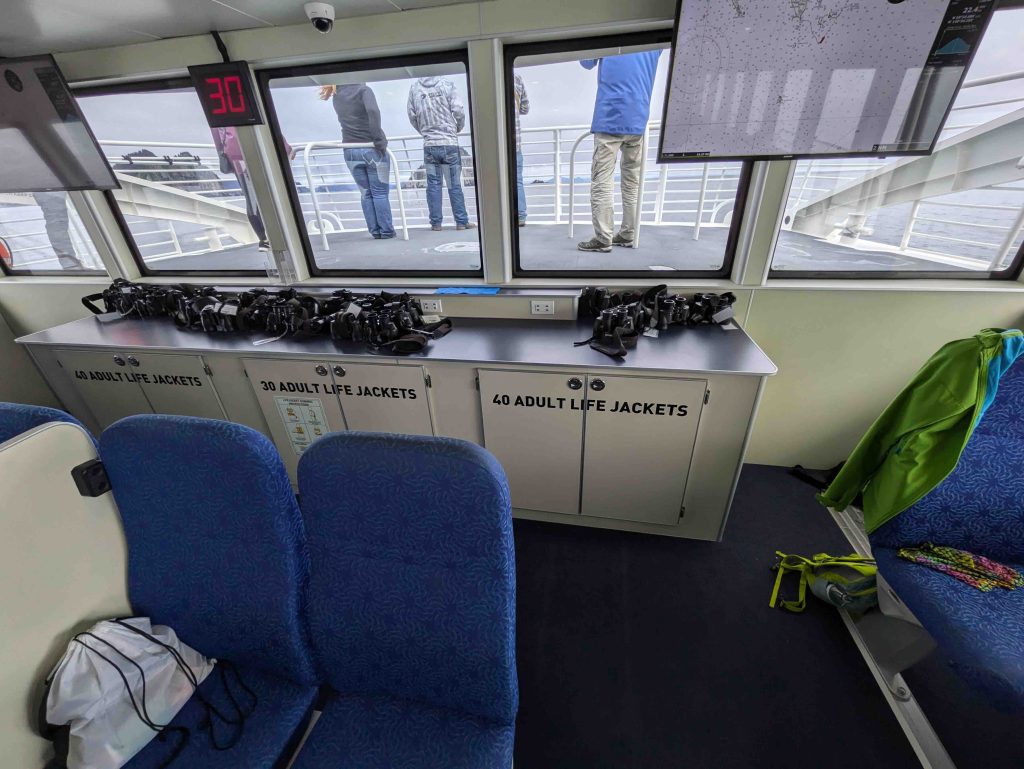
They had a few cabinets in the boat where life jackets were stored. 
“We also have binoculars that you can use for viewing. There are only limited numbers available. So do share them and return them when you are not using them so that someone else can use them.”

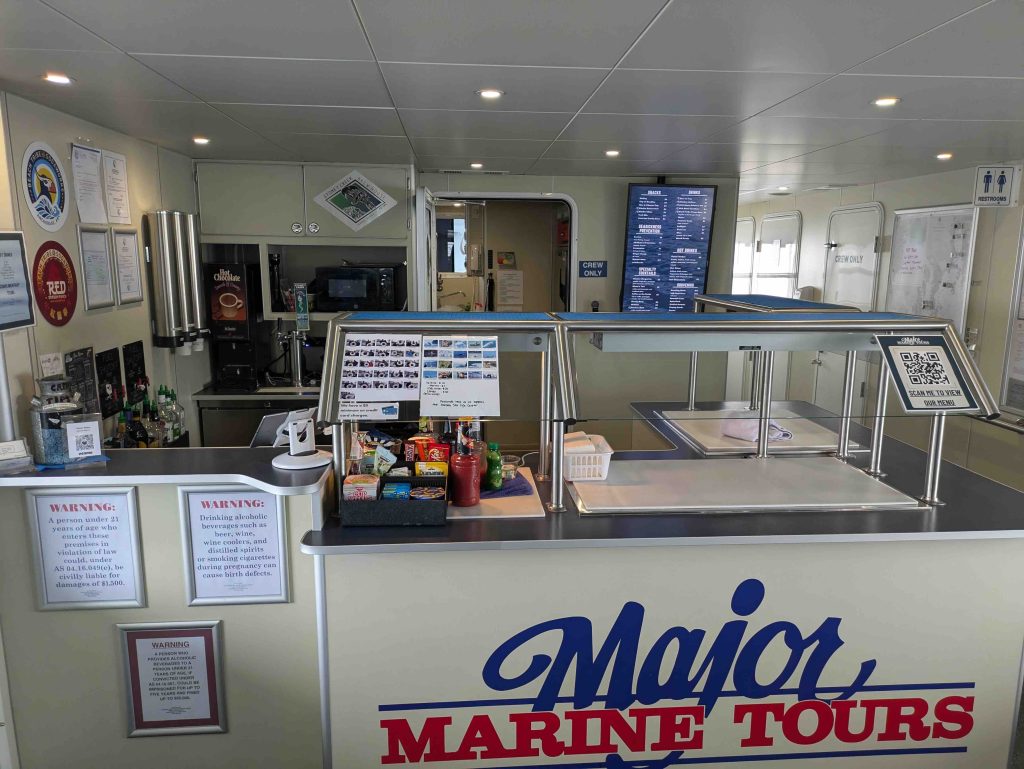
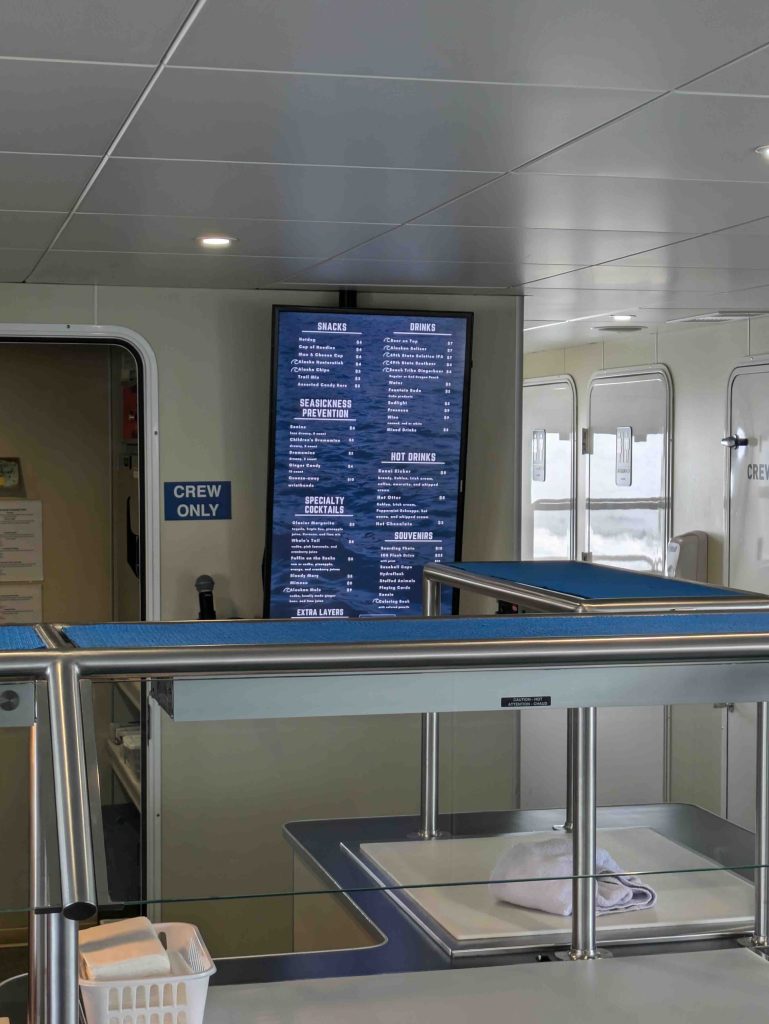
The binoculars were stacked above the life jacket cabinets. There were 4 TV screens at the 4 corners of our deck, so no matter which table you were sitting at, you could see at least one screen. The windows were large and ensured that, even if one had difficulty stepping outside, one could still get good views from inside. On one end, inside, were the life jacket cabinets, while on the other end was the pantry. There was also a restroom. A staircase near the pantry led to the second level, which also had indoor seating but was smaller than the first level. And, as with the first level, you had the open area lining the perimeter of the deck. To get to the 3rd level, you had stairs outside – the third level was fully outdoors with a few seats. But to protect passengers from rain, it did have a roof – just that the sides weren’t closed. 

Categories
Travelogue USA

USA Part 29 – A campfire

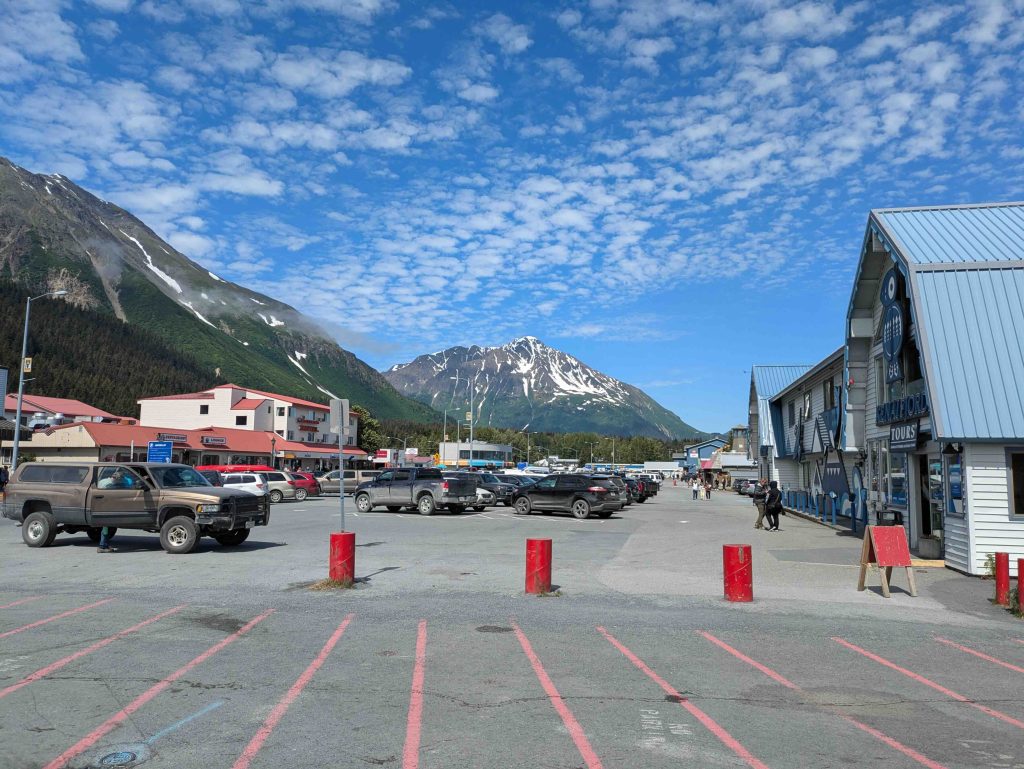
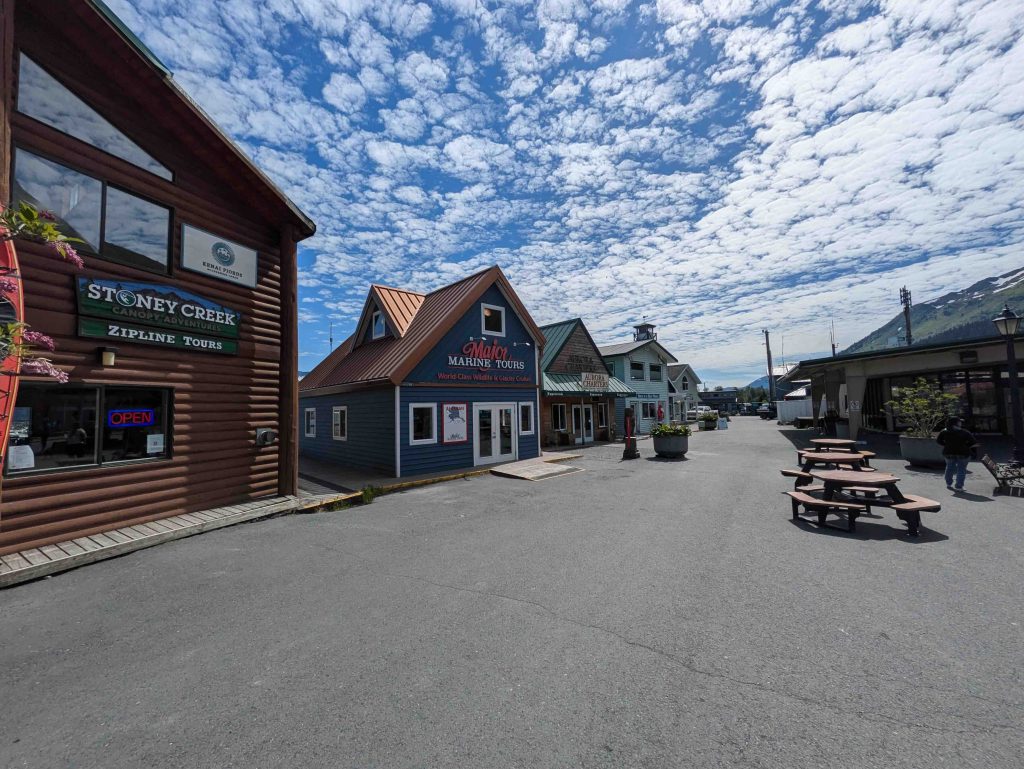
Before heading for lunch, we thought of checking out some tour operators to see if there were any other activities we could try today. The area we landed in was just beside Resurrection Bay – the water body beside Seward that connects to the North Pacific Ocean. We went in search of a zipline operator but found that this area had many activity operators – zipline, cruises, kayaking, and dog sledging. Each operator had a nice hut where they had their office – I even saw our cruise operator’s office, the major Marine Tours. We checked out a few, but the only one with a suitable timing was the dog sledge (dogs pulling you in a cart), which we decided to skip.

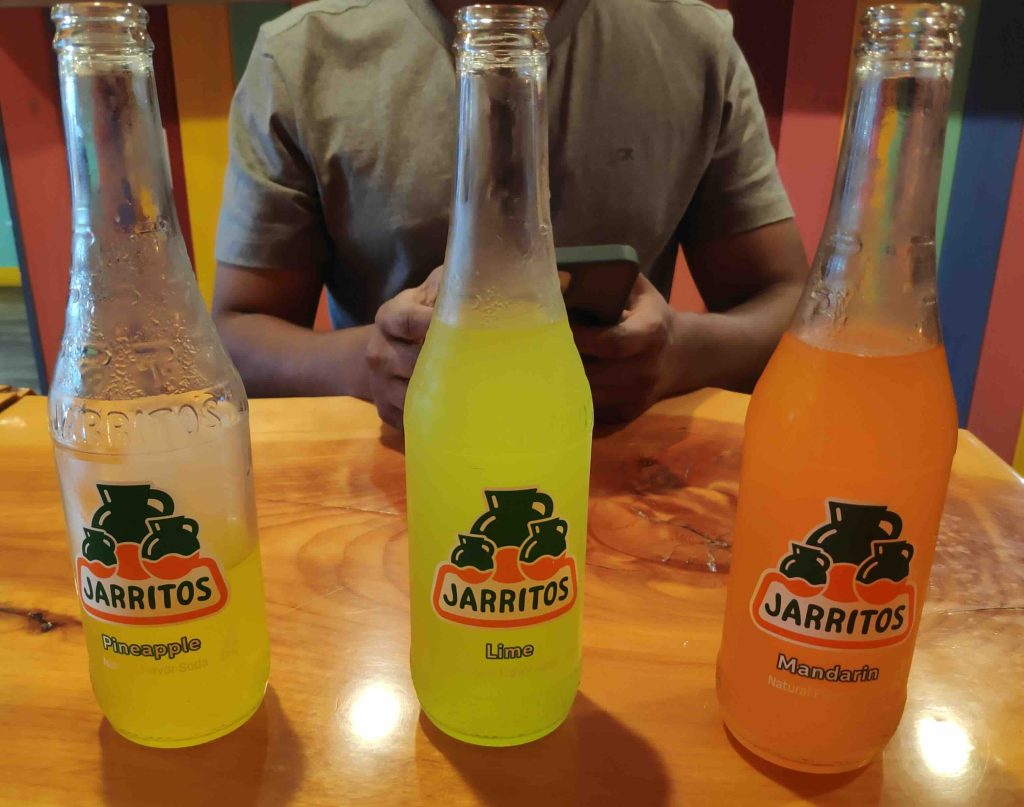
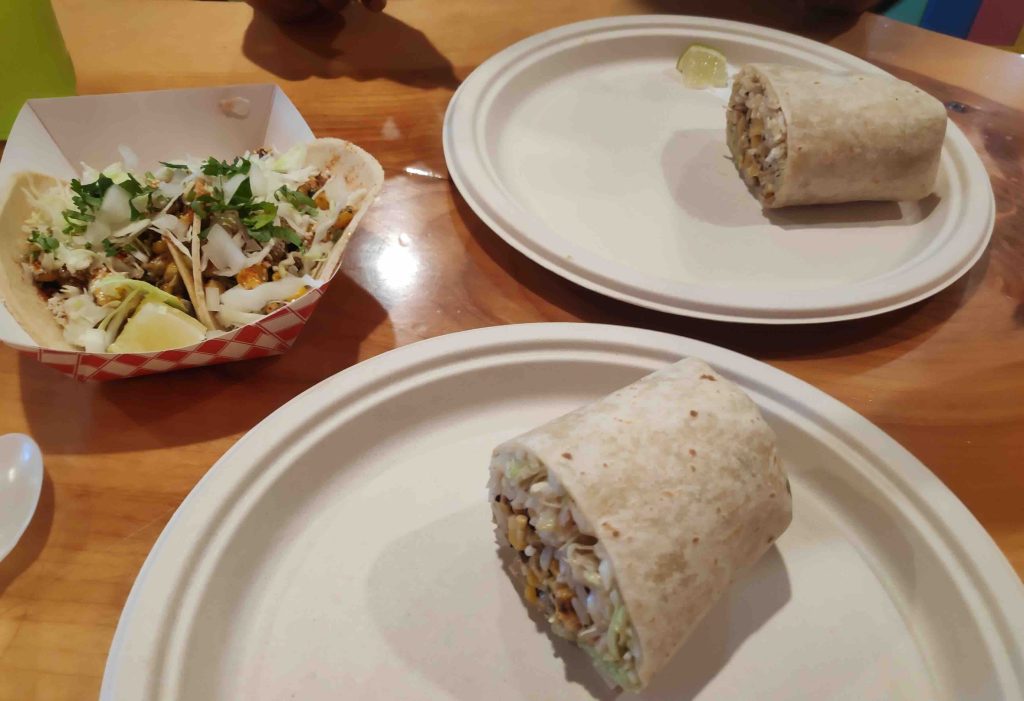
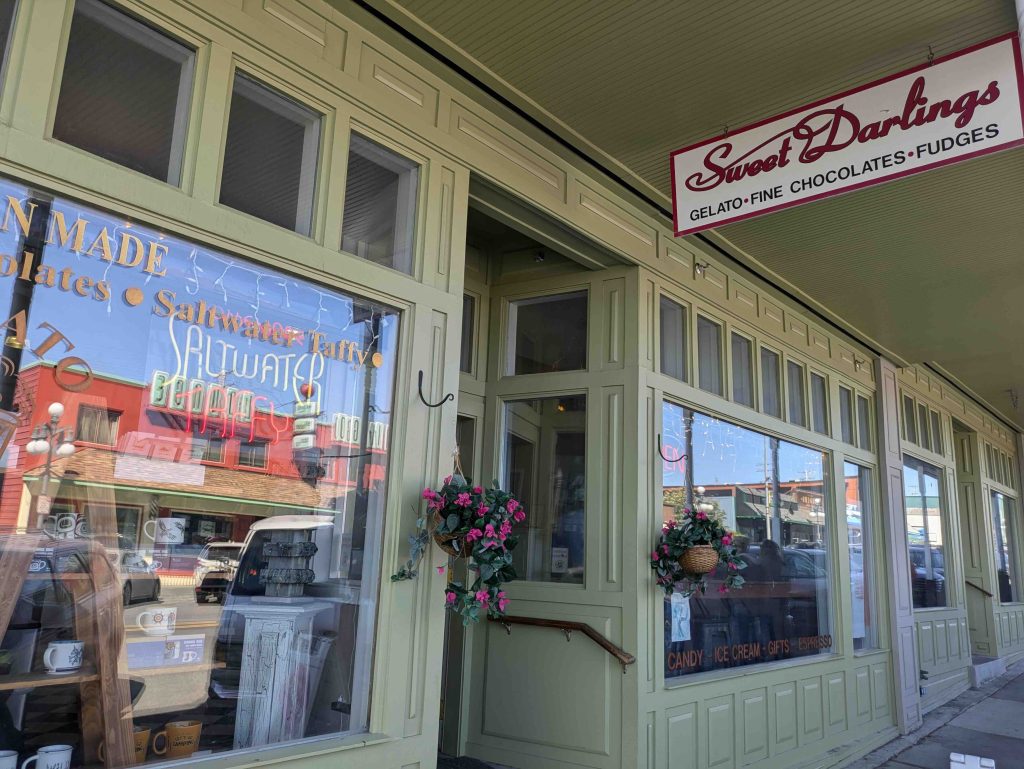
Most restaurants were in the downtown area (same place where we had dinner yesterday and breakfast today) – and so we were back there to a Mexican restaurant that Raghav and Rakesh had picked – the Lone Chicharron Taqueria. We ordered some burritos and tacos along with Jarritos (Mexican soda brand). On the table next to us was an American lady with 2 of her grandkids; their parents had gone somewhere nearby – Rakesh struck up a conversation with the kids and even told them a few words in Tamil since they were curious about our native language. After lunch, a couple of blocks away, Raghav noticed a board saying ‘Sweet Darlings’ – it was a dessert shop and not something that we’d give up. I looked up their online reviews, which seemed ok.
They were packed with customers – not overflowing, but all tables occupied, and even at the counter for their gelatos, there was a queue of 6. I tasted a couple of flavours, and Raghav bought a scoop of gelato – it was ok; I didn’t find it unique. On the same stretch, we saw a fairly large gift shop that had plenty of small souvenir-type items as well as larger gifts – a great place to pick up items to distribute to friends and family. 

“Anything we want to do today?”
“Want to go to the Alaska Sealife centre?”
“What’s in there?”
“Sort of like an aquarium.”
“If there’s a polar bear, we can go. That’s the only thing we’ve not seen.”
“Na – they surely won’t have polar bears.” It’s a place to see the types of local fish and animals that inhabit the waters in the area.
“There are some trails further down – it seems to be in a park. We can check out the park.”
We drove south from the Downtown area, as Google advised us to – it led us into shady, deserted side roads – even though there was daylight, it felt like we were on the wrong route.
“Are we on some private roads?”
We got out of what seemed like private property and landed in an area that seemed like the edge of a forest – this was one end of the park, but there didn’t seem to be any entrance.
“We can’t leave the car anywhere here on the road, either.”
We spotted a couple of trail boards, and I guess the trails would take you through the park; one of the trails, per my research, would take you to a fort. But that was a longer hike.
“Want to do the trail?”
“Na. It will take time, and I’m not sure of the elevation. I was thinking we could enter the park.”
Considering Moorthy’s knee, we decided to return. Near the waterfront, there were signs of life – few lodging cabins; some had kayaking activity; it was a nice short return ride where we drove just near the water of Resurrection Bay – we were driving beside the Pacific Ocean! This was the beachfront, but it was rocky.

Junk food

It was around 5:30 pm when we were back home. Moorthy was having a back-and-forth conversation with the owner of our cabin regarding the internet connection – it was patchy, the speed was terrible, and he couldn’t watch the cricket games. The owner’s replies were also fairly inconsiderate – he messaged in the morning, and she said she would look at it in the evening!
“I thought these places would care about the reviews that people posted. Seems like she doesn’t care about it.”
Finally, Moorthy found where the wireless device was placed – it was like a treasure hunt to locate that! And then we played around, positioning it in different places to see where the speeds would be good.
“Try keeping it outside.”
I placed it just outside our door, and that’s where we found the signal strength and speeds were the best. The cabin next door was still unoccupied, and so there was no one else in these woods except us.


One issue when you travel in groups is that you’ll tend to buy these large packs of snacks – and we had chips and some crunchy flavoured onion rings that we kept munching on through the evening, along with cookies. 
“We should go for dinner and buy dinner and come so that we don’t end up getting stuck like yesterday.”
Raghav was searching for restaurants. 
“We can get food and do a campfire. There was wood in that supermarket.”
We had seen cut logs for sale at Safeway in the morning. So fuel wasn’t an issue, and there was an outdoor fireplace just in front of our cabin to start a campfire.

A feast


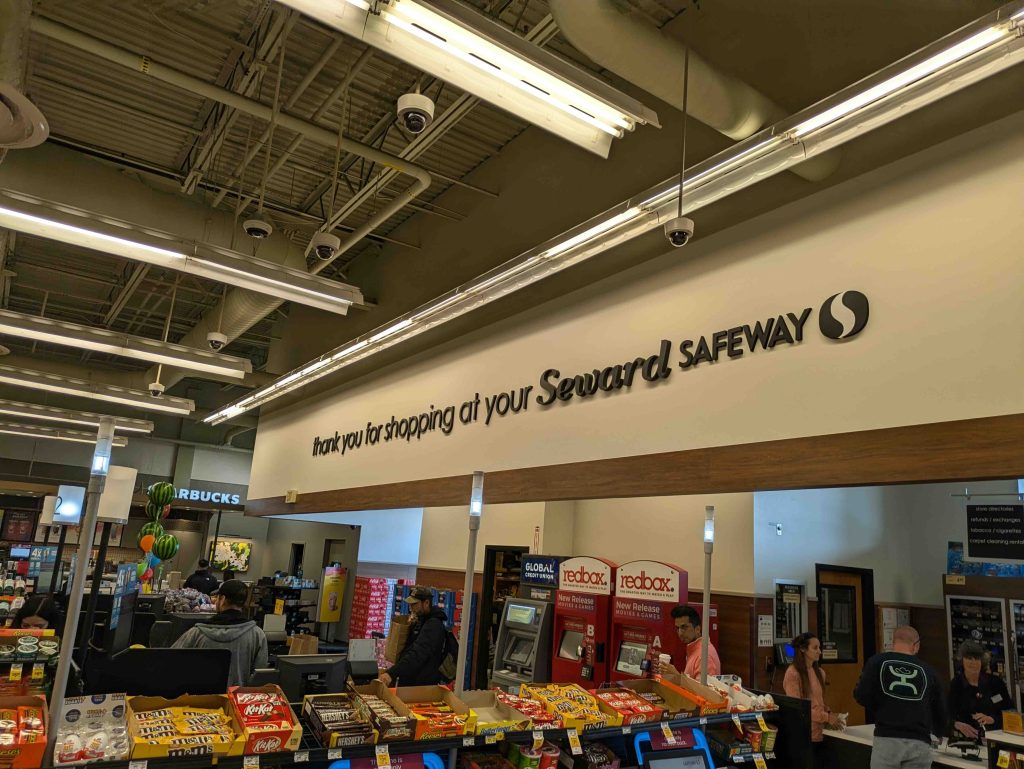
At 7 pm, we were in Safeway, and everyone wandered off to different aisles. When Raghav and I saw Rakesh a while later, we were surprised to see veggies in his shopping cart.
“Why?”
“Moorthy said we’ll cook dinner.”
“But why cook here?”
“He is insisting.”
A few minutes later, we spotted Moorthy while Rakesh was wandering around the veggies section. “Rakesh is eating very little. I think he wants Indian food.”
“But Rakesh usually eats only a little. He likes Thai food, and even that he eats less only. He is not particular about Indian food.”
“No man, he will eat more. He is eating very little in the restaurants.”
When we saw Rakesh picking Indian spices, both of us burst out laughing. With family or kids or having issues with finding suitable food, it would have been normal to cook while travelling – but with the four of us, it just felt ironic. 
“We’ve come all the way to Alaska to cook Indian food!” It wasn’t like we weren’t finding anything to eat, and there was just one more day to go. “Moorthy says that since you are not eating well, we should cook.”
“I don’t need Indian food.”
“He says it’s for you.”
“I think it’s because he wants Indian food,” Rakesh quipped. “They even have some of the Indian masalas in this shop.” 
“You both are certainly very serious about this.”
There was no way to talk them out of it. And anyway, since we didn’t have anything else planned for tonight, it was fine. And we joined in to help them pick items for the dinner feast and campfire. We even bought some fancy salt and pepper bottles. And at last we picked a bundle of fuel logs – they were already chopped into smaller blocks to make it easy to handle.

By 8 pm, cooking had started; Moorthy helped chop the vegetables, and Raghav helped Rakesh prepare the dishes. Fortunately, just like the first place where we stayed in Anchorage, this one also had all the utensils that you’d need for cooking. 
“Rakesh is the chef. And Raghav is the sous chef,” we commented. 
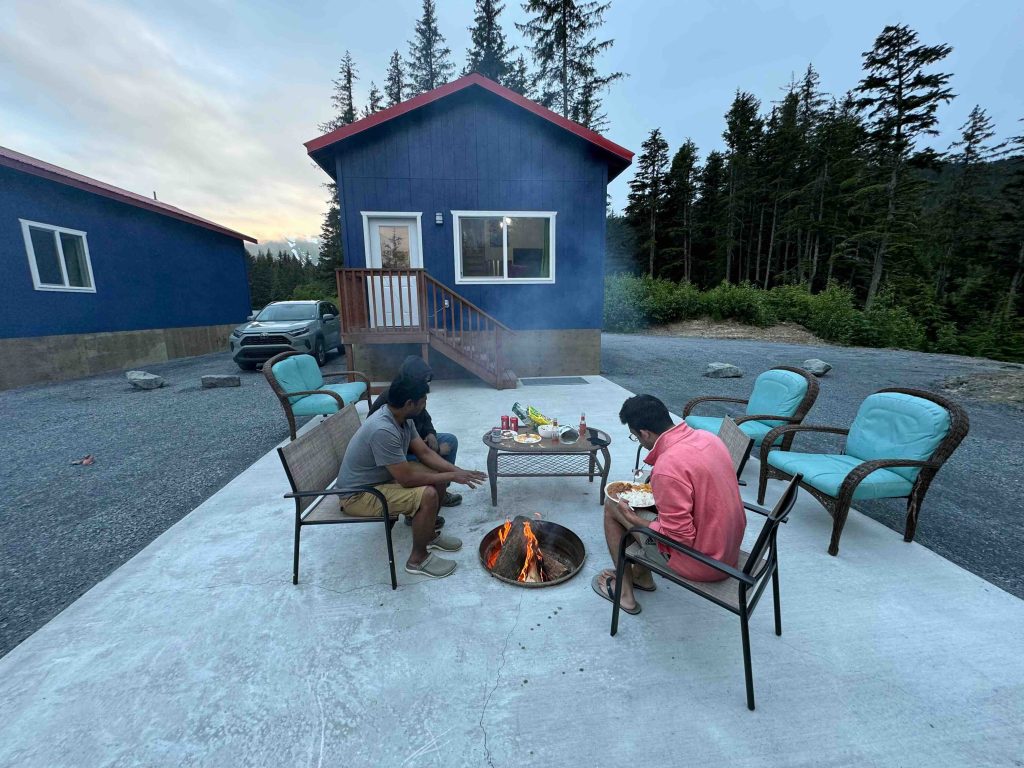
They kept rice, gobi-65 (cauliflower starters) and a cauliflower gravy. Add to that some potato chips we had and some drinks, and that was our dinner by the campfire. 
“What’s that?” I asked Moorthy as he pulled something out of a small box.
“It’s a fire starter kit. Helps start the fire.” He sure had thought of everything when we were at the supermarket!
It was 9:30 pm, and we still had daylight – but it was cold outside. I had to wear a couple of layers: a sweatshirt and full-length pants. And I still felt cold. Rakesh, on the other hand, was wearing just one layer – a thin t-shirt and shorts! We spent some time sitting around the fire, warming ourselves, enjoying the food, and chatting.

We wrapped up at around 11 pm.
“Keep everything packed since we’ll have to check out in the morning.”
“Let’s start at 7.”
Check-in time was 7am, but the staff had said today that if we came by 7:30am, it would be ok.

Categories
Travelogue USA

USA Part 27 – Change in plans

Around 10 am, we were supposed to be at the ice hiking office. Moorthy and I were up by 8.
“Man, this pain has got worse,” Moorthy said.
“What happened? You fell at night?”
“No. Yesterday I tripped in Whittier.”
I recalled the incident when he tripped over a cable protruding from the ground. It seemed like an innocuous incident back then!
“I didn’t have much pain yesterday, but today it’s bad. Can walk but steps may be hard.”
Rakesh came down the stairs.
“We’ll get something for breakfast?”
Since Raghav wouldn’t have breakfast, the three of us decided to eat something and be back.
“Let me test walking on the steps.”
And he was wincing in pain the minute he put his weight.
“Let’s have breakfast, and then we can take a call.”
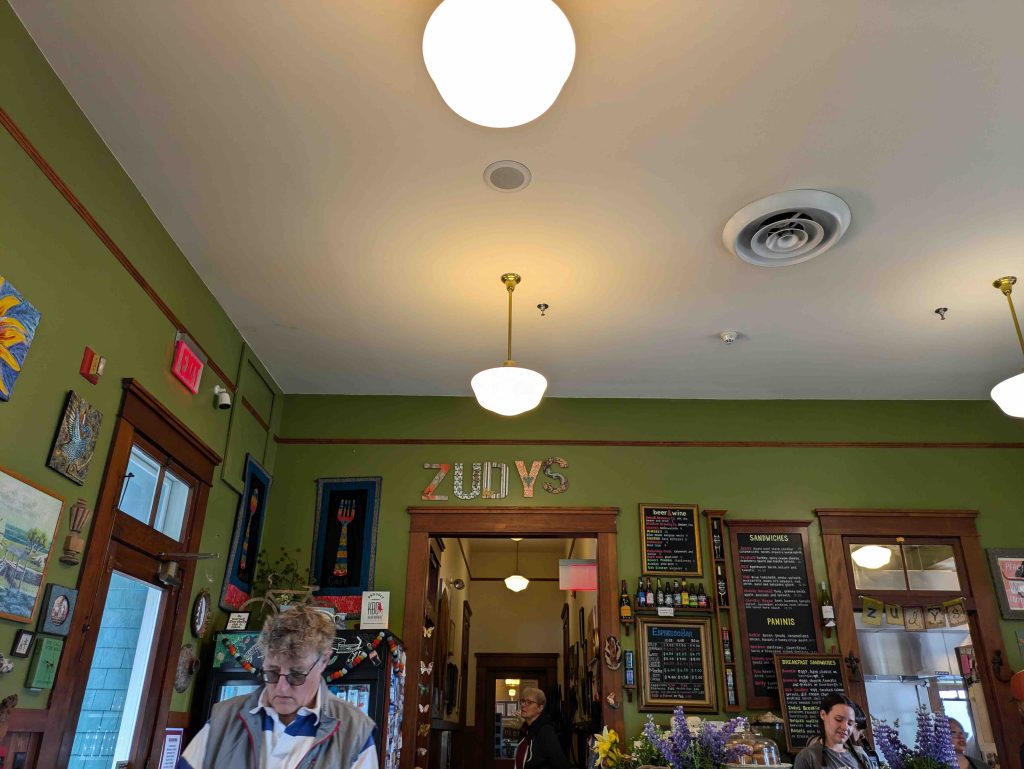
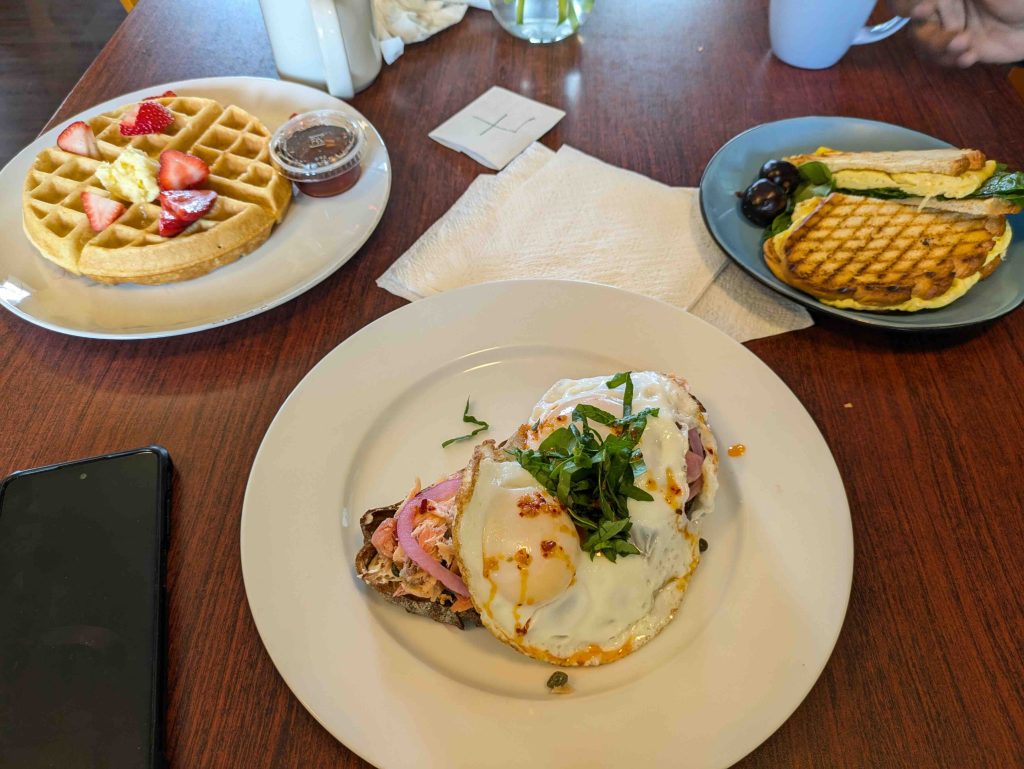
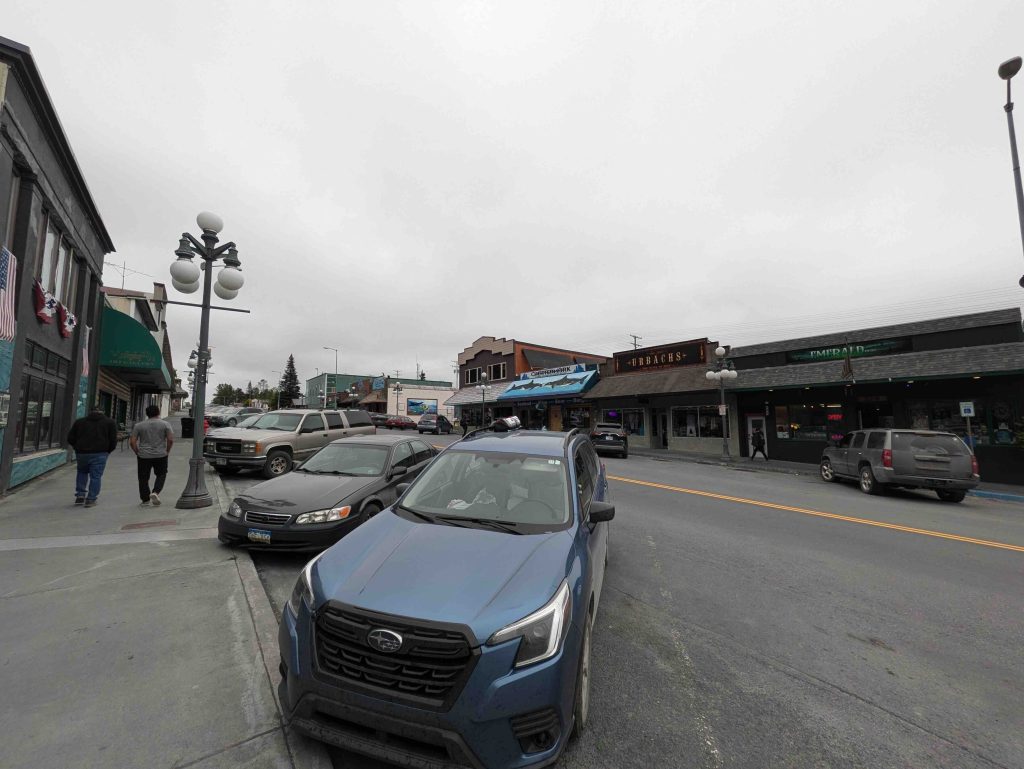
Rakesh drove the car so that Moorthy could rest his knee; we drove back to the downtown area we were in last night and parked over there. There was a restaurant called Zudy’s Cafe that was open, and on the way, we crossed the Alaska Sea Life Centre. I ordered a salmon breakfast sandwich; Rakesh had Belgian waffles, and Moorthy had egg and cheese. There were quite a lot of diners in the place, and some large groups as well. Seemed like a popular morning spot. This setting also had that old-school feeling of the 1980s – nice, quaint cafe.

At 10 am, we were back in our cabin. Moorthy was still in pain, and so we abandoned the hiking plan.
Raghav talked to the operator, but they said nothing could be done.
“Is there some wheelchair assistance available?” 
We knew we were pushing our luck, but no harm in asking. This was meant to be a hike.
“Wheelchair will be available, but can’t be used for the hike.”
“Is there anything else that we could do?”
“There is a flat trail that we can have a guide for you.”
I guessed that it was one of the initial hikes that were listed in Exit Glacier – just that they’d have a person along with us providing commentary. We opted out of that.
“Can you provide a refund?”
“Unfortunately, since there is no time for someone else to fill up the position, we won’t be able to do a refund. And there are no names on the waiting list. But if someone does come, then we’d be able to refund.”
They took only a small group on the hike each day. If no one is already on the waiting list, it is unlikely that anyone will sign up within the next hour.

“I can just wait down while you guys go and come,” Moorthy said.
“But it will be around 5 hours or more, and you’d just be waiting.” We decided it wouldn’t be right – if it were an hour or two, it would have been ok, but 6 hours alone would just be extremely boring.
“We’ll figure out some other alternative.”
“Maybe can get a knee brace. Might help to some extent in reducing the pain and giving support.”
“Any medical shop nearby?”
“I saw Safeway. Surely they’ll have.”
I knew Safeway was a popular supermarket in Canada; I hadn’t seen one during my US trips so far. But then Alaska is bordered by Canada. Moorthy had to return the brace because the size wasn’t right; instead, he got a crepe bandage and tied it around his knee in the car.

We then headed to the Exit glacier hiking operator’s office since it was nearby. The place also doubled as a store, and they had a lot of hiking-related gear available for purchase. We enquired at the front desk about any options we had, but it was pretty much the same as what Raghav had heard on the phone.
“Let’s just go to the exit glacier and see what’s there.”

It was a 20-minute drive to the place – the road runs parallel to the Resurrection river and as you drive down this road you can see what is called ‘exit glacier’ – we had seen some pics online and we could get a glimpse of it from the road itself; the Exit Glacier is part of the Kenai Fjords National Park (it’s a park of some 600k acres – not the type of parks we tend to think of – these are massive areas of the state that are designated as park areas). Exit Glacier is one of the glaciers on the ‘Harding Icefield’ – a large ice sheet that covers a significant part of Alaska, and from this sheet, 40 glaciers flow out (called Harding after the name of the US president who visited it in the 1920s).

And if you are wondering what a glacier is, it is a large accumulation of ice/snow that originates on land and moves down (moving ice). Happening over multiple decades, this leads to glacier ice (with more snow accumulating than melting over these decades). 
https://www.usgs.gov/faqs/what-glacier

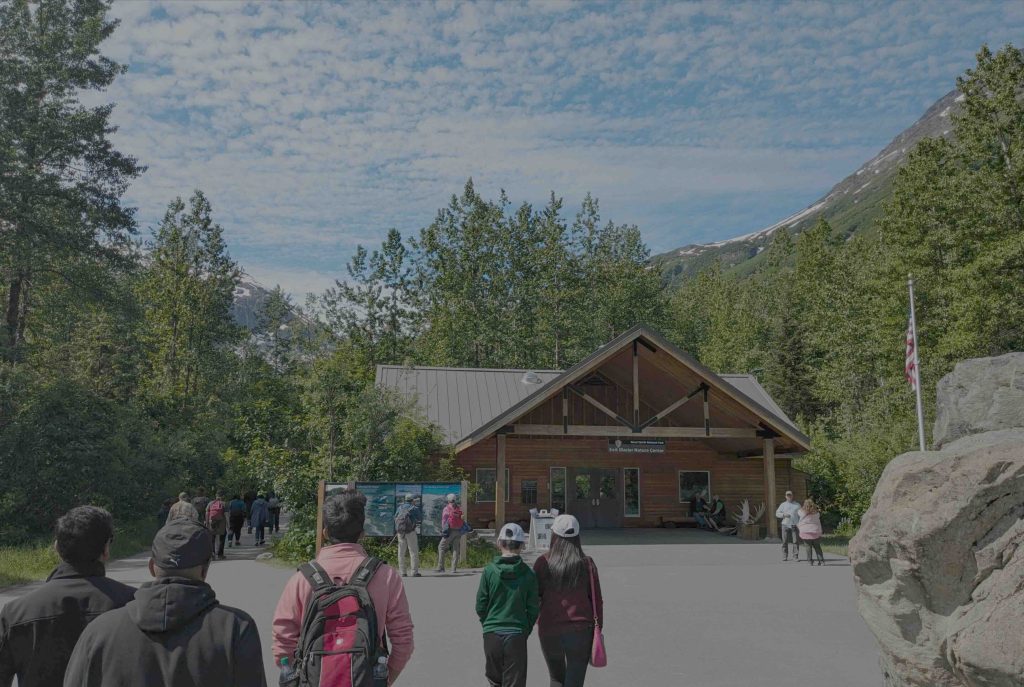
It was 12:30 pm when we landed outside the Exit Glacier Nature Centre. There were ranger-led walks, but we decided to skip that since we didn’t know how far Moorthy’s knee would hold up.
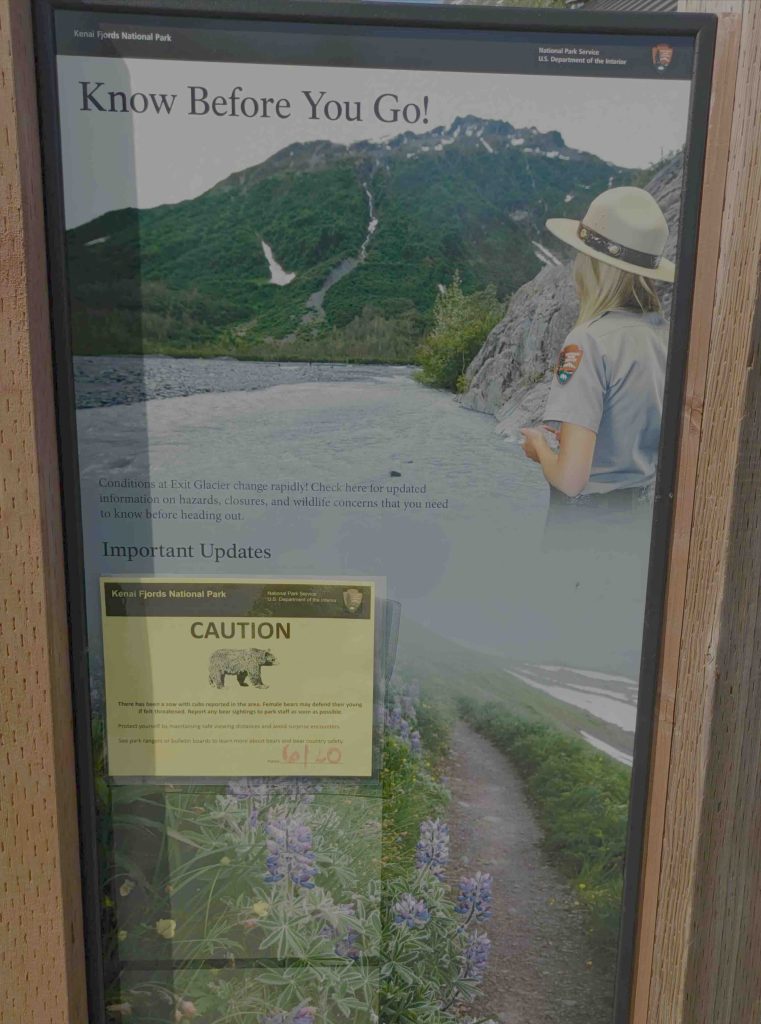
The notice board had a post-it note from 5 days ago about a female bear and her cubs spotted in the area! 
“There are 3 trails – the Glacier View Trail looks ok.”
“Yeah, it says wheelchair accessible as well. Should be flat terrain then.”
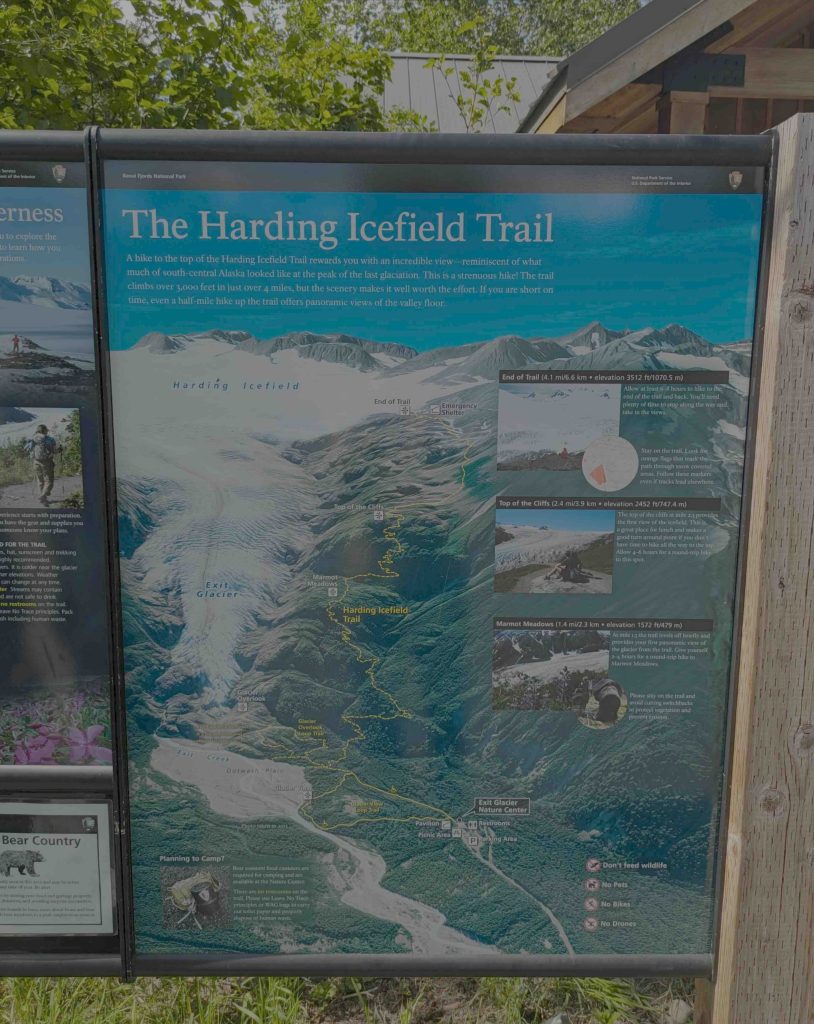
Another trail was the Harding Icefield Trail – the board said it was a strenuous, steep hike one way for 4 miles (6.5 kms) with an elevation of 1km. It said plan for 6 to 8 hours! They did mark a couple of points earlier on the trail that could also be used as turnaround points. Seemed an interesting route – you’d get to see what an ice field looks like – from the pic it seemed like you’d see an endless cover of ice under the blue skies on a sunny day.

Categories
Travelogue USA

USA Part 26 – Cop encounter

Seward is about a couple of hours’ drive.
“We are not going to make it in time for dinner. Most places would have closed.”
Our ETA was around 10:50 pm, and if we made it, we might be lucky and find some places that closed only at 11. Unfortunately, we discovered that many stretches of the road were under construction. And similar to the incident earlier while returning from Denali, you had cars lined up waiting for their turn to use the road – and over here we also had a ‘pilot car’ that we had to follow – sort of like the F1 races where you have the safety car come out. When that was on the track, you are not allowed to overtake anyone and have to stay at a speed lower than the safety car. There are two flaggers on either side of the construction zone, and they decide which lane is halted and which is allowed to move. 

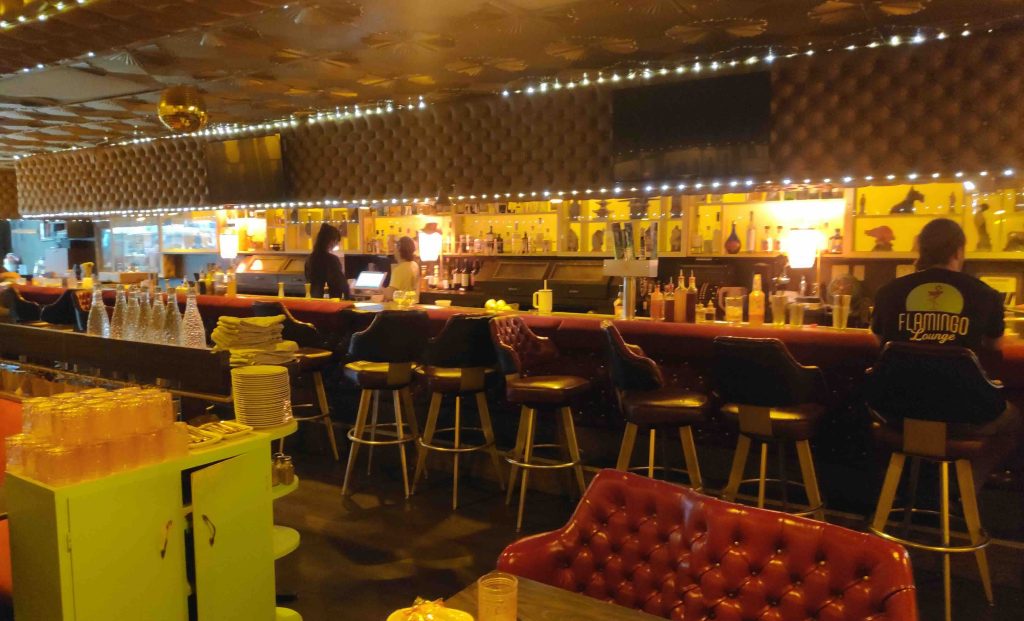
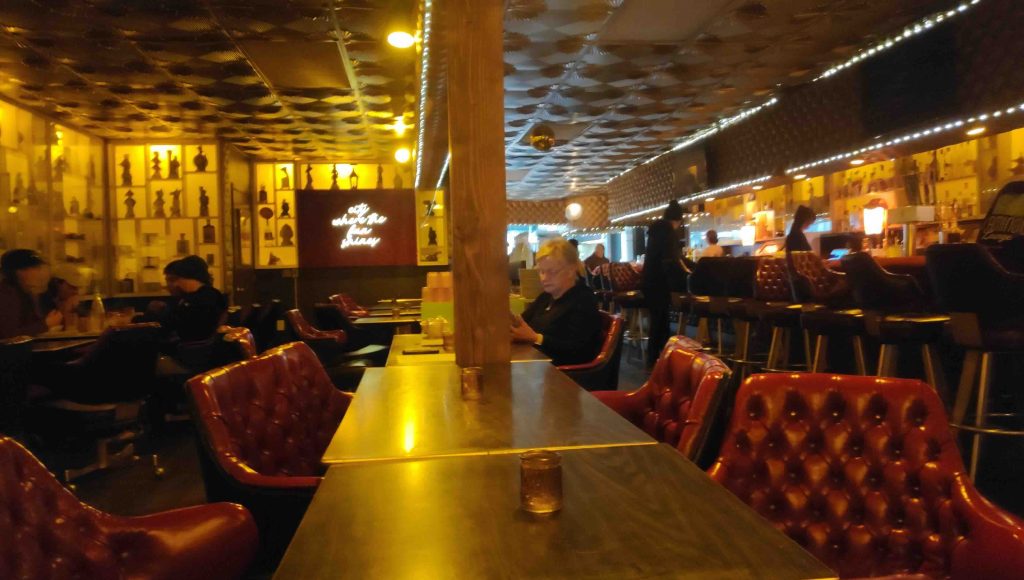
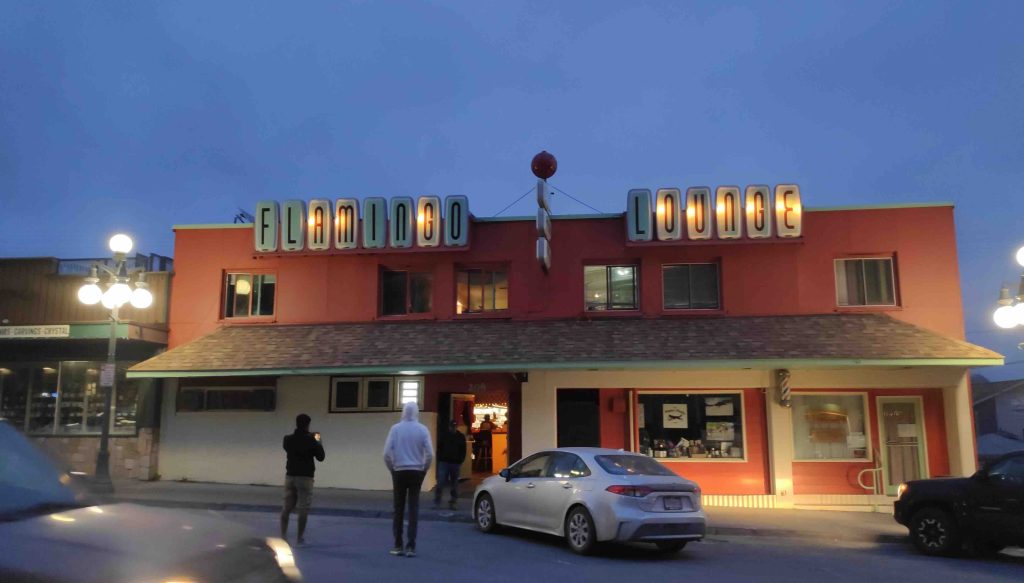
The net result was that we reached Seward only at 11:10 pm, and most places had closed. I had snacked on the salmon burger and wasn’t hungry, but our veggie boys had barely eaten anything. As you come down Seward Highway, it takes you to what appears to be Seward Downtown with a cluster of shops, restaurants and bars. There was the Flamingo Lounge, which we decided to check out. We also walked across the street to see if anything else was open – there were a couple of other bars, but they seemed much more inclined to drinks than to food. There were still a fair number of people inside the bars. We returned to Flamingo since it did have restaurant-type seating on one side. The first thing that struck us over here and in the other bars was that the setting gave you this old school vibe – like interiors similar to what may have existed in the 1970s and 80s. It felt cosy. The place was open till midnight. 

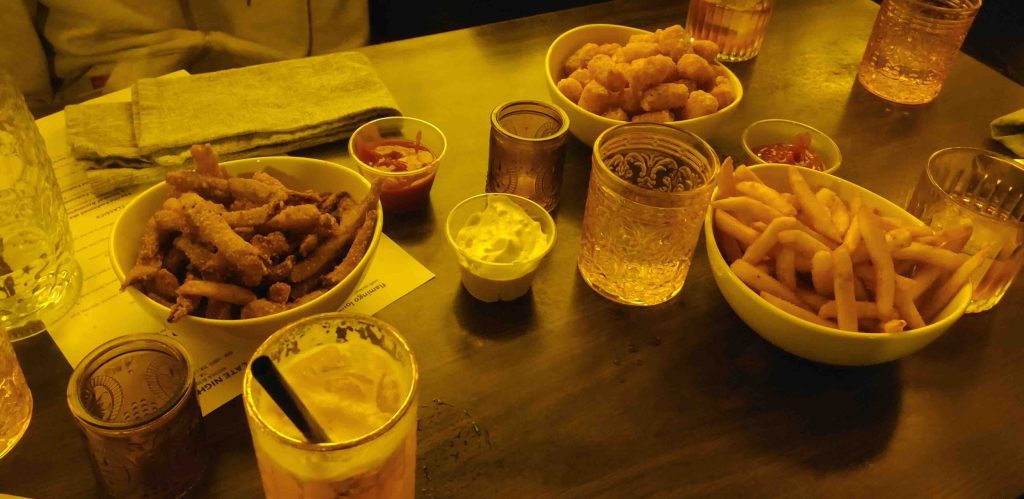
There wasn’t much to eat for the veggies – fried pickles (jalapeños), chips and potato fries. Raghav ordered all 3 dishes. For non-veggies, there was fish, pork and reindeer meat available – but again, everything was the fried type that was meant to be sides for drinks. Raghav also ordered an alcoholic cocktail drink, where he asked the bartender to substitute the alcohol! 

We stepped out at midnight, and Rakesh drove us in the direction of our next stay – a cabin in Seward. We had to go back up the Seward Highway. There weren’t many vehicles or people out on the street at this hour, but as we were driving, we saw a cop’s car in the opposite lane. As we went on, the cop’s car turned around and followed us. 
“Slow down,” Moorthy said, and Rakesh pulled over. The cop was coming for us!
So the rule here is that you shouldn’t step out of the car, but hand over your documents to the cop. 
“Where are you from?”
“Coming from New Jersey,” Rakesh said coolly.
“Give all the rental documents and insurance.”
Rakesh handed over the papers.
“Your headlights were not on.”
“Oh, it’s a rental car, and I thought it had come on automatically. Didn’t realise.”
“Where are you coming from Seward?”
“Uh… We were just here at the…” Moorthy tried to step in and answer, but the officer cut him off, “Question was to him. Let him answer. He is responsible for his driving.”
“From Flamingo,” Rakesh said.
“What did you have?”
Moorthy later said that this was a subtle way for them to figure out if you were driving after a drink.
“We were looking for some food. So just had some fries there.”
“Where are you staying in Seward?”
Rakesh gave the place of our Airbnb booking.
The officer did go back to his car to check something and then returned.
“Do you know the speed limit here?”
“No.”
“You are driving without knowing the speed limit?”
Wrong path to go down, and Rakesh quickly corrected himself, “No – I mean it’s 25.”
“And do you know how fast you were driving?”
“I was slowing down to 30. Because I thought it was 35 earlier, and it was 25 in this area.”
“You were going at 37. This is a residential area, and everywhere the speed limit is 25. It’s 6 points for a speeding violation.”
“Sorry. This was my first time, and I was reducing the speed.”
After a brief moment, the officer said, “I’ll let you go with a warning for now. Get a good meal for your family and friends.”
Fortunately, no fine, and Rakesh drove slowly, sticking to the 25 limit. 
“I wasn’t at 37. When I saw him on the other side itself, I had lowered my speed. But problem was that headlights weren’t on.”
With the new car, we struggled to figure out if the headlights were on or not – I even went through the car’s booklet to understand how it worked, but it wasn’t clear.
“I don’t think they will put a fine easily on visitors since they’d want to be welcoming to tourists,” Moorthy said.


We reached our cabin area in a few minutes.
“Which one is it – there are two – the one on the right or the left?”
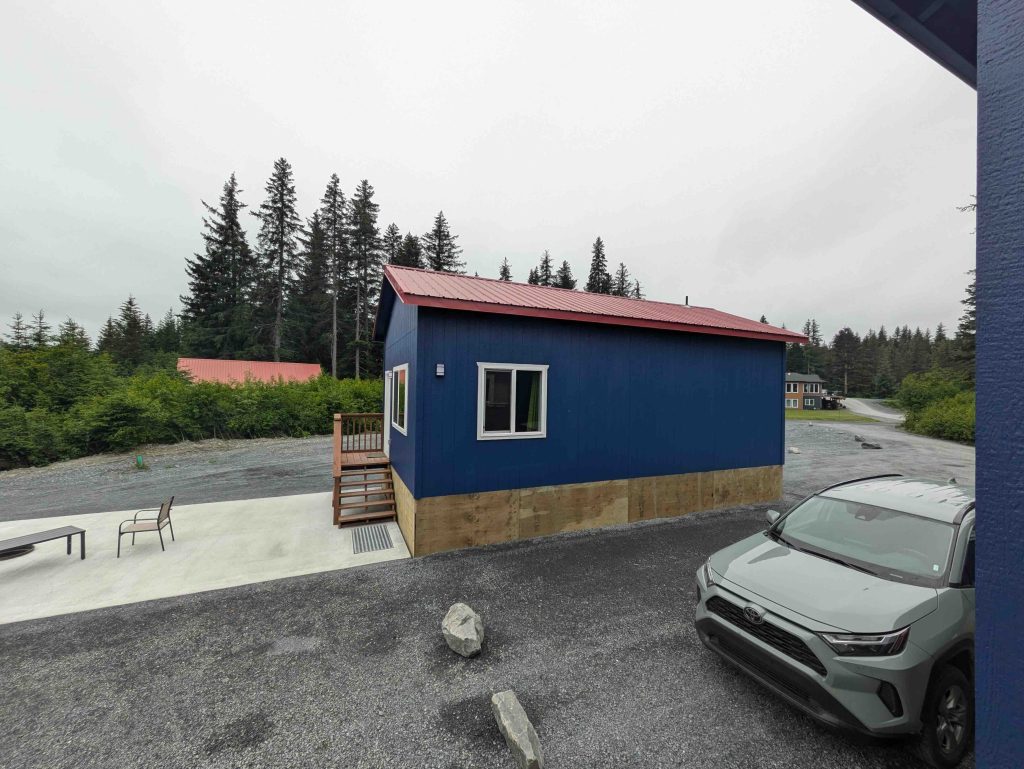
We were on a road named Blying Sound Dr, and according to Google Maps, we had arrived at our location. We had a door number of 32280, but there were 2 individual cabins a few feet apart, both painted dark blue with red roofs.
“No signs of anyone present in either of the two.”
There were no vehicles either, and both cabins looked identical. After going around both properties a couple of times with our flashlights on, we confirmed which one it was. 


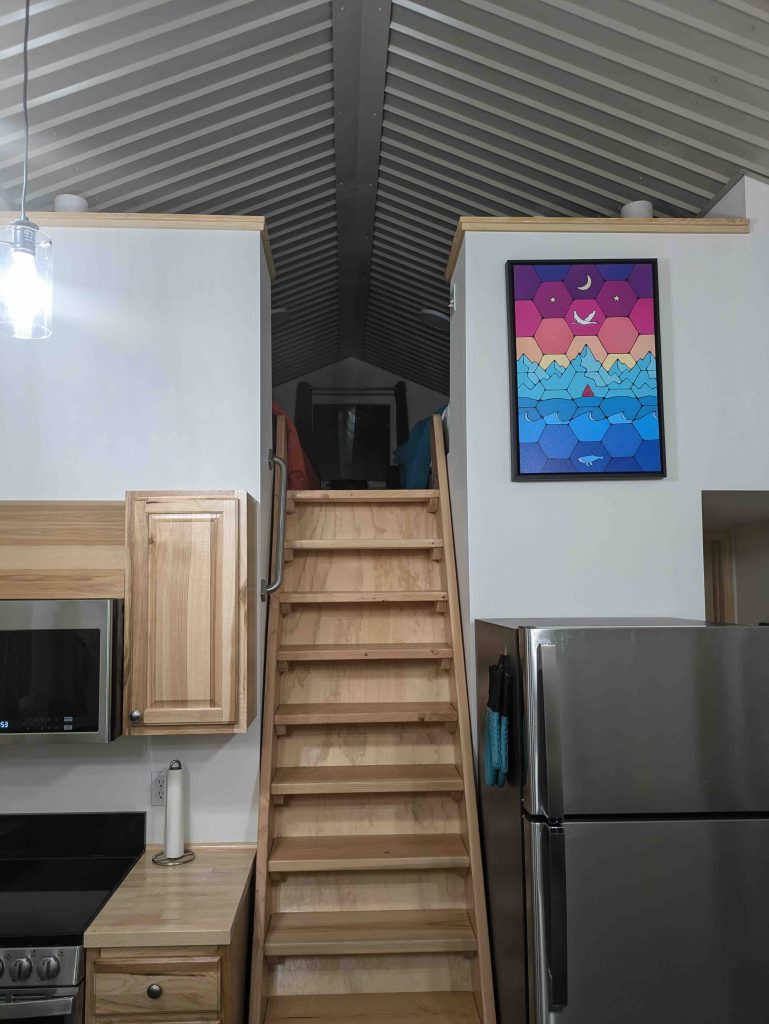
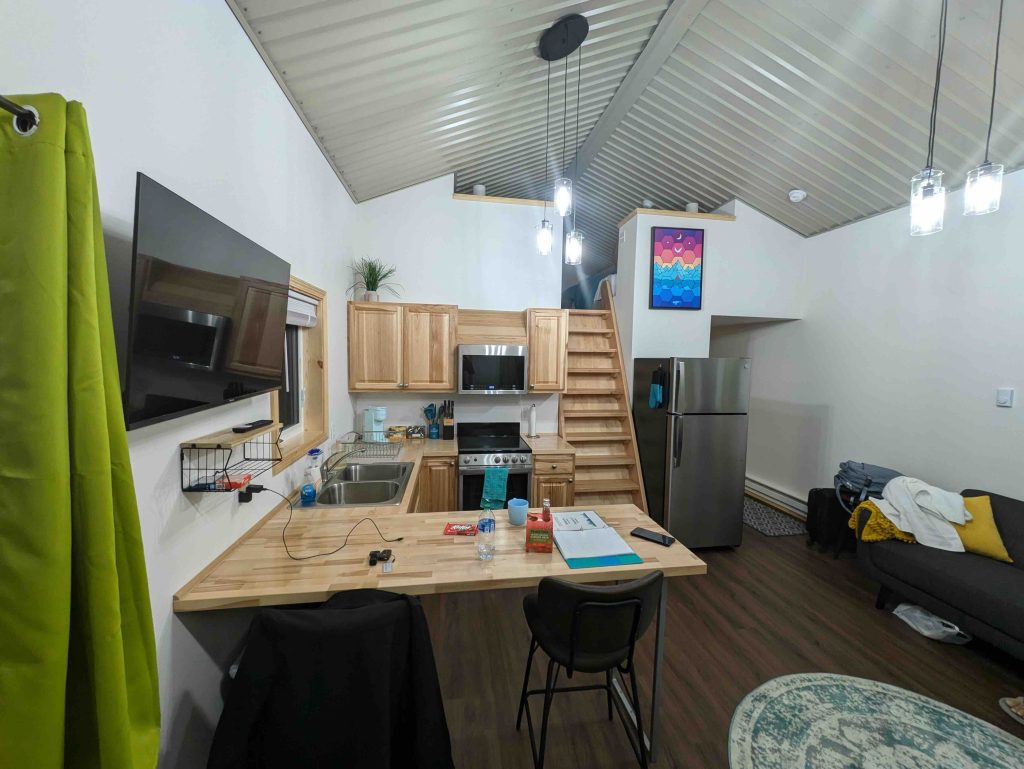
It was a cabin with a second floor, where a couple of beds were stashed.
“Nice setup, but the stairs are narrow. Would be risky at night if someone stepped on it without paying attention.”
And for me, there was a height problem on the 2nd floor – if I stood straight, my head knocked against the ceiling. 

Categories
Travelogue USA

USA Part 25 – Driving on train tracks

Rakesh stopped the vehicle on the side to give us time to figure out our direction on the map and decide our next destination.
“He’s following us.” Behind us was the same guy in the AWCC vehicle who had asked us to leave the place while we were watching the black bear. 
“He wants to make sure we really leave! Let’s leave and then figure out where to.”
We exit the AWCC road. “Any coffee place nearby?”
“Nothing close by. But there are a couple, 25 minutes or so away.”
“On the way to Seward?”
“No. It’s a detour we have to take.” 
“I’m ok to drive. Just tell me the route.”
“Ok then. And anyway, there’s nothing to do in Seward today.”
“Let’s go.”
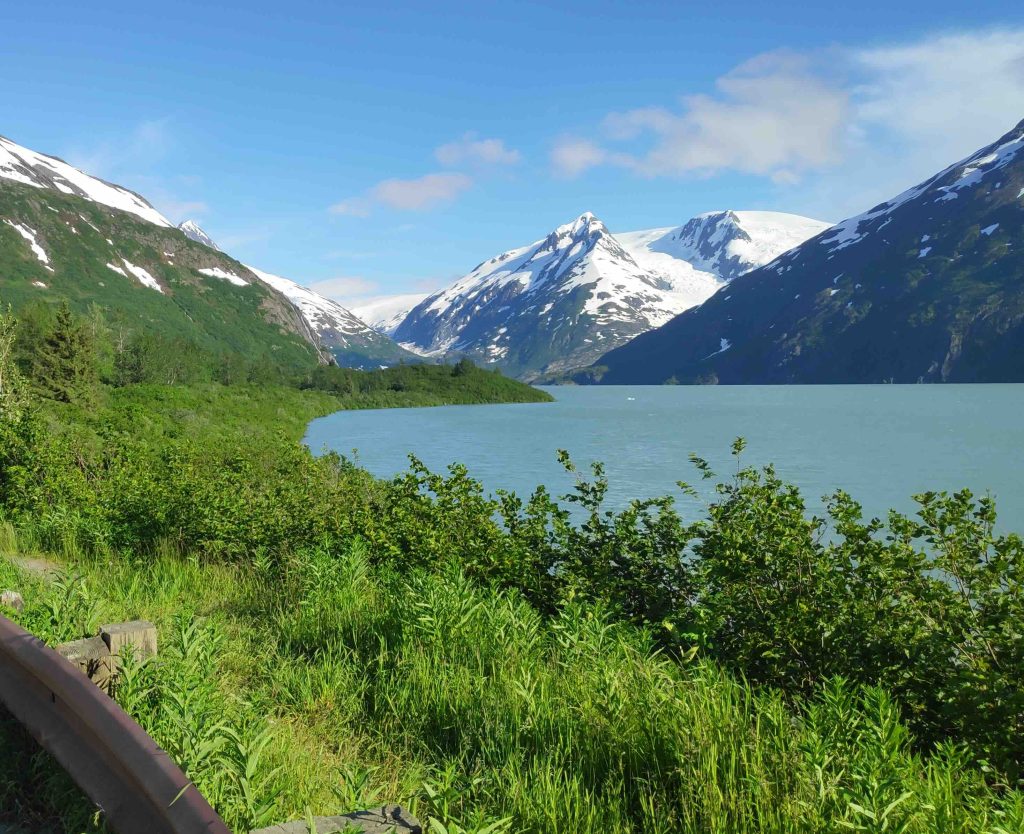
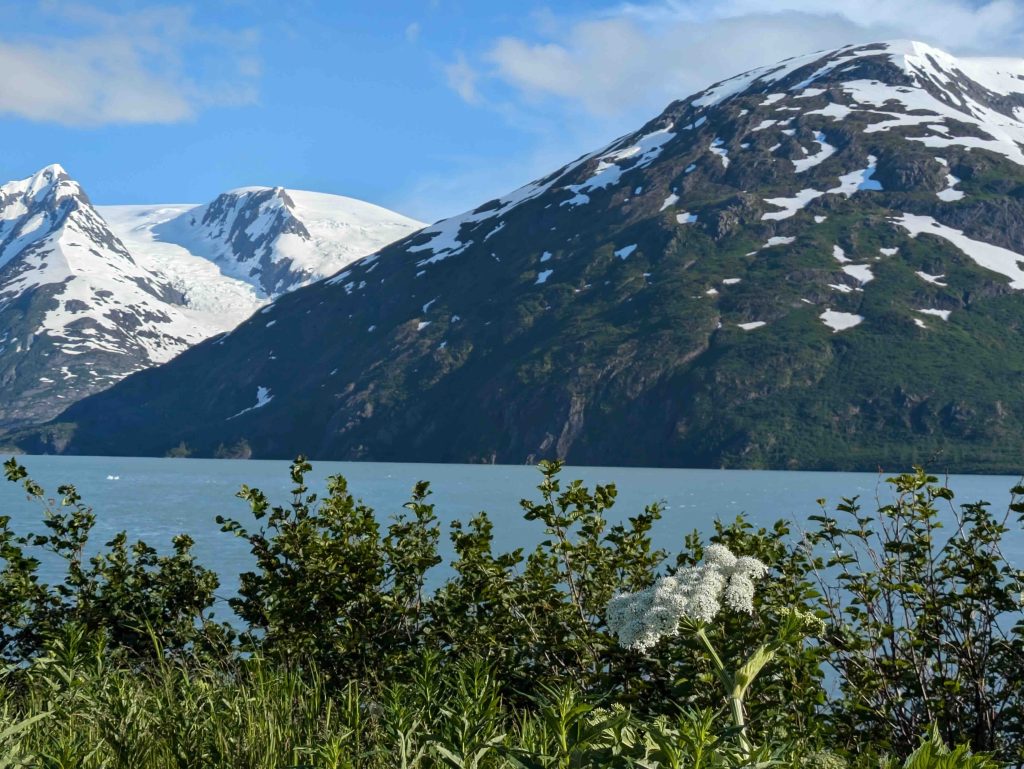
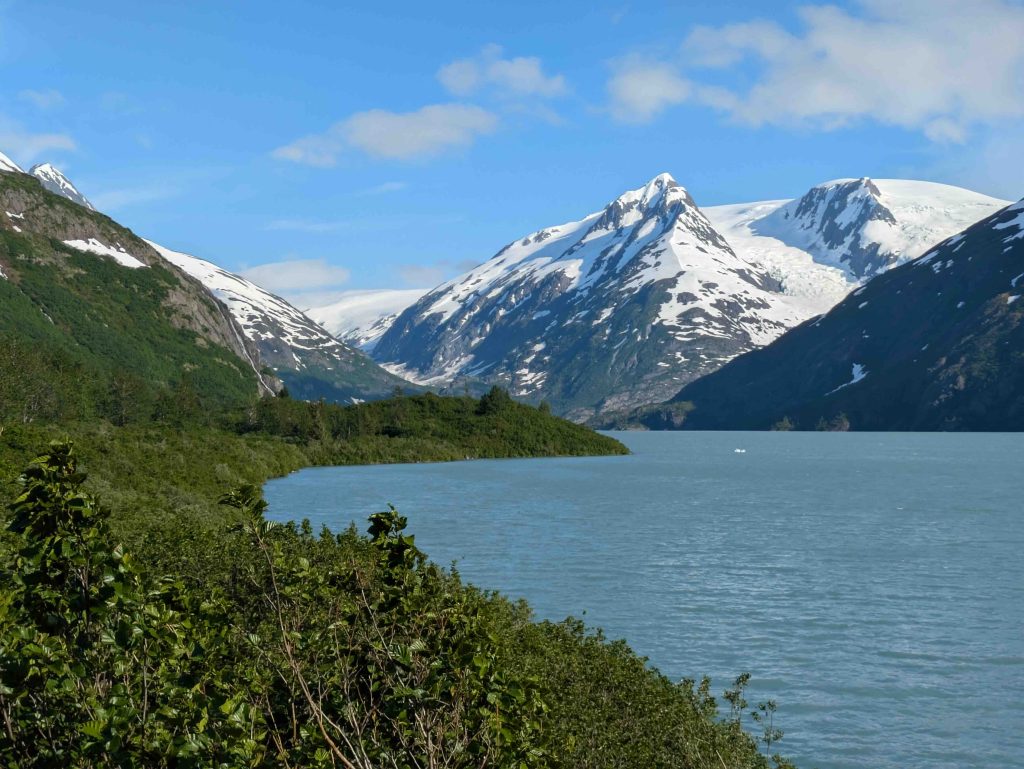
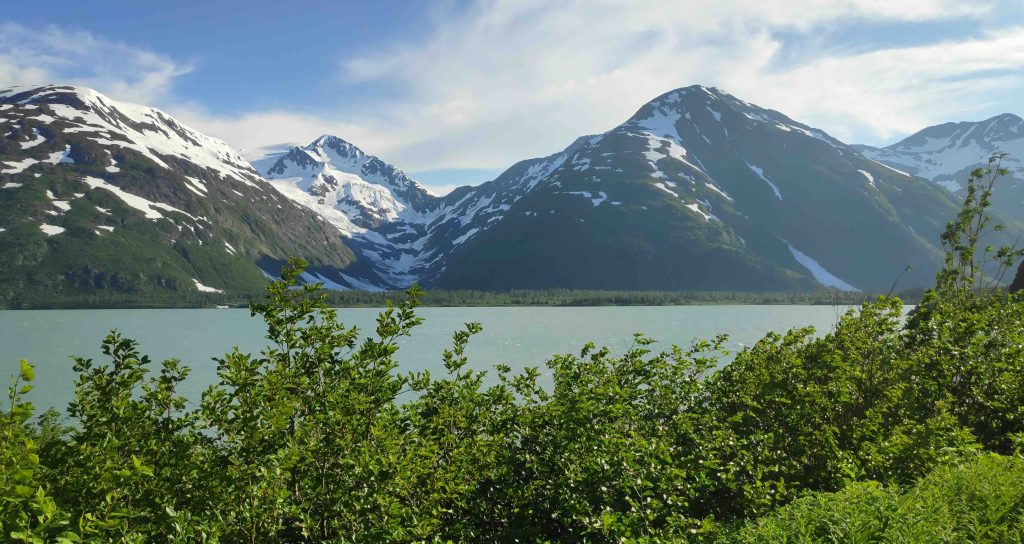
On the way, we crossed Portage Lake.
“There’s a scenic point here.”
Rakesh pulled over, and we got out to take a look. It was another amazing location – sunlight beaming down from one side and clouds covering the tops of the mountains on the other. There was an Indian couple in matching green sweaters clicking a lot of pics.
We also took a lot of snaps – especially focused on one person in the group. “These will be good snaps for matrimony websites.”

As we drove towards the cafe, we came to a toll gate – but it was manned, and we had to pay $13. 
“Is this your first time?” the lady staff asked.
“Yes,” Rakesh replied.
“Here you go.” And she handed him the toll receipt and some pamphlets, which Rakesh kept aside in the car. “Go to lane 3 and wait for the green light.”
Rakesh got the car moving, and we saw a bunch of lanes ahead. He went into lane 3, which was empty, and waited. 
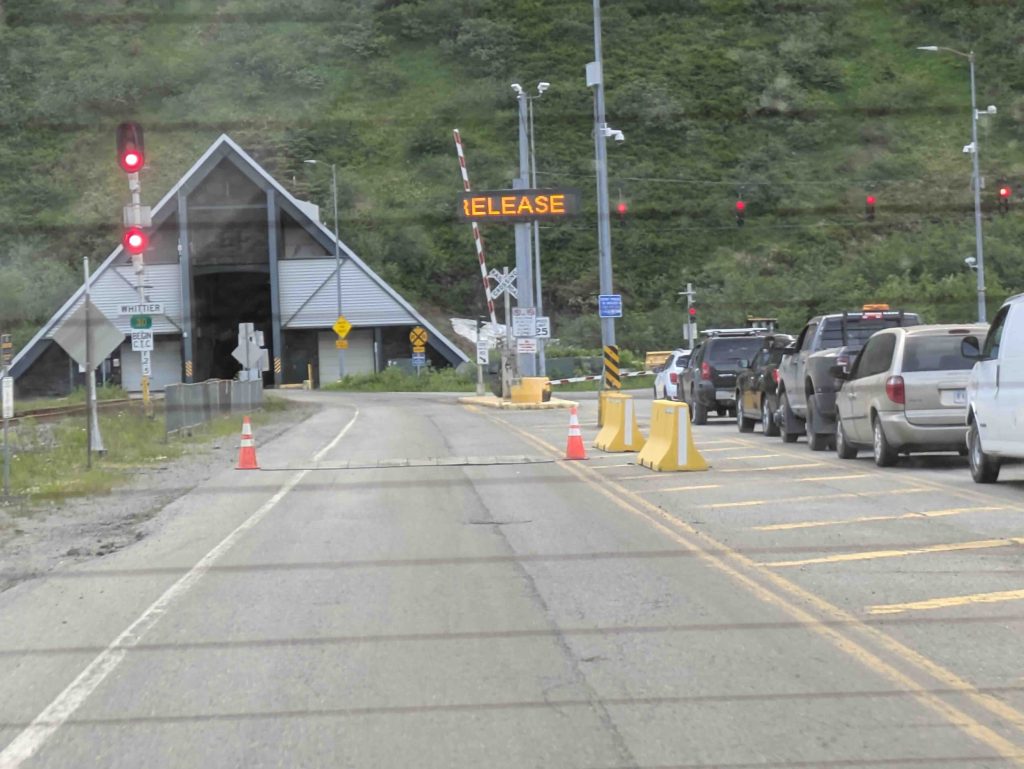
“What is this? 6 lanes that go into the tunnel?” There was no other vehicle on any lane, but we still waited as the lady had said. Once the light turned green, Rakesh moved. And the 6 lanes merged into a single lane that entered the tunnel.
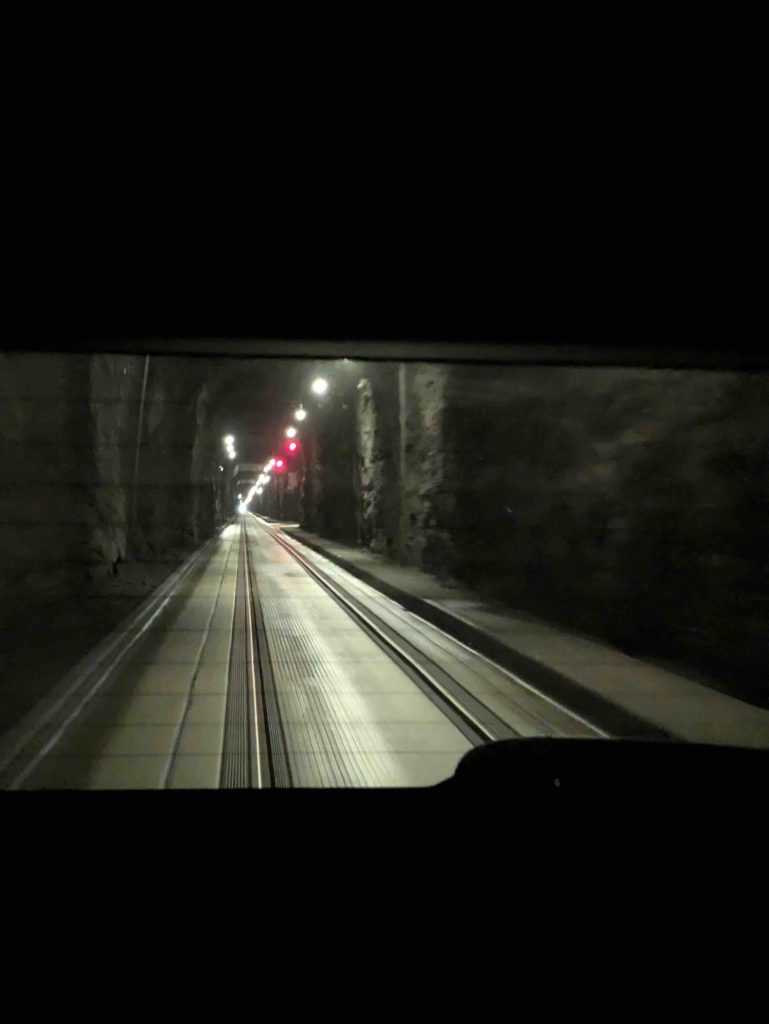
“We are going on top of a railroad track!”
“And there’s no other lane. What if a car comes from the opposite side?”
“Or what if a train came from the other side?”
“There is some space on the side.”
“Or Rakesh will go in reverse. Like Tom Cruise doing a stunt drive!”
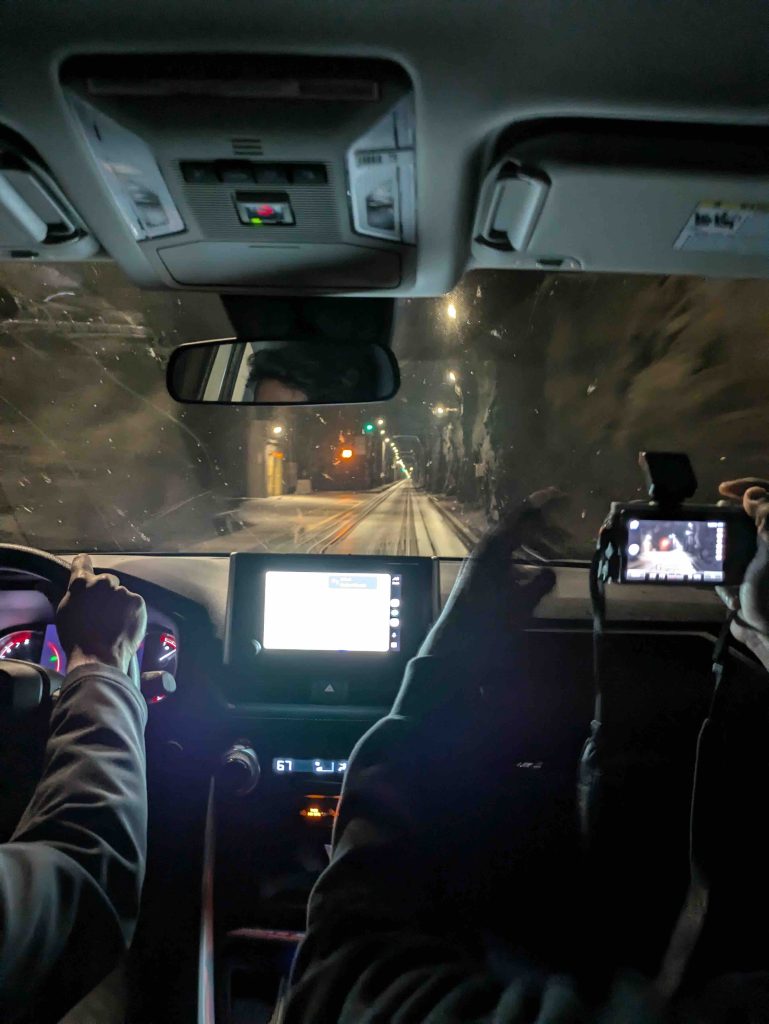
We were literally driving on top of train tracks in a dark tunnel, which had lighting at periodic intervals. The speed limit was 25 mph, and there was an indicator displaying the speed of our vehicle – Rakesh stayed just under 25. 
“Rakesh is going right through a mountain.”
The tunnel ride was nearly 5 minutes long, but there was finally light at the end of the tunnel!
“We are surely not continuing on the train tracks. It says take left.”
As Rakesh took a left onto the main road, we noticed a long line of vehicles waiting to enter the tunnel.
“They held up all the cars because of Rakesh. A VIP,” we joked.

I later found that the tunnel is called the ‘Anton Anderson Memorial Tunnel’ (also known as the Whittier Tunnel). It was built in 1943 by the US Army and served as Alaska’s main supply line during the war. 1941 is when Japan bombed Pearl Harbour; this was constructed after that and provided strategic military benefits. Pearl Harbour is straight down south of Alaska. 

We entered the town of Whittier, and Rakesh parked the car in a parking lot. It was 8 pm. The cafe we came in search of had closed. 
“Let’s just walk around.”
There were a row of shops and outlets – most had closed.

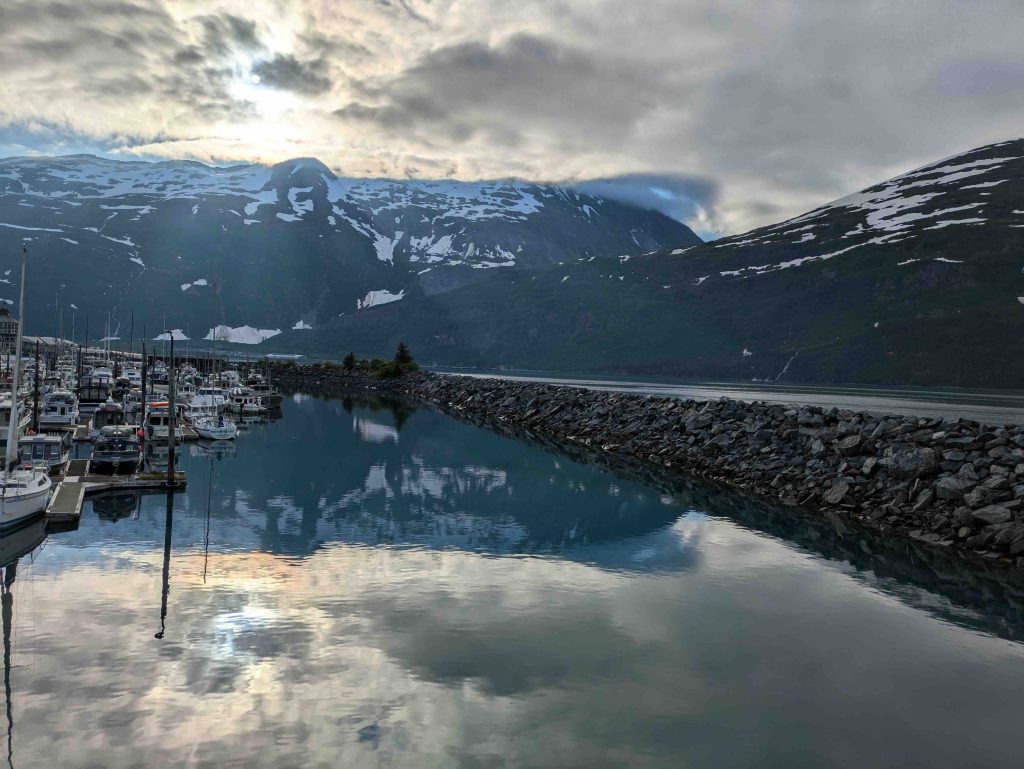
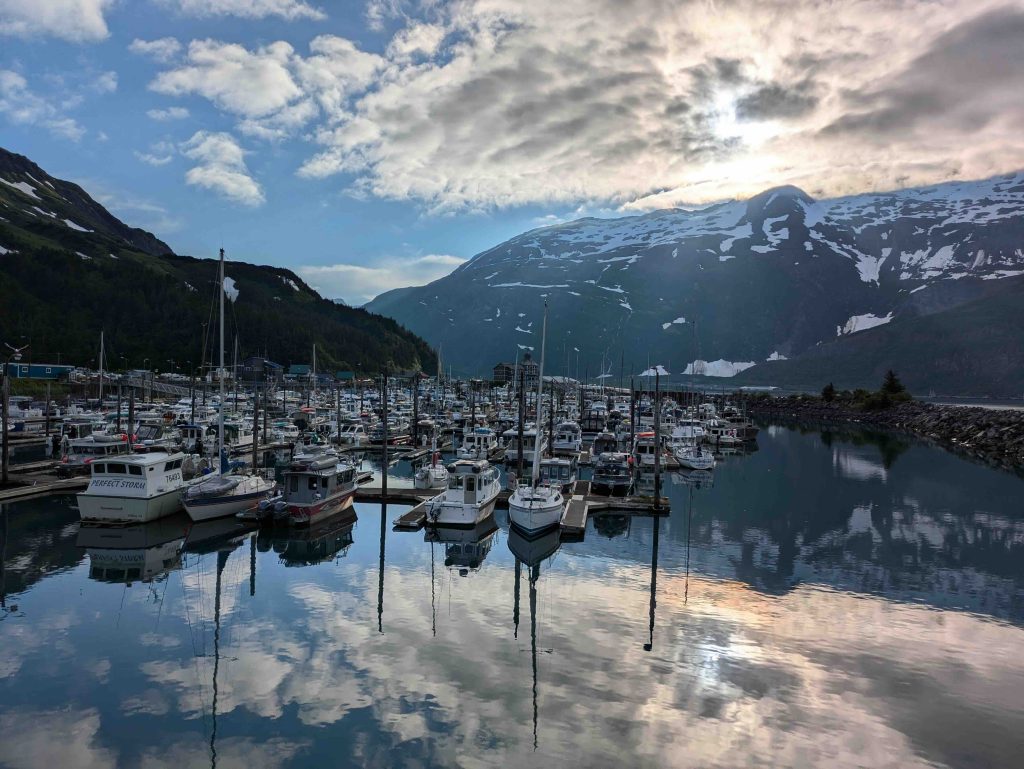
This is a port town, and we saw plenty of boats docked on the water. A lot of scenic views welcome you in Whittier – docks, boats, pristine waters, snow capped mountains, fluffy cotton clouds, sand and greenery.

Moorthy used his pro camera to take plenty of snaps of the scenery and of us. 
“Moorthy, you go. I’ll take some snaps.”
He joined Rakesh to sit on a rock while I clicked. Just as he got up and walked, his foot hit a strong cable that was sticking out of the ground and tripped him over. He went down on his knees on the gravel. Got a little bruise but seemed ok – there are these small incidents that you don’t really think about at that moment but come back to bite you later on.
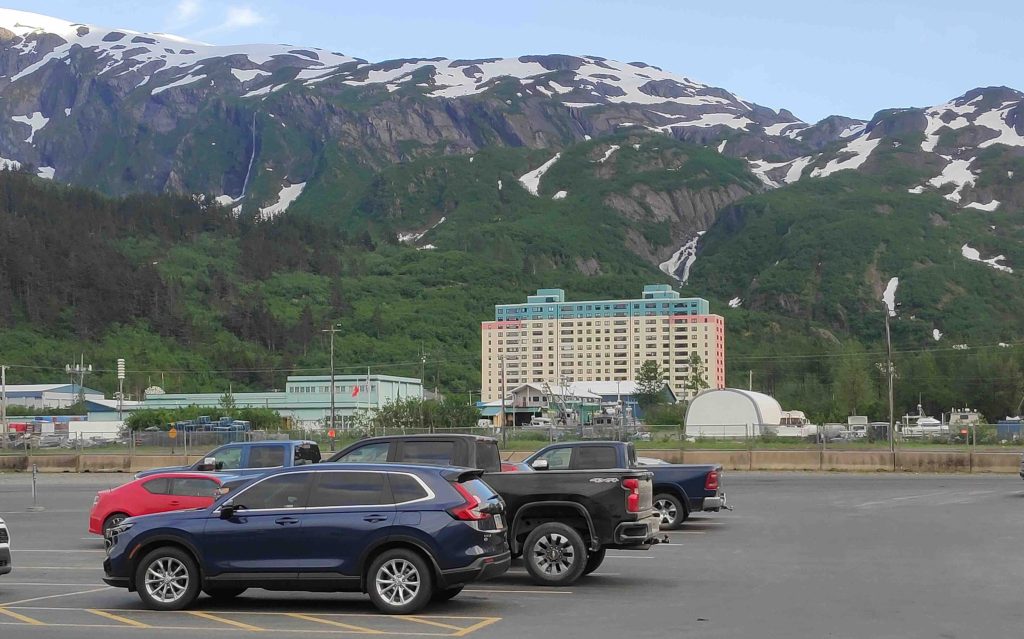
“I’ve seen that building in some photos before,” Raghav said, pointing to the one building that you’d see when stepping into Whittier – it was a weird multi colored building in white, pink and blue. 
“That seems to be the only building over here where people can stay.”
There was no other structure that looked like a residential place. 
“The whole town stays in one building?”

We later found out it was called the Begich Towers Condominium, and almost the whole town stayed there! 
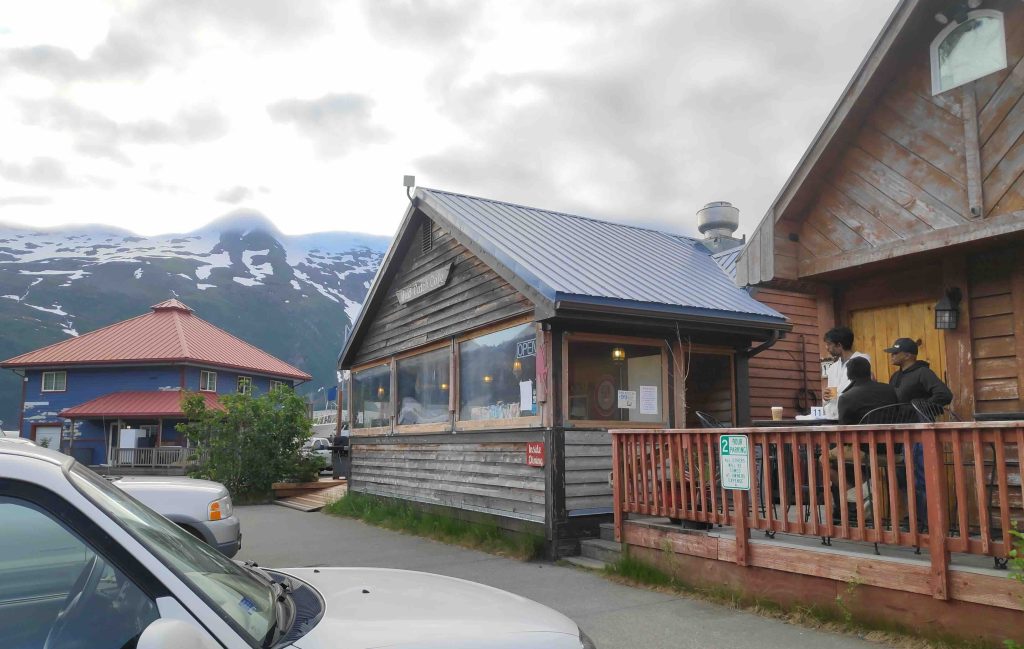
“This Wild Catch Cafe says open. Let’s check it out.”
Since it was near closing time, they said we couldn’t dine in. We picked some coffee – Kaladi Brothers Coffee (KBC), which we found in different places in Alaska (they are a coffee roaster brand started in Alaska, and we had also seen a couple of their cafes during the trip; even in Jitters, we remembered seeing some connection to Kaladi Brothers). We ordered the mixed berries cheesecake and a salmon burger. We ate in their outdoor seating area. The food was good. 

It was past 9 pm when we exited Whittier.
The lane lights were all red, but another light a little further ahead was green.
“There’s no other car around. Maybe we can go?”
“No – it’s red. We should wait.”
We debated for a while. “Maybe that lady who was there when we came has left, and there’s no one.”
“Can’t be a manual system.”
“But then why is it red for so long even though no vehicles are here and nothing is coming from the tunnel?”
It was a bit of a wait before the signal turned green, and then Rakesh started. That was when we found that the pamphlet the toll gate lady gave us had information about how this tunnel operates.
“That’s why she asked you whether this was your first time here.”
The pamphlet explained the 6-lane system and the rules to be followed within the tunnel. Oh well, too late for us!

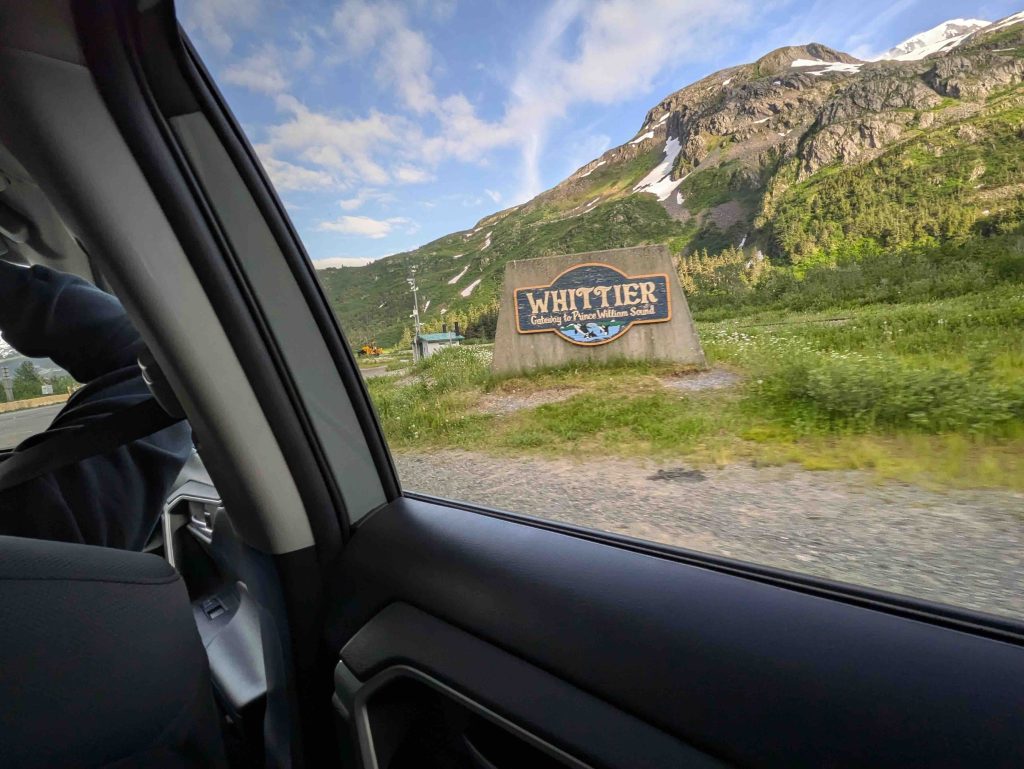
Whittier was also marked in some places as the “Gateway to Prince William Sound” – I had never heard the term ‘sound’ before used in the context of a place – ‘sound’ as per the dictionary refers to a wide body of water connecting larger bodies of water. Some operators run cruises from Whittier into Prince William Sound. 

Even though we had seen many scenic sights by now in Alaska, we still weren’t bored of them – if you do visit Alaska, it’s definitely worth a ride to Whittier through the tunnel.

Categories
Travelogue USA

USA Part 24 – The bears

Another set of similar animals were there in the zoo – fox, coyote, wolf – in ascending order of size. The nice thing here was that each of these animals had a name that was mentioned on the boards outside along with a little blurb about it – ex: there were 2 foxes – Storm and Jade; Jade was an orphan picked up by joggers when they realized that there were no signs of the mother around; Storm, on the other hand, was illegally owned as a pet, and thus was seized and brought to the conservatory. 


“Let’s check if the bears are there.”
Using the map, we walked towards the bear enclosure; we saw cardboard cutouts of black, brown and white polar bears.
“Even if we don’t see bears, we can take a snap with these life-size bears!”

Black bears are not all black – they can be blonde or cinnamon-coloured too! Grizzly bears are a type of brown bear; brown bears are about 4 times as heavy as black bears. A black bear has its rump as the highest point, while a brown bear has its shoulder hump as the highest part. Polar bears are even heavier than brown bears – and they are carnivores, unlike the other two, which are omnivores.
The saying about brown bears and black bears has a 3rd part to it as well that made sense now – ‘If it’s brown lie down; if it’s black fight back; if it’s white goodnight.’ 

“Some people are there near the fence – maybe the real bears are visible.”
We went closer and saw not 1, not 2, but 3 brown bears in the vicinity. There was a little pond, plenty of grass and trees within the bear enclosure. A couple of them were walking around, and though they were large, they looked cute. One bear caught something in the water (seemed like a salmon), and it began thrashing around the catch ferociously at the edge of the pond – no matter how cute you think they are, beware their power!

Moorthy captured the whole scene on video.
“Two of them are twins – JB and Patron.”
Their story of how they landed in AWCC was a sad one – a mother bear (called a sow) killed a moose calf in some person’s backyard; the person thought the bear might attack his dog and shot the bear with his gun. But her 10-month-old cubs were in a nearby tree. The AWCC took the 2 cubs in since they were orphaned.
“The other one is named Hugo.”
Hugo was also found when she was less than a year old – a couple of folks while snowmobiling discovered her dehydrated, malnourished, and injured due to porcupine quills stuck on her paws. She was not able to walk or eat and was taken in by the AWCC. All 3 bears were now more than 20 years old. 

“Your video is good to use in National Geography,” Rakesh said when seeing Moorthy’s footage.
We walked along the perimeter fence till the bears disappeared into the grass and trees. JB weighed around 450 kgs as per a board that read ‘sizing up JB’!
“Mission accomplished – we’ve seen bears in Alaska.”

On the other side, there was a vast area where bisons roamed; a few came to drink water from a large tub near the fence and let visitors have a close look at them.
Raghav and I walked further along the outermost road of the conservatory and ended up on a boardwalk – it was called the ‘Turnagain’ boardwalk, and a board explained that we were seeing the point of confluence – a point where multiple modes of transport converged. The Turnagain arm is a water inlet bordered on both sides by land, and at this specific place, it is bordered on all 3 sides. The term itself comes from Captain Cook – he was the one who explored the Pacific Ocean and when they came down this water inlet from the Pacific, they thought they had discovered a route from the Pacific Ocean to the Atlantic Ocean – but coming further down the inlet they found there was no way out and they had to ‘turn again’ to get out – thus the name ‘Turnagain arm’!

In the 1890s, this was also an area for the gold rush – a person was said to have trekked in the frigid cold to lay claim to the land and establish a gold mine (Crow Creek Mine – it’s a tourist attraction now). 
“From the boardwalk, we can see the end of the Turnagain Arm.”
There were a couple of others on the boardwalk – one of them in a wheelchair. After they left, we went to the edge to admire the scenery – a clear day, mountains with snow on one side, greenery on the other side, rocks nearby, and clean water in the middle. And behind us was the farm-like view, with animals roaming about. Picturesque and serene.

Moorthy and Rakesh were driving down the road, and we told them also to check it out. There weren’t many people who came all the way to this side – but it’s definitely worth spending a few minutes here. 
We had just under an hour left before the place would close. We still had a few more areas to cover and walked along while Moorthy drove. 
“On the other side, there’s a black bear area. Let’s go till there.”
On the way, there was a birds section where we saw a bald eagle – story behind this was that it was shot at and lost its left wing before it was adopted by the conservatory. An interesting piece of history was that in the 1920s, it was legal to hunt eagles in Alaska, and the government even paid 50 cents for each dead eagle – the program was started to help protect salmon. More than 120k eagles were killed at that time. Eagle hunting is no longer legal. Owls and eagles kill prey using their talons (claws). 

People gathered around some of the enclosures to try spotting the bird or animal inside.
We then saw the coyote and the wolves.
“The black bear area is supposed to be between these two.”
“Yeah, that’s what the map says. But there’s nothing here.”
We were running out of time as well – down to the last 30 minutes. We went along the path as per the map a couple of times but didn’t find any signs of a bear enclosure.
“Let’s ask a staff.” We spotted one, and he said, “It’s near the gift shop.”
We headed again towards the same side from which we had come. “But we covered this area fully.”
“Yeah. Surely not here.”
Near the gift shop, there was an eatery as well – a grab-and-go place – I paused for a moment when I saw their menu that was displayed outside. One of the items was “reindeer polish” – that’s reindeer sausage. The irony was that just nearby was the reindeer enclosure!

Down to 20 minutes before closure. The map said that there was another black bear enclosure near the brown bear area too.
“Let’s check out that one.”
We hopped into the car to save time. I did want to see the other bears before leaving, but they were not to be seen. There is a boardwalk that runs along the top of the bear enclosure – it gives you a top-down view of some of the places.
“Man, not even one to be seen.”
“We were lucky we saw them when we entered.”
No sign of any movement either. 
“But there are some areas that we can’t see – they must have gone in there.”

Back down below to the original spot where we saw the bears, we saw a couple of ravens (like crows but bigger) eating fish near the pond – this is apparently common, after the larger predator has finished eating, the smaller ones scavenge for any scraps left behind. This must have been the salmon the bear ate earlier. 
“Let’s go to the bathroom and leave.”
The bathroom here was called the ‘bears bathroom’.
“Maybe we’ll see the bear in the bathroom!”
But the place was empty. 
“We should make a sorry face with the staff and hope that they feel pity and take us to show the bear.”
As we came out, we saw a lady staff member in a conservatory vehicle.
“Is there a black bear?”
“Yes. There’s a juvenile. In fact, I saw the bear while driving down now.”
It was 7 pm – closing time. But the staff told us where it was. “I’ll be going back down that side. You can follow me.”
We followed her, and she showed the enclosure – looking at the map, this was called the ‘rotating carnivore habitat’. I guess they used it for different animals during the year! As we walked towards it, another staff member said that it was closing time and we should leave.
“We’ll just see the bear and leave.”
Another family near the enclosure spotted the animal. The bear had stepped outside its wooden cave while two ravens were watching it.


It was 5 minutes past closing time, and the staff came again asking us to leave. We were literally the last group to leave!


A nice set of audio guides for the place: https://alaskawildlife.org/visit/audio-guide/

Categories
Travelogue USA

USA Part 23 – Wildlife Conservatory

A lot of the forest that we see in Alaska is what is called the ‘boreal forest’ – there are fewer species here, but the ones that are here (trees and animals) are the ones that can survive in extreme winters with short summers. The trees are spruce, balsam, birch, aspen, etc (all conifers – yeah, takes you back to geography class days!)
For more details: https://www.adfg.alaska.gov/index.cfm?adfg=boreal.main

Around 10:30 am, we were on our way back, leaving Denali. 30 minutes into the drive, I stopped Moorthy after we crossed a bridge – I remember there being an interesting view around here when we drove past this on our onward journey. This place is called Hurricane Gulch – a gulch is a V-shaped valley. Moorthy pulled over to the side on the gravel, and we noticed there was another car that had parked ahead of us as well. We couldn’t walk on the bridge – it was a highway, and you don’t have a walkway. But there was a side path which went into the woods. We followed it.
“Hey man be careful. I don’t know if there is a path. It seems steep.”
But Raghav went over a hurdle and proceeded down – it’s only a few steps that you can go.
“Come here Ringo,” we heard an old lady calling out to a cute little dog which was on a leash. The view was spectacular – there was a river flowing way down below, woods to our left, the bridge to the right – you never realise how high the bridge is till you look down!

We took a few snaps; the old lady wanted to take a snap with her dog, the bridge in the background. She was old but still firm and steady as she managed the dog with one hand, and she even offered to take a photo of us as a group. Not for those with a fear of heights, but worth a pitstop for the view. The car in front was hers; she was from Canada.

We ran into a traffic jam due to road construction on one lane of the highway (the highway only had two main lanes); so you had construction workers letting vehicles go for a couple of minutes from one side while they blocked the other side, and they kept alternating. This is one of the rare situations in which vehicles can cross the solid double yellow line separating the two lanes. 

“What’s our plan? Straight to Seward?”
“No. We stop first at the Alaska Wildlife Conservation Centre. It’s on the way only – after Anchorage. But the last entry is at 6, and it closes at 7.”
My hope was that we’d make it between 4 and 5 pm, so we’d have at least a couple of hours.
“We’ll see bears?”
“Probably, since there are supposed to be some there. But I don’t know if we’ll see it.”
“May turn out to be like Denali.”
“But Denali, also, we would have seen if we went on the trail – that night, there was a notice there which said a bear was seen the prior day.”
“And that hiker who came on our bus the next day also said they saw a bear.”
“If only we had got the bear spray and practised with it, we could have gone on the trail that night.” I did feel quite confident using the bear spray now. 
“The bear spray worked on a different bear!”

Alaskan Gold

After about 3.5 hours of driving, we stopped at the Jitters coffee place (since it was on the way and not much of a detour); picked up coffee and drove along. At 2:50 pm, we were in Anchorage and decided to stop somewhere for lunch. Raghav and Rakesh were the ones who picked the place.
“It’s a Nepalese restaurant. Yak & Yeti cafe.” 
Inside, they had pictures of Tintin from ‘Tintin in Tibet’ – that was, I guess, the inspiration for the name of the cafe. I’m not really sure why Google had this marked as a Nepalese restaurant – the first couple of items on the menu were palak paneer and channa masala, which are typical Indian dishes. But then we did see something called a shapta (pork dish – Tibetan) and a couple of other pork dishes as well – one of them was definitely Indian (it was the vindaloo curry – a dish popular in Goa). I picked a half-sandwich while the other 3 picked rice bowls; ended up being lucky we didn’t do 4 rice bowls since the bowls were fairly large for one person. The food was good – very Indian except for the sandwich.

Raghav had been going through some brochures during the 4-hour drive, and he saw an interesting jewellery shop he wanted to check out.
“If we are running out of time, we can skip it.”
I checked the map, “It’s nearby only. Can quickly stop and go. Let’s keep the cut-off as 4 max, so that we can make it to the conservatory by 5, since it’s a one-hour drive from here.”
Moorthy parked in a slot where we had 10 minutes of parking time available – after that, we would get ticketed; it seemed like the earlier person who paid for parking may have left with some time remaining. 
“Bet that Raghav will finish within 10 minutes?”
“This I think he will because we’ve said there’s the next place that we have to get to!”
I knew of Raghav’s impulsive shopping but didn’t feel he’d exhibit that trait in a jewellery shop.

It was a cosy little shop – he was looking for something unique to get for his wife. He saw a couple of interesting pieces and enquired about the price.
“How many carats?”
“We do jewellery only in 14 carats. In India, you do a lot higher, right?” the staff asked as he took out the items from the display and gently placed them on the glass top for Raghav to take a closer look.
“22 carats,” Raghav said.
There was also an American family in the store; their little kid was gleefully crawling all over the carpeted floor, while the mother looked closely at the pieces, and the dad kept an eye on the kid.
We were out of the place within 10 minutes. “Very expensive compared to India. Can get similar ones in India also. I was looking for something unique to Alaska.”
“On time for parking.”
Anchorage city traffic signal stops are similar to what you find in New York or Boston – it feels like there are signals at very short distances. We passed a brown, low-key building that said “Federal Bureau of Investigation”! They surely didn’t want to be seen as an attraction. 

In 30 minutes, we were racing down our familiar Seward Highway – the same one with the scenic views that we drove on the first day. Only this time, we had to go further, all the way to the city of Seward. We went past the Chugach National Forest and then crossed the town of Portage – wiki describes this town as a ghost town since it was destroyed by an earthquake in the 1960s. 

At 5 pm, we reached the Wildlife Conservatory. This place does have some activities too – but we were late for them – there is a “moose encounter” where you can get up close to Moose and even feed them; there’s the tour where a guide will walk you through the conservatory; there is the black bear encounter (the most expensive ticket, but there is a note which says no physical touching of bears!); and then a bear encounter (to get closer to brown bears). But all of these are limited tickets for a day, and the activities wrap up by afternoon. 
“This place takes in injured or orphaned animals and provides them a place to live.” That’s how this is slightly different from zoos. 
There are also a few free activities during the day, but again, nothing after 5 pm. 
You get a map to the place when purchasing the tickets. You can either drive through the area or walk it out. 

Moorthy drove the car slowly while we stepped out and walked. We landed first in the moose area – there was one moose within a shed that you could see up close. It didn’t seem bothered by the visitors. Next to this was the elk – there are a few of these that may seem similar – moose, elk, reindeer, caribou! An elk is bigger than a deer and caribou, but smaller than a moose. They shed their antlers every winter, and a new set grows in the summer. On the other side was the muskox – has a thick coat of fur; sort of looks like a bison. They herd together when defending against predators, but this becomes a problem with human predators – it made it easy for human hunters to wipe out the whole herd together. This species was wiped out of Alaska by the 1800s, then reintroduced in the 1930s by bringing a few from Greenland – there are about 2500 now in Alaska. The muskox were sitting in the middle of the grassland. The animals did have a fair amount of space to themselves. 

Map of the place: https://alaskawildlife.org/wp-content/uploads/2024/06/AWCC-Map-Summer-2024-Web-Size.jpg

Categories
Travelogue USA

USA Part 22 – Clint Eastwood style

As usual, it was Moorthy and me up early in the morning by 7 am. And in 30 minutes, we were ready to step out. As soon as we drove onto the main road, we noticed some rustling among the leaves.
“It’s a moose,” Moorthy exclaimed. 
The moose was munching on grass and walking towards the next set of cabins.
I dropped a message in our group for Rakesh and Raghav, informing them that there was a moose near their backyard – but it wasn’t delivered because I didn’t have any mobile network there.

It was quite a cloudy day – the mountain ranges were hidden behind the clouds for the most part, but in some places, you could see them; add to this some purple flowers and greenery on the sides of the highway, and it made for a pretty sight. The morning ride got better as we went further down the highway – there was this point where suddenly the sky was clear – so you had heavy clouds behind you while ahead of you were clear skies. 

We were hoping to find a cafe or restaurant, and we spotted a food truck called Moose’s Brew on the side of the highway – perhaps it was part of the lodge that was behind it, but the board did say open. We went around it once to find the counter. Picked up coffee and some bread. We asked for the wifi password, but the lady wasn’t willing to give it – was weird because nowadays every joint gives you access to their wifi, and that too we were buying things from them as well. Suddenly, she shrieked, “Oh, a spider. Yikes. It’s coming here.” And she shut the window of the counter. 
“Where’s the spider?” I asked Moorthy.
“Don’t know, man. Maybe above the car.”
She opened the window slightly to pass the receipt while she was chatting with another staff member who was inside the food truck. Quite an awkward moment – all for wifi access!


As we turned the car to start our return journey to the lodge, I shouted, “A moose!”
This one was also eating grass and slowly ambling towards the trees. Had enough time to take a snap, but we didn’t get too close to it – just stayed in the car at a safe distance. Not as terrifying as bears, but moose can also be dangerous. We refuelled on the way back, and by 9 am, we were back in the lodge.

“Did you guys see the moose?”
“No. There’s nothing here,” they said, not believing us.
“There was – we even tried messaging you.”
“You can show them the proof of the photo.” But I didn’t have time to take a snap of the first one, so there was no way to prove it. 
“We saw a second one as well. Have proof of that.”
The prep

Folks took turns showering and getting ready before we checked out. And in the meantime, I looked up a few videos and articles on bear spray usage.
‘Don’t fire it in the direction of the wind,’ they would say. But I did wonder that when confronted by a bear, you probably wouldn’t want to turn around and shoot at empty space, hoping the wind will carry the particles to the bear charging behind you! But anyway, for testing, it was a good piece of advice. 

You need to be able to operate the spray with a single hand – which includes taking off the safety clip that’s there on the can (prevents anyone from accidentally pressing the spray). It sort of looks like the Wild Wild West movies, where you’d have Clint Eastwood draw the gun from the holster in a single-handed sweep and fire; you need to do something similar here! 

‘Don’t keep the spray inside your backpack’ – can’t be digging through your bag to find the can while a bear is nearing you!

‘Don’t spray it on clothing’ – unlike insect repellents, bear sprays don’t work the same way – the odour left behind by the spray may actually attract a bear to the place!

I cut open the pack and first tried to pull out the safety clip – I struggled to get it off using both my hands, and this was meant to be done single-handed! After a few times putting it on and off, I got the hang of it—it gets a little easier as it gets smoother. 
“Time to test this.”
“You are going to shoot?” asked Moorthy.
“Yes.”

The action

A few feet away from our cabin and our vehicle, in the middle of the woods, I did the single-handed flick to get the clip off. I confirmed the wind direction and depressed the trigger on top of the can. An orange stream of particles burst forth for a fair distance, with a fair amount of force, towards our vehicle. It was pretty cool.
Moorthy came out to take a video. “Do it again,” he said while standing on the wooden porch and getting his focus right.
I heard Raghav cough lightly a couple of times from inside the cabin. 
Moorthy said, “Start.” And I repeated the one-handed firing sequence like Eastwood. 
“Not much smell?”
“No – slight burning smell. But since we fired in open air, and the wind is going that way, it must’ve spread out.”
I shook the can to estimate how much spray was left— there was still a decent amount inside after a couple of shots. They say when you face a bear, you fire it just for 1 or 2 seconds, and then, reassess the situation; if the bear advances, then repeat again, and you may be able to get 3 or 4 rounds of shots before the can goes empty.

We heard Rakesh cough a couple of times – he was in the bathroom, inside the cabin. I put on the safety clip. As I neared the cabin, I heard Raghav cough, and when I entered, I coughed a couple of times as well. I was at the doorstep, and since I was coughing, I stepped back a bit. Moorthy was standing outside, busy checking out the video recordings on his camera.
Then we heard Rakesh coughing again. Seemed strange. A couple of seconds later, he coughed again harder… and then again… and then we knew there was something wrong – the intensity of the cough wasn’t reducing. And Raghav also coughed, but not as strongly as Rakesh.
“Rakesh, are you ok?”
And in response, we heard coughing!

He came running out of the bathroom wrapped in a towel, coughing and struggling to speak. “Burning. Something in the throat. Something is coming inside.”
Raghav peeped into the bathroom, and he started coughing. “It’s inside.” 
A moment later, I coughed, and so did Moorthy.

“Man, it’s the bear spray.”
“You sprayed it inside the cabin?” Rakesh asked, shocked.
“No. I sprayed it there in the open, far away from our cabin. How could that come inside the cabin, and that too, in the bathroom?”
It’s an irritation in the back of your throat.

“The bear spray worked on the bear!” we were joking just yesterday that Rakesh was dressed like a black bear – in a black jacket and black sunglasses.
“Man, it’s the fan in the bathroom. It’s fully in the bathroom,” Moorthy said as he stepped in to inspect. And then he also joined in the coughing.
We switched off everything in the bathroom and stepped outside. 

“It probably was pulling in the air from outside rather than working the other way round.”
“The wind was blowing away, and maybe the particles just got carried away.” Was a bit of a strange path, but possible – the wind stream needed to have veered to the right to carry the particles towards the bathroom.

“Man, how did you manage to stay so long in the bathroom with that?” Moorthy asked him. 
The bathroom was quite suffocating with the strong smell of the chemical.
“I didn’t know. I thought it was some passing smell. Just check if it’s poisonous?”
“No, it’s not from what I’ve read.”

But I still double checked online – you definitely shouldn’t be using this to spray another human, but here, since it wasn’t a direct attack, didn’t seem like it should be an issue. By now, within the whole cabin, we could feel the peppery stinging odour; and with even a slight whiff of it, we would cough instinctively! We had to wait for a while for the smell to disappear. Rakesh’s coughing finally reduced as we spent more time outdoors. 

I felt quite confident now in being able to use the bear spray if required! Just that our friendly bear, Rakesh, had to suffer a bit for me to learn 🙂

Some tips on bear spray: https://www.adfg.alaska.gov/static/species/livingwithwildlife/bears/pdfs/bear_spray_what_you_should_know.pdf