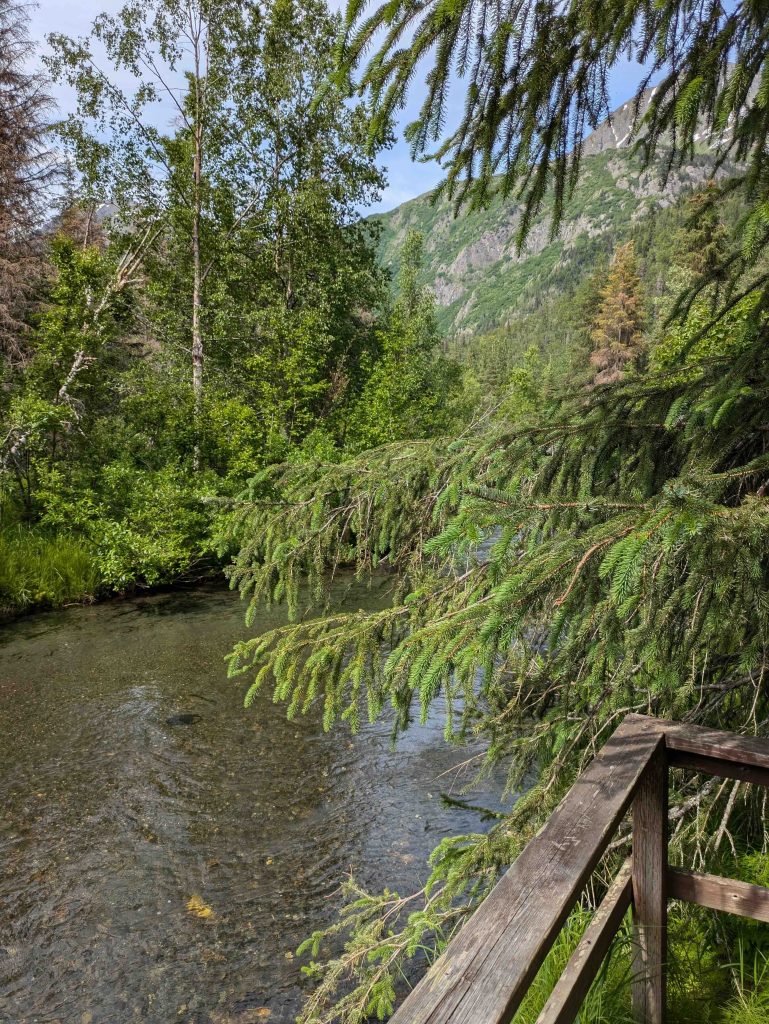
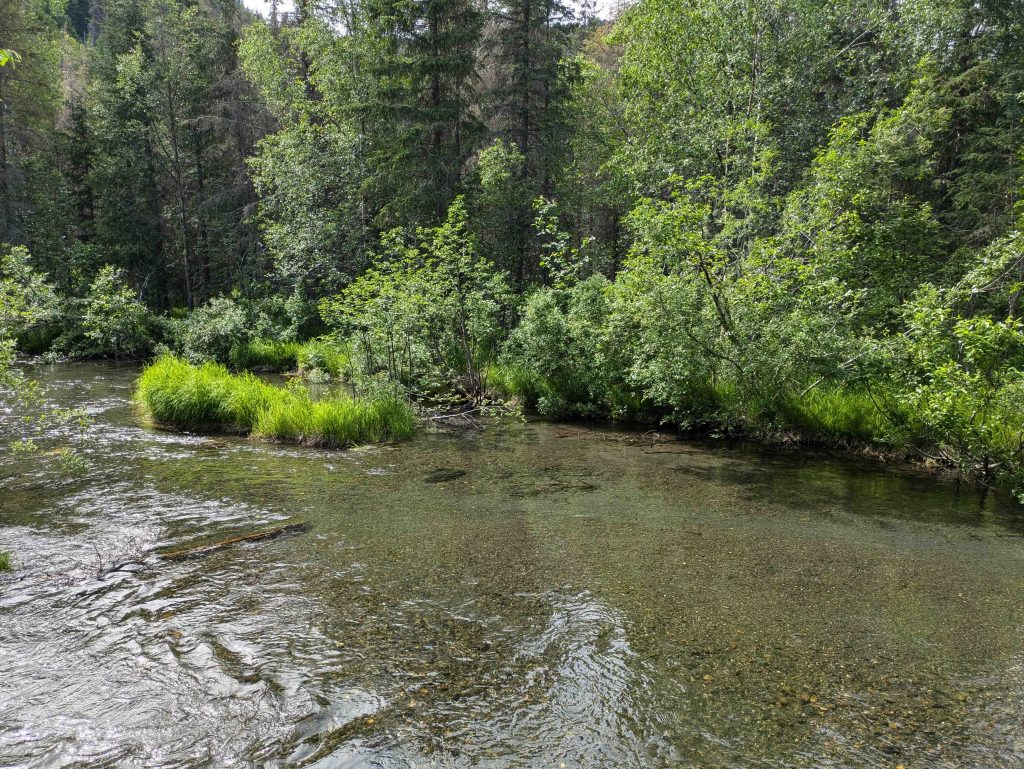
We were soon on our way back towards Anchorage. But on the way, I spotted a salmon viewing spot on the map. Unlikely that we’d find any, but we thought of stopping anyway since it was on the return route. “We also have to empty the bear spray can,” I reminded folks. Can’t be carrying that on the flight. At 3pm, we pulled over and followed the Google Maps walking route. It was a little trail surrounded by trees that led us towards a waterway, and there was even a viewing platform constructed just above the water. “No salmons today.” As usual, we tested the water temperature, and it was cold. Rakesh needed to take a toilet break – and as per Google, there was no rest area anywhere in the vicinity. “You are taking a risk in bear territory,” we warned him.
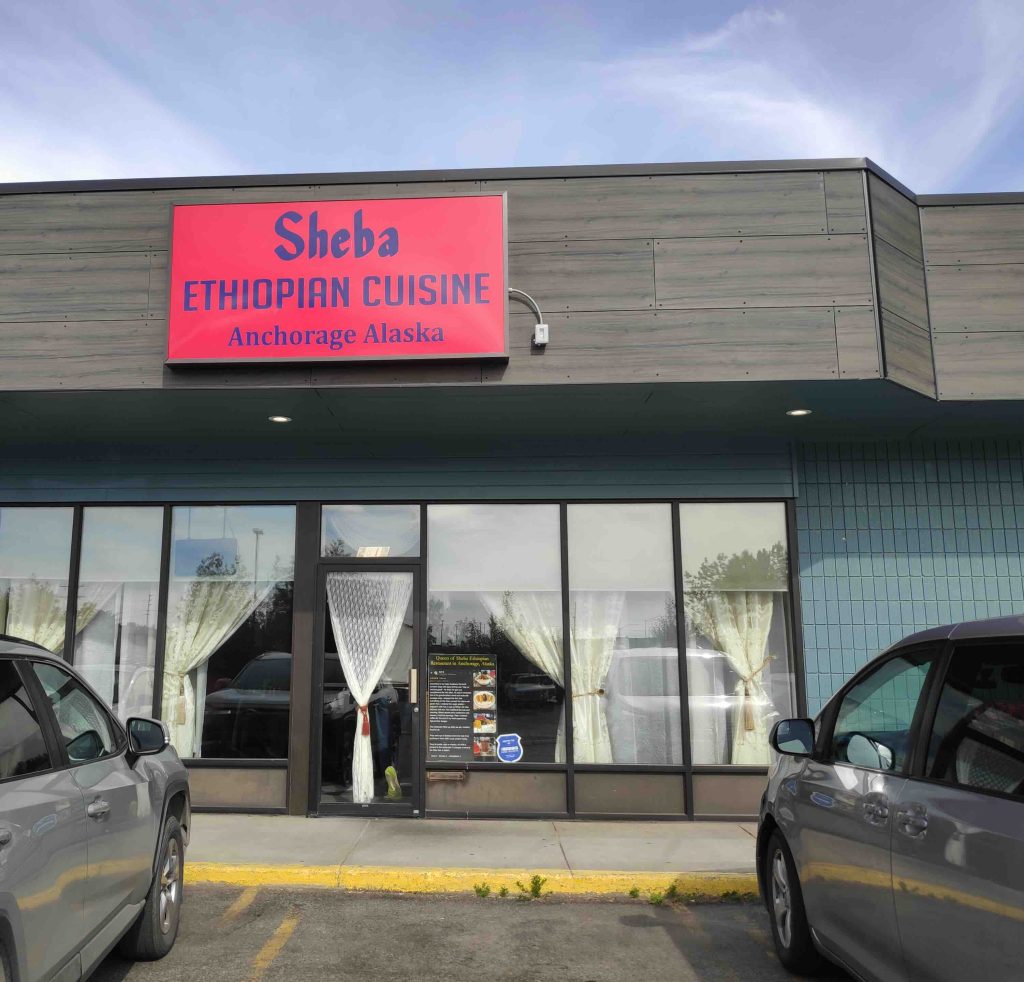
Raghav took out the half-filled bear spray can from the bag. After figuring out how to pull off the cap and trigger it, he fired the remaining contents into an open area after verifying which way the wind was blowing. “Let’s get back to the car. Now we don’t have the spray if we encounter a bear.” On the return leg, Raghav mentioned, “I’ll anyway need to check in my bag because we have the birch syrup. Can’t take that in cabin luggage.” “Oh yeah, forgot about that.” “And in that case I can pick up the Alaskan gin in Walmart before we head to the airport if we have time.” “We should be good.” Raghav had spotted this when we had arrived in Anchorage on day 1. The stop at Walmart’s was like a pit stop – he knew exactly what he wanted, billed it, and returned to the parking lot. Raghav and Rakesh picked a restaurant in the vicinity – the good thing about Anchorage was that the airport wasn’t too far from the main area of the city. So we still felt we had sufficient time to dash to the airport. “Ok with an Ethiopian restaurant?” “It seems to have veg items also.” “Let’s go.” All of us were game to try different cuisines. A distinctly red board labelled “Sheba Ethiopian Cuisine” welcomed us. The restaurant is called the Queen of Sheba (Google reveals that the Queen of Sheba has historical significance and is also a key character in an Ethiopian epic).
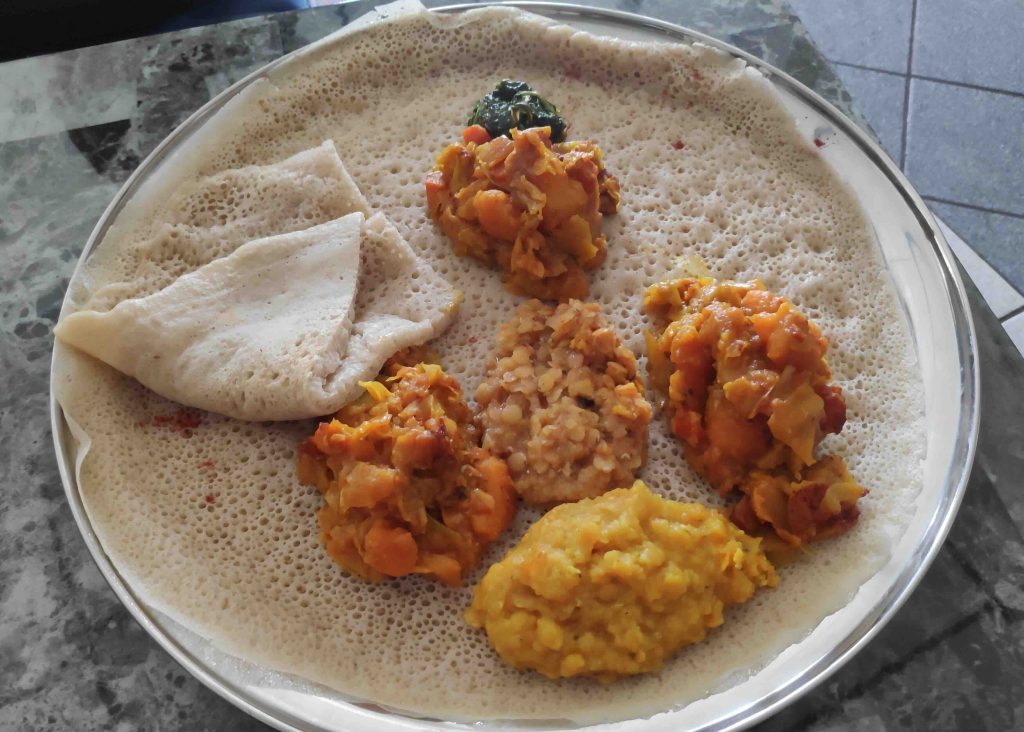
The menu described their cooking style – which reminded me more of Indian cooking – use of spices, turmeric, pepper, garlic, fenugreek etc. The food comes with what they refer to as a flat sourdough bread (called injera) or rice. The injera is more like a South Indian dosa (an Indian pancake or crepe) than bread. Even the way of eating was mentioned in the menu – use your fingers and scoop up the food using a bit of the injera; again, how we normally eat without the use of spoons and forks (they do offer cutlery). And Ethiopian food is generally communal eating – so people share from the same plate. We just stuck to the vegetarian dishes to keep it simple, and there was a mixed vegan platter with all their veg main course items. They brought us two plates with the injera spread open, and on top of each were a few scoops of the curries. Raghav and Rakesh ate from a plate while Moorthy and me shared from the other. The food tasted really good – reminded me so much of Indian food – not spicy hot but flavorful and light on your stomach. The items on our plate – ground chickpeas, red lentils, yellow lentils, a dish with cabbage and potatoes, collard greens.
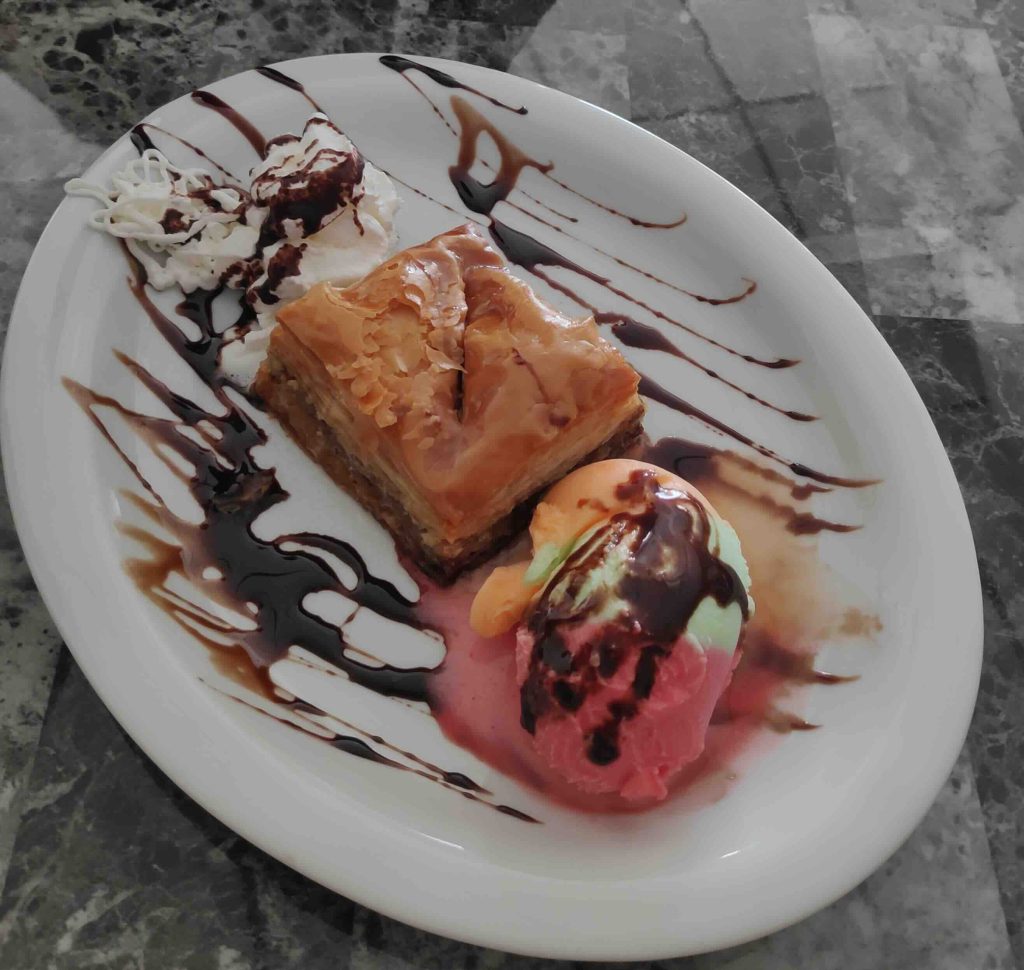
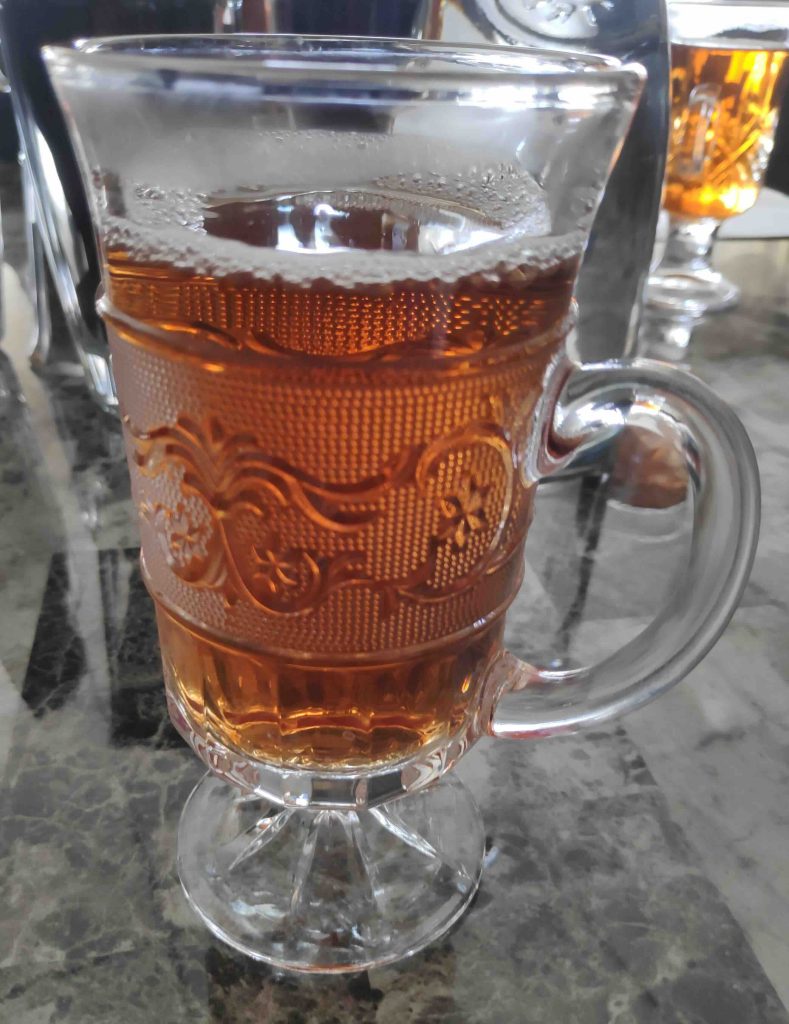
We drank some Ethiopian caffeine-free herbal hot tea (we have variations of these in India) and wrapped up our meal with Baklavas for dessert.
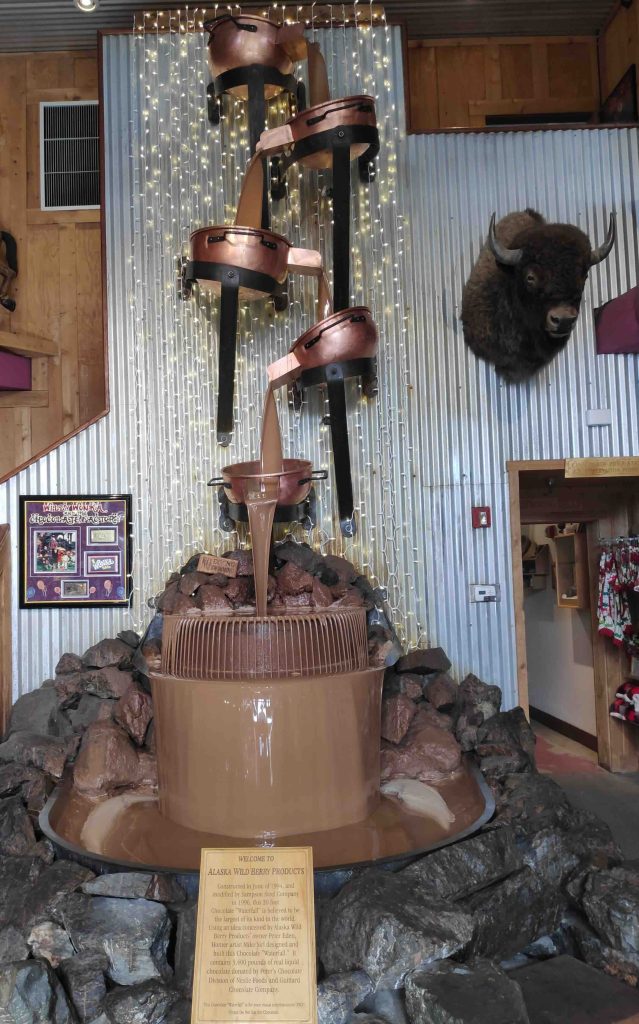
On these trips, you don’t really think about the number of mementoes that you need to buy; I thought I had bought a handful that should suffice, but as I sat in the car, I remembered that I had a few more folks for whom I needed to get stuff. And so we decided to check out the Alaskan Wild Berry Products shop that was nearby and on my list. “Let’s go if we don’t have time,” I said. “Make it quick. We still can manage,” the others said. So I ran in and was pleasantly surprised by the size of the shop – this was a fairly large outlet. I noticed that they also had birch syrup and plenty of the other mementoes we had seen in Denali. There was also a Chocolate Waterfall that you won’t miss when entering the shop – literally, chocolate flowing down! A notice did say no diving or swimming, and that it’s only for display, not for eating, though it is real chocolate!
Chocolate waterfall
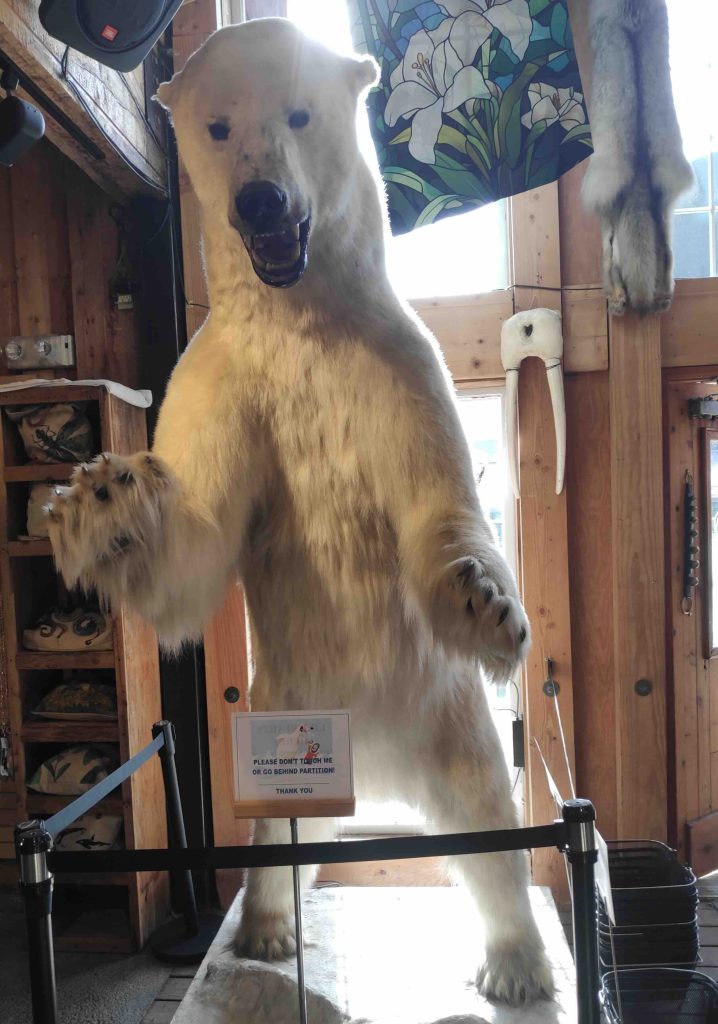
“Hey, we get to see a polar bear before leaving,” Raghav commented. It was the only one we hadn’t seen. They were busy taking snaps with the bear and at the fountain while I picked up a few items and rushed for billing. You always get into this situation where, when you are in a hurry, the queue at the counter will not move. It was taking quite a while for the 2 customers ahead of me to complete billing. Our folks were already in the car and ready to go – we didn’t want to delay any further, and right now I was starting to cut it close. I kept wondering every minute whether I should just leave the items and head to the car, switch counters, or stay on. Only two counters were operating, and there was already a longer line in the other one. Eventually, I got my turn and dashed out and into the car.
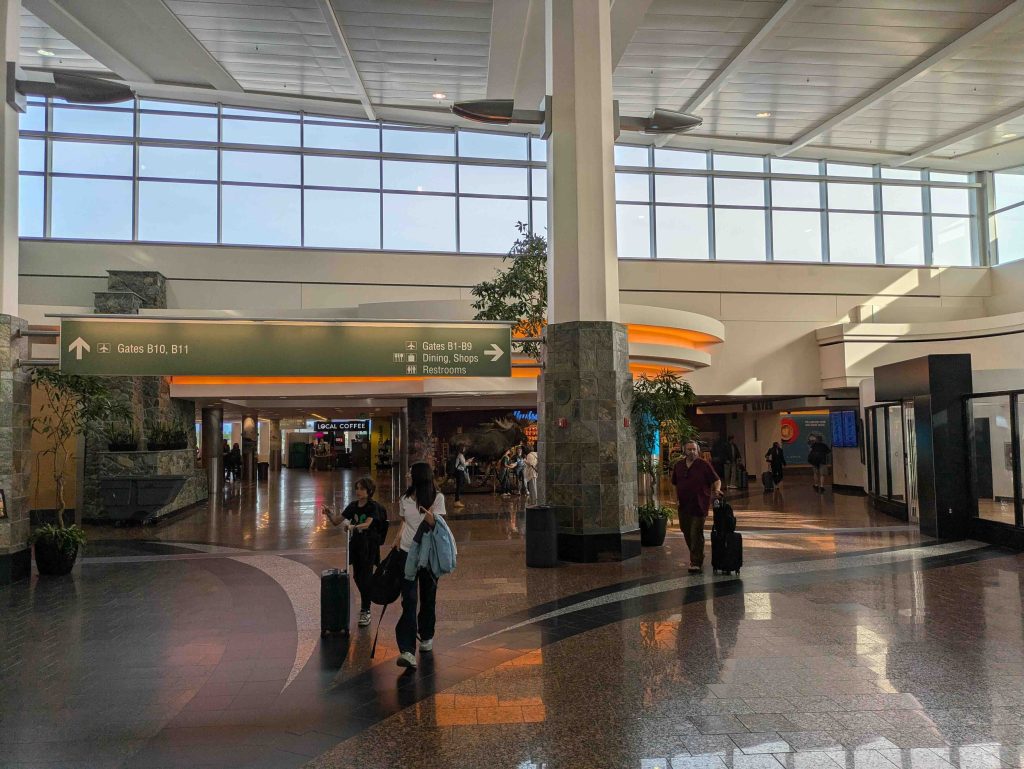
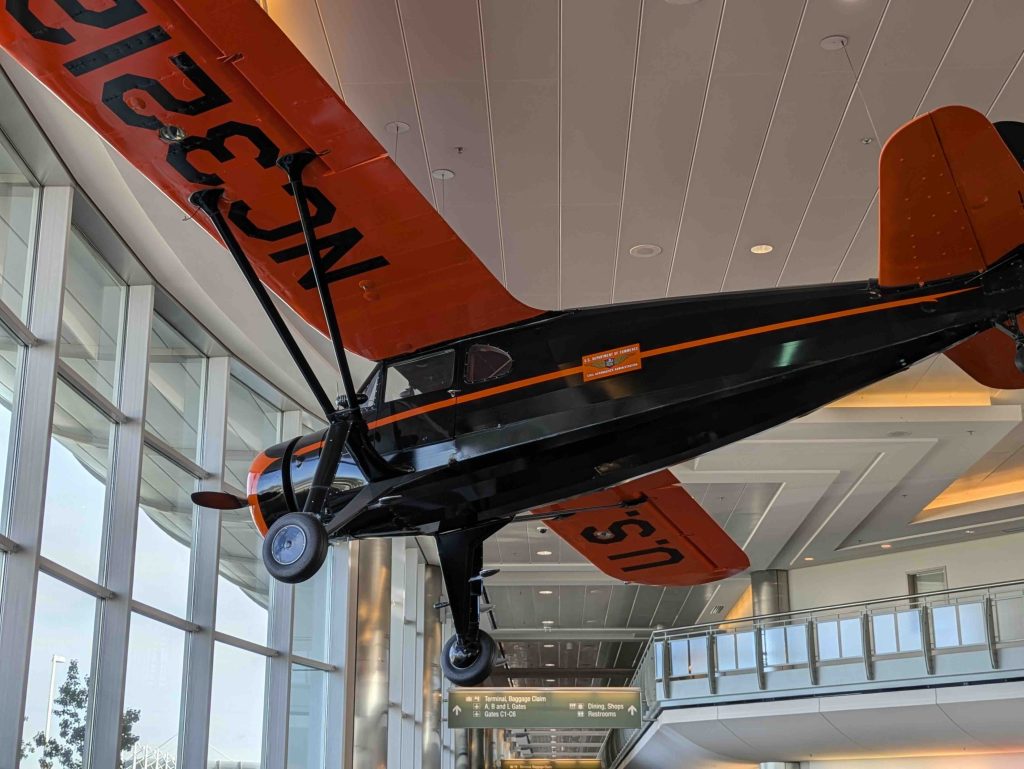
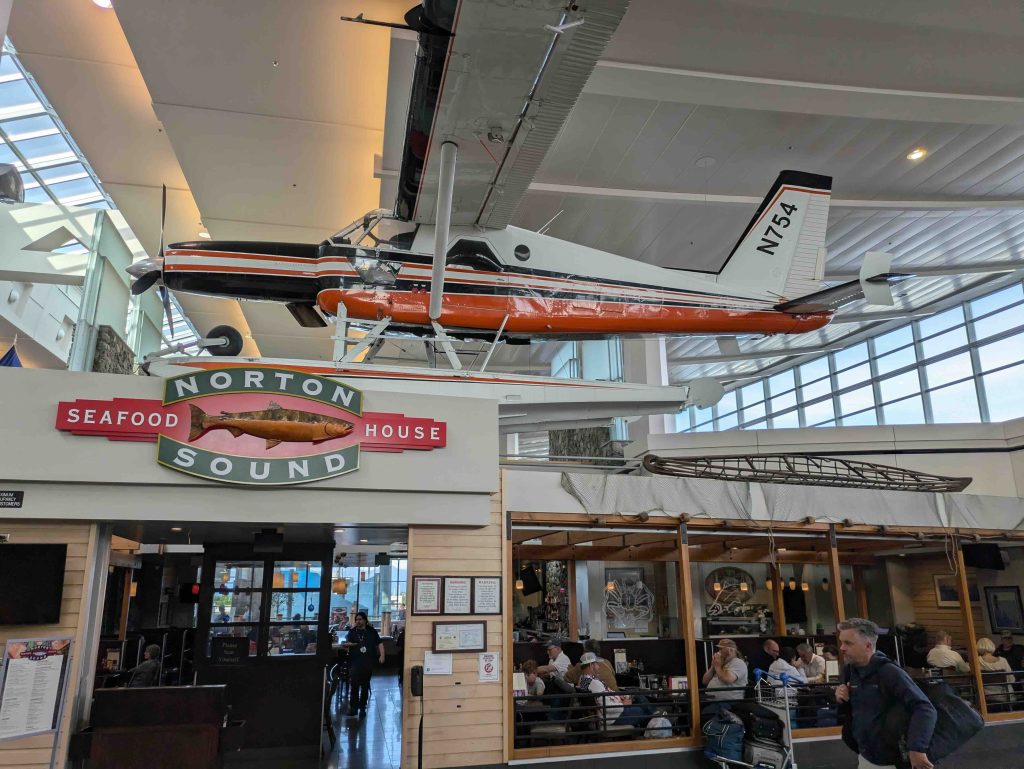
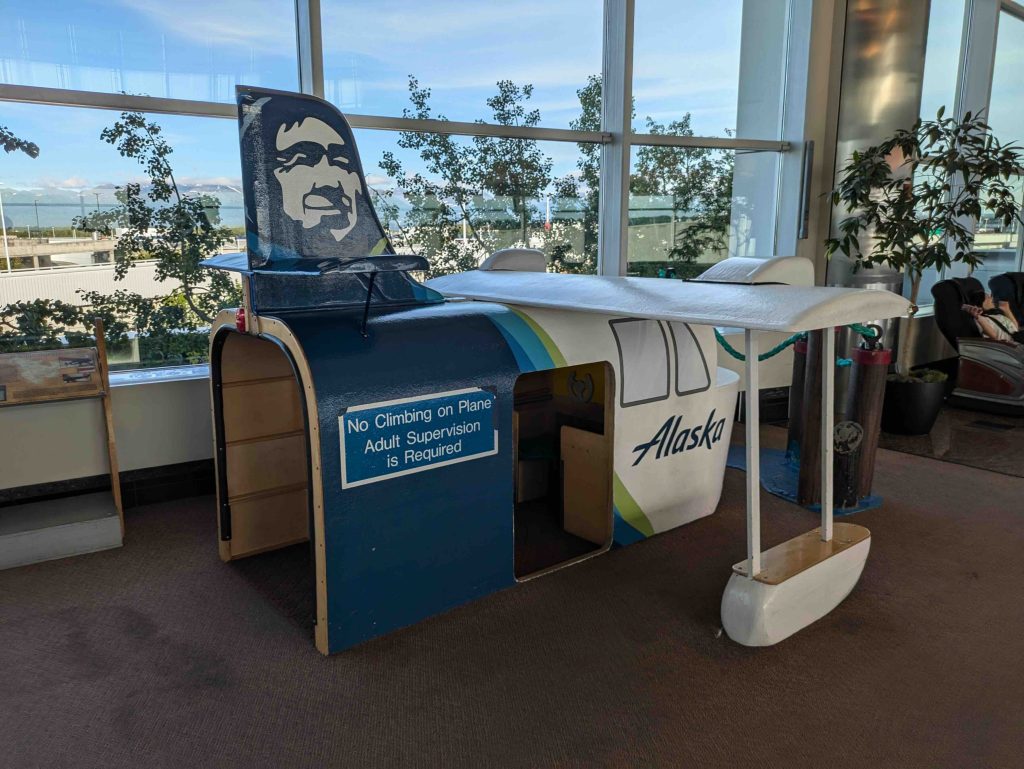
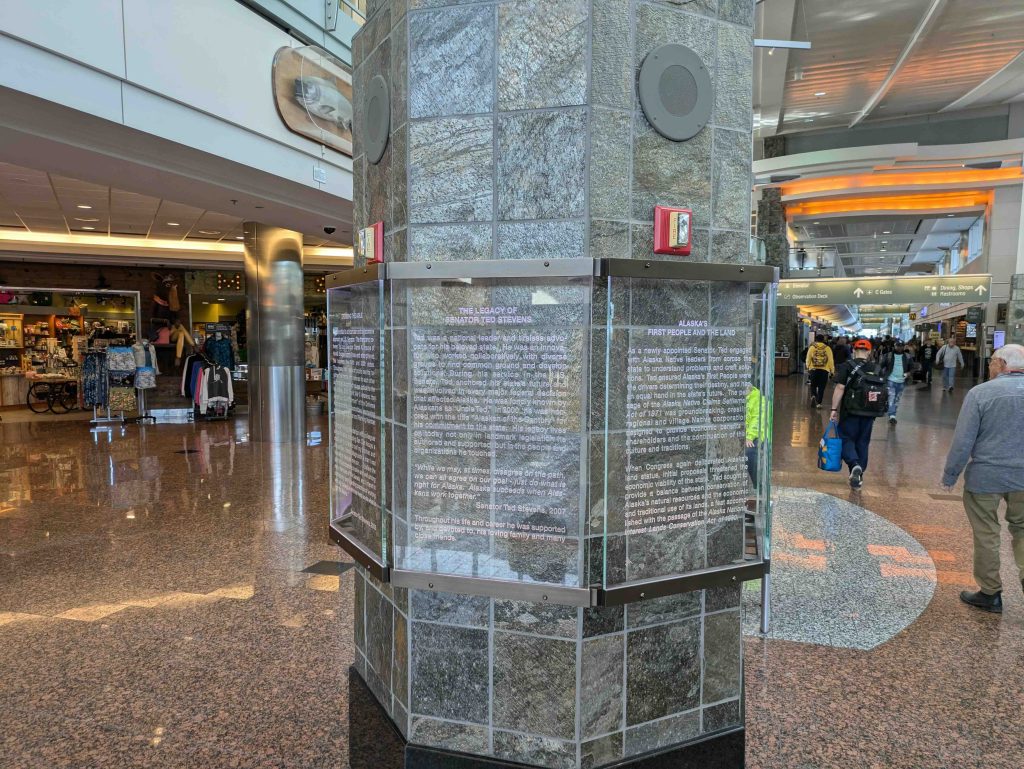
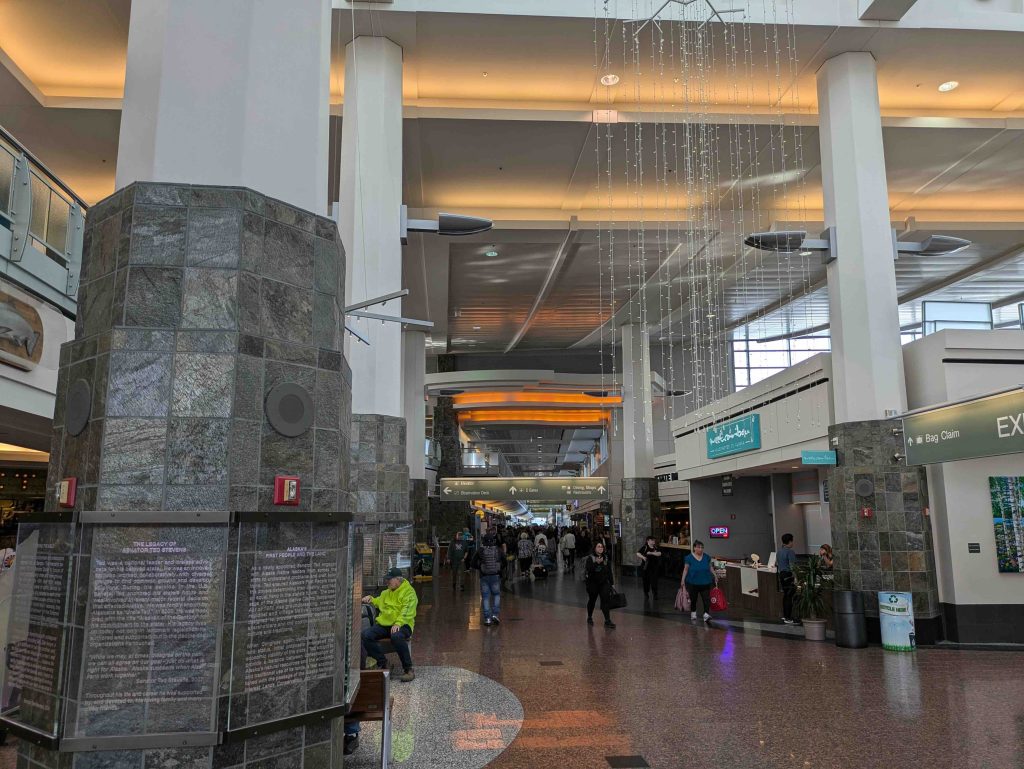
We did make it to the airport in time; we also loitered around the airport to soak in the atmosphere – this feels like a cosy airport- a lot of artefacts on the ground, in the walls, on the ceilings, and it doesn’t give you the commercial vibe.
That brings a wrap to a marathon travelogue on Alaska – an unplanned trip, but certainly was worth it. Hope you enjoyed reading it as well.
I headed back to the upper deck. It wasn’t long before the captain said that there may be another whale in the vicinity – a fin whale. “The fin whale is the 2nd largest whale species. First place is the blue whale. They can grow up to 80 feet.” They can weigh up to 70 tons – a newborn weighs around 1.6 tons! “They can stay underwater for a long time – even for an hour without surfacing. Patience is the name of the game – just like the humpback whale, we are looking for that puff of smoke. And then, after that, you’d see its long back.”
We waited for a few minutes – it was hard to stand still since the breeze was strong, and the boat was rocking a little on the waves. I think the captain would probably have said this was still calm seas! Some were brave enough to just stand leaning against the railings while holding their cam with both hands. I still wanted to have one arm on a railing! Reminded me of bus conductors in India – even though the bus swerved, accelerated and decelerated abruptly, they’d be able to stand inside without holding anything for support.
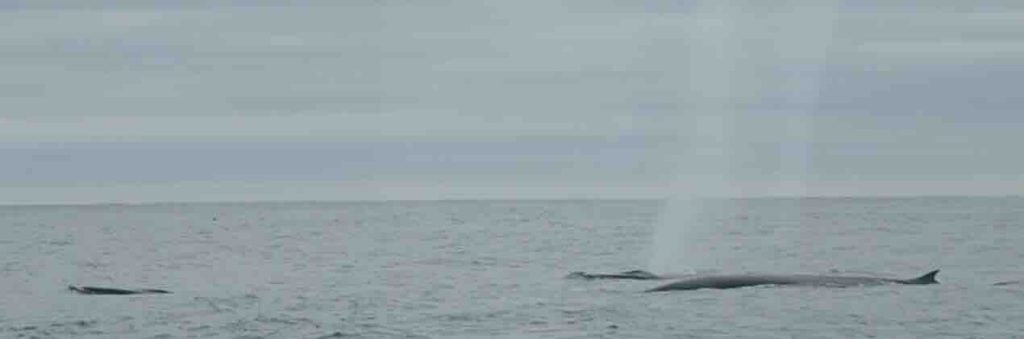
We saw a couple of spouts, and then their long back appeared above the water – no tail flip here. But as we were watching them, another one appeared on the other side of the boat. That was a sei whale. “Sei whales were earlier mistaken for fin whales. It is smaller than a fin whale and the 3rd-largest member of the whale species. And there’s one more.” There was another spout. “There is bait back under us from 350 feet to 50 feet; it’s just bait. I’m sure there are 20 to 30 fin and sei whales here. This is a feeding frenzy out here. There – there’s another spout – and two more – different from the ones we just looked at. It was 12:50 pm; the captain said we were running late, but since there were so many whales, he said we’ll try to see a few more before leaving. And he hoped that we wouldn’t mind being 15 to 20 minutes late. Don’t think anyone was going to be upset about a longer cruise.
SpoutThe fins
Raghav and Rakesh were on the upper deck, while Moorthy stayed down in the cabin – and he got a nice video of 3 of the whales that were swimming beside our boat – not too close, but their tops were clearly visible. All of a sudden, we saw a whale swim extremely close to the front of the boat – it felt almost like it was just below us and swam perpendicular to the boat. There were so many spouts we spotted, and many instances where we could see the top. “There are not many blue whales that have been spotted in Alaska.” That was the only one we hadn’t spotted yet! “Blue whales and fin whales migrate to the same place in winter – near Costa Rica. And blue and fin whales have started to mate together.” We could see other smaller boats swarming towards our vicinity. “They’ve all come for whale watching. When there are sightings, the news spreads quickly.”
By 1:15 pm, we had moved away from the whale territory, and things quietened; people returned to their seats. Near the whale territory, it was cloudy, but out here, it was again a bit sunny and bright. Raghav didn’t stay outside for long stretches since he had a bit of motion sickness. Fortunately, I didn’t feel any uneasiness in this long boat ride, and so stayed on the upper deck. There were just a couple of others out here.
The Bear glacier that you see at a distance is landlocked and a lot larger than the tidewater glacier Holgate that we saw earlier. This one is 13 miles long, and it’s at the entrance to the Kenai Fjord National Park.”
Some history
Around 1:30pm, a day staff member came around distributing a small box with a brownie. It tasted really good – maybe more so because of us being in the middle of the ocean. The staff, in the meantime, were having some activities with the kids near the pantry – there was a book they had given the kids earlier that they were going over. And they were also distributing some goodies. Raghav and Rakesh had dozed off in their seats. I returned to the upper deck and stayed there till the end of the cruise.
“There used to be a river in Seward downtown, and even 15 centimetres of rain would cause flooding. So, natives preferred Aialik to Seward. It was a hard place to live in. The Governor of Russia, back in the 1790s, came here on resurrection Sunday. After seeing the place, he made significant developmental progress. He felt that the Seward area was perfect for getting a ship for the purposes of trading. After he passed, development in this area came to a standstill.” The interesting thing is that, back in those days, it seems the US and Russia were on somewhat friendly terms. “In 1867, the US bought Alaska from Russia. And then in Alexander Baranov’s logbook, he had mentioned that in December, he found no ice here. This is the northernmost ice-free port. And this is the resurrection bay area,” the captain said as our boat returned to the bay from where our journey had begun 6 hours ago. Alexander was a Russian merchant.
“The purchase of Alaska is called Seward’s folly! The purchase happened because the Secretary of State, William Seward, back then, bought it for 7 million from Russia – 2 cents for an acre.” Back then, it seems most people were not in favour of the purchase because they thought it was a barren land – they even termed it President Andrew Johnson’s ‘polar bear garden’!
As per history, Russia had originally occupied Alaska, and they profited from the fur trade – but no one really stayed there long enough, and no permanent colony was set up. Eventually, the fur trade declined, and it was hard for Russia to maintain the territory at a time when it was waging the Crimean War and had lost to Great Britain. And so they were open to selling it. And Seward believed that it was land that the US should own – he was an ‘expansionist’ looking to expand US territories. With both countries on good terms, the deal went through. It surely didn’t turn out to be a folly in the long run!
Captain’s seatBack to the start
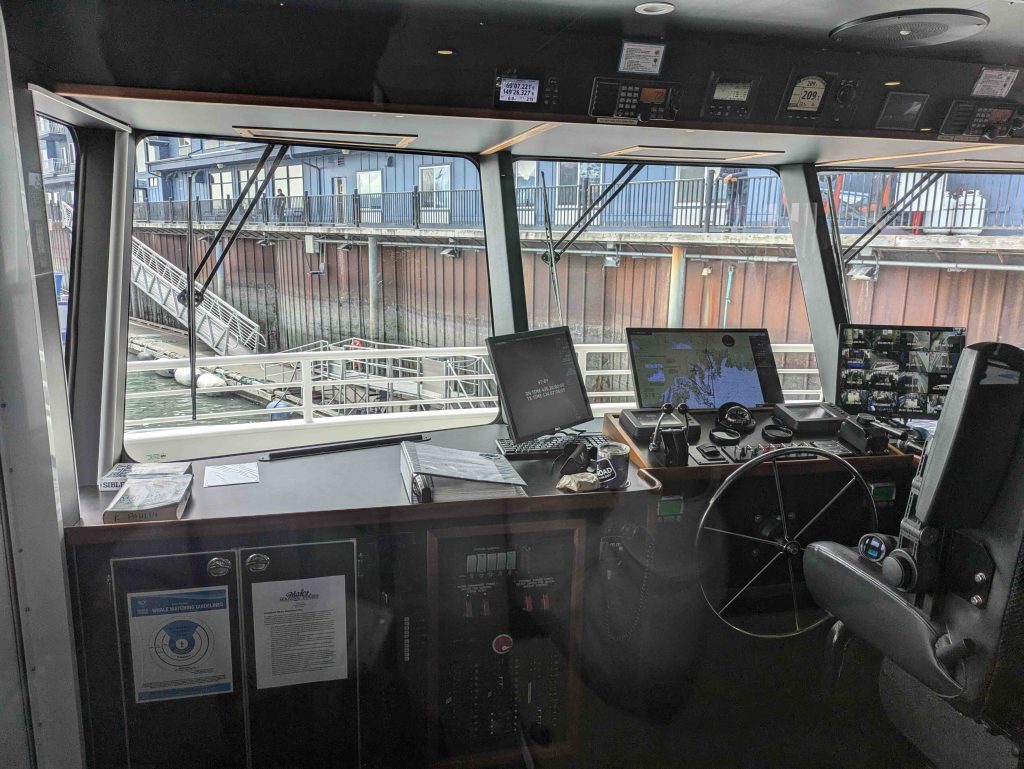
“We’ve covered a total of 106 miles today.” By 2:20pm, we were back in the dock from where we had started. While leaving, I tried to get a peek at the captain’s wheelhouse; I noticed a couple of books on his desk – one on marine mammals of the world and another on birds. I guess the captain kept his knowledge up to date so he could pepper in fun facts during the cruises. I was almost the last person to exit. People contributed to a tip jar as they exited – that way the tips would be shared among the crew for the day.
Back in the Harbor hotel, we took turns using the restroom. While I was waiting near the exit, a couple came up and asked, “Have you been on this cruise before?” “No.” “Oh. Was nice seeing that you were the rare ones spending all the time outdoor in your sweater and hoodie.” “Ah. First time – enjoyed it. How about you?” “Our second time. Have a good day.”
Tip for those doing the cruises
Take the longer one; I think the 6-hour is great – there are even longer ones if you do enjoy being out in the ocean, but otherwise the 6-hour is good for starters.
Wear layers – no harm in wearing or carrying extra layers because sometimes it does get quite cold.
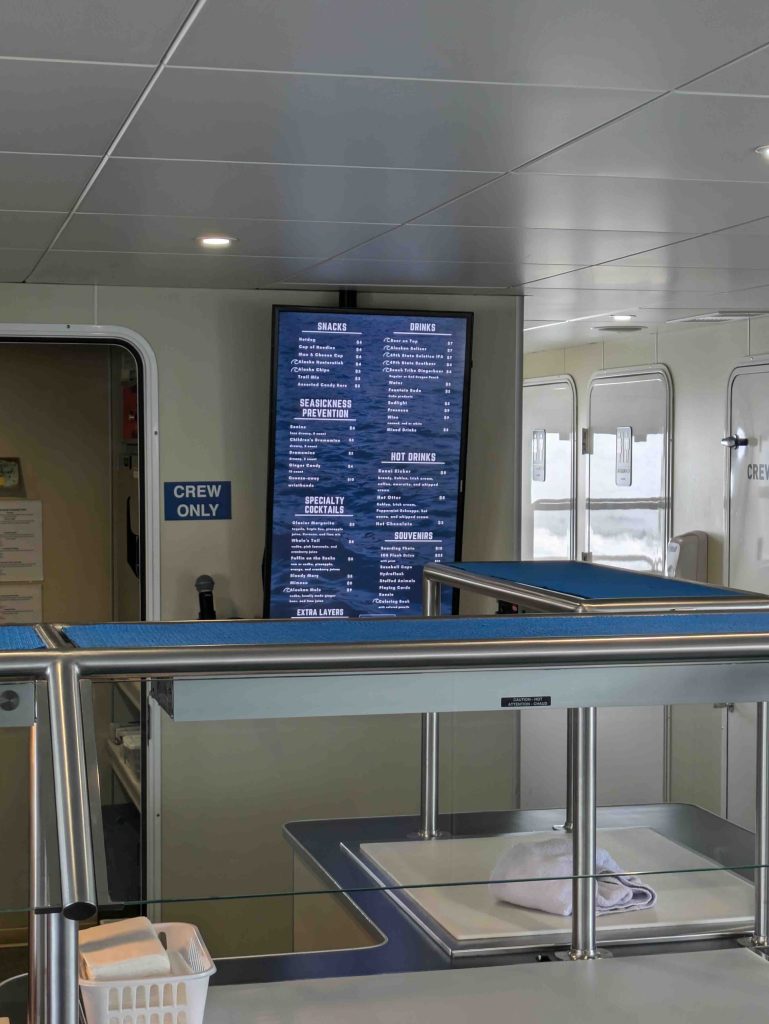
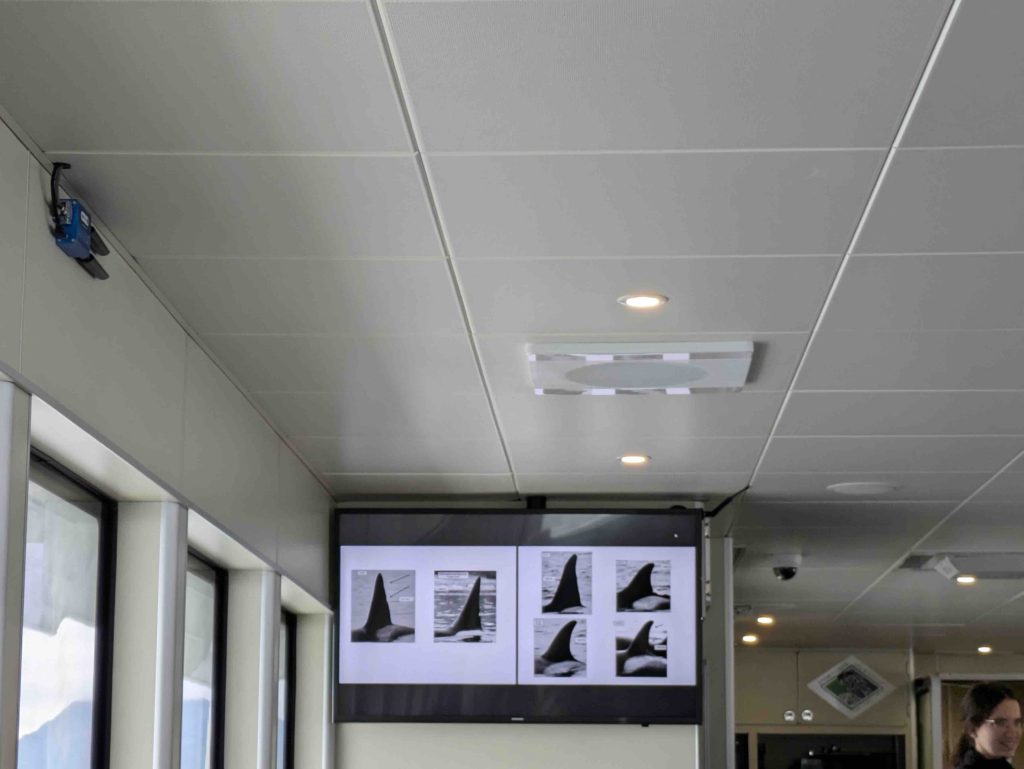
At 10:30, the captain announced, “It is time for lunch. As your table numbers are called, pick up your food from the counter.” On the TV screens inside the deck, images of the whale fins were being displayed – I think that’s what the staff had clicked. For the vegetarian option of the meal, you had to mention that when you did the booking – else they had turkey burgers or hamburgers. Lunch was simple – a sandwich, chips, a cookie and a drink.
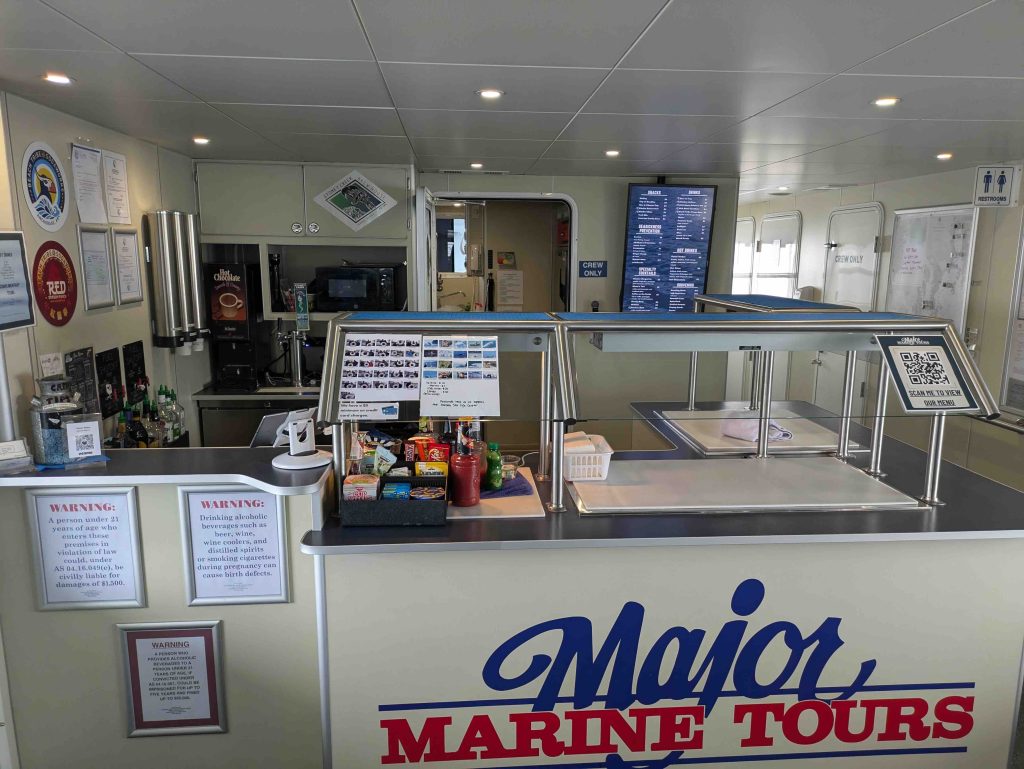
PantryOther items on menuImages of the fins
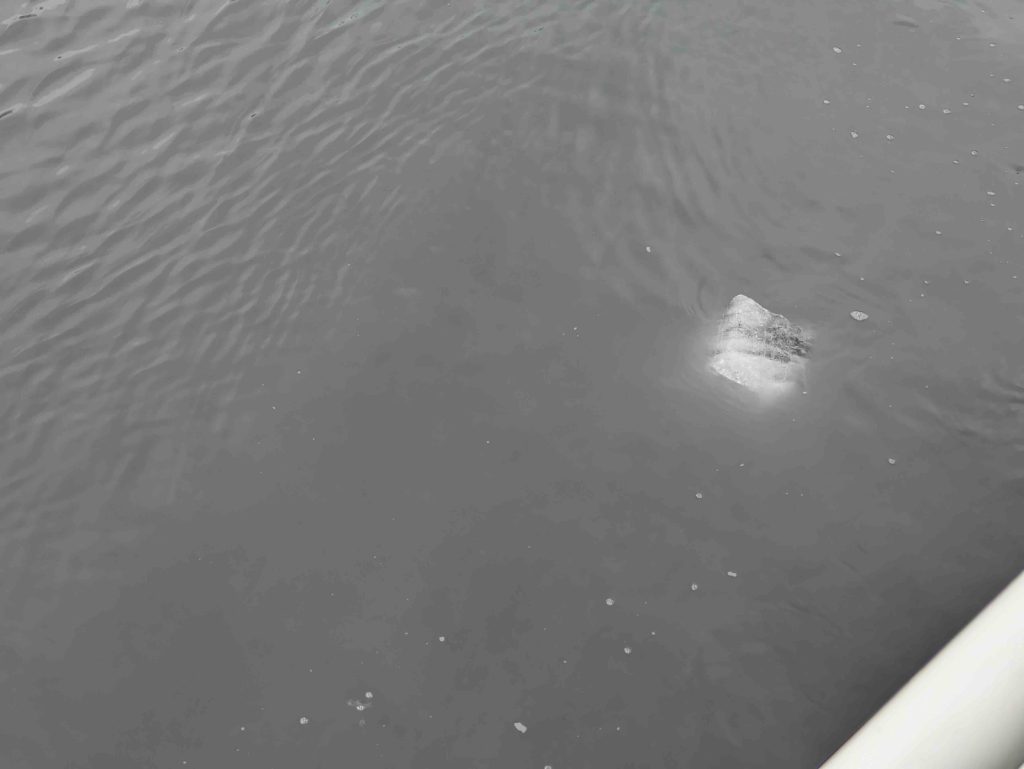
I didn’t spend much time inside; I headed back up to enjoy the outdoors. It was a bit breezy and chilly, but it was fun watching the ocean. I noticed the staff on the lower deck gathered at the rear. They had a long pole with a fishing net, using it to catch some blocks of ice floating near the boat. Those blocks must have come from the glaciers.
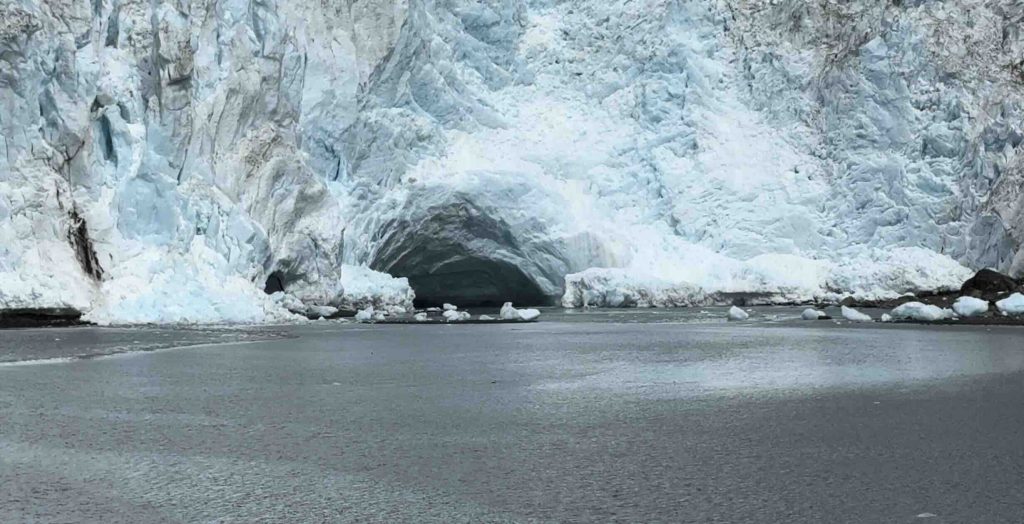
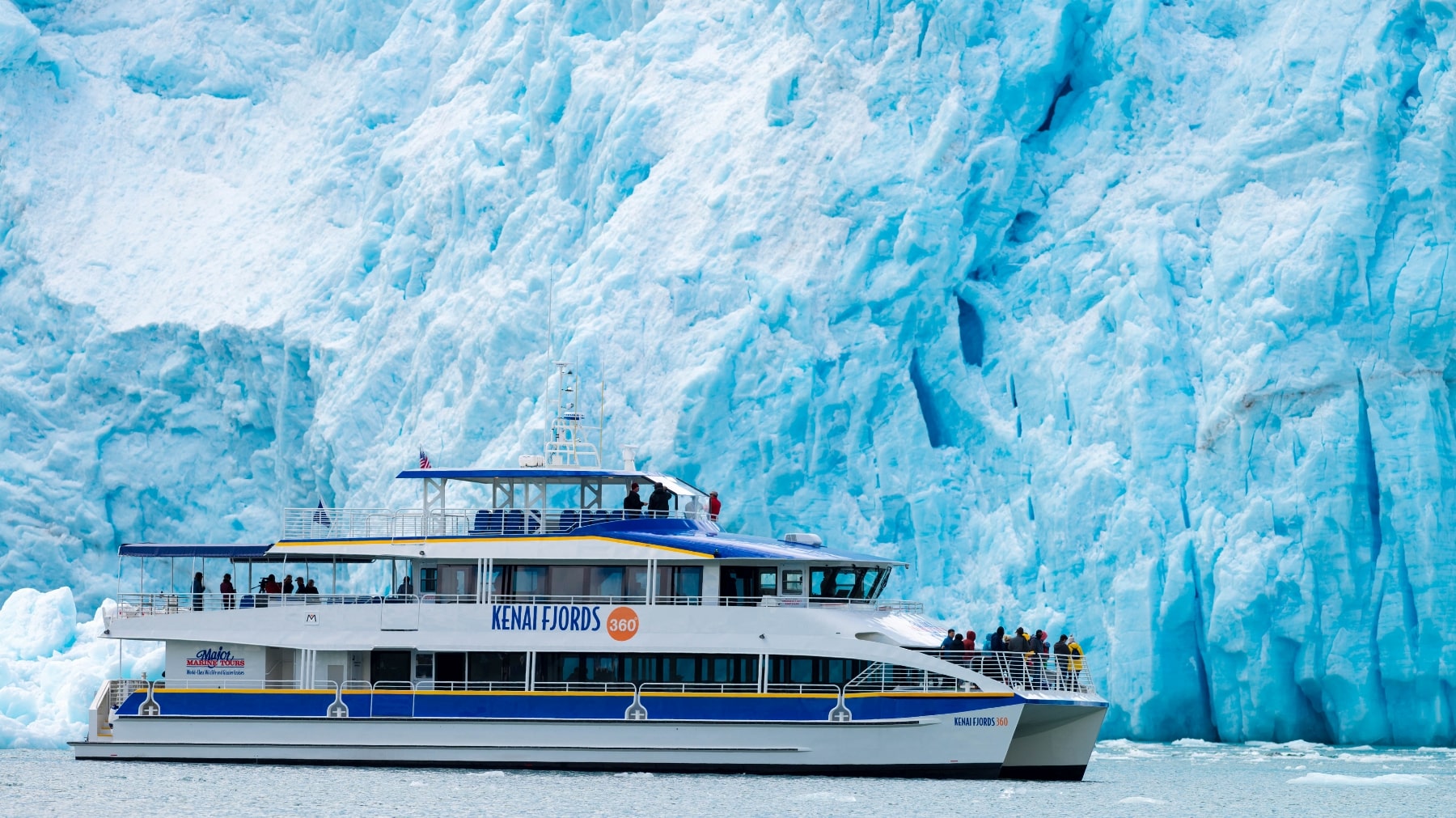
At the halfway mark (almost 3 hours into the trip at 11 am), the captain announced, “Welcome to Holgate Glacier. This is the only glacier here that is advancing rather than receding. It is 5 miles long and about 700 meters tall. The glacier is a moving river of ice. There is about 2 to 3 feet of ice coming down every day.” He went on to explain why glacial ice appears blue: the dense ice absorbs all other colours except blue. The Holgate glacier is one of the many glaciers that flow from the Harding Icefield (the place we visited yesterday).
The captain stopped the boat for about 15 minutes near the glacier. It was like a mountain made of ice, in blue and white. Beside the glacier, you could see normal mountains in brown and green. Though we were at a distance, we could sense how much ice must’ve been packed into the glacier. We took snaps with the glacier in the backdrop. One of the lady staff came up holding a block of ice. “Does anyone want to touch a piece of the glacier?” We were the first group to volunteer. Raghav took it in his hands and passed it along – none of us had gloves, and so it was a challenge holding it while posing for a snap!
Holgate Glacier
Moorthy was filming the scenery, and as we admired the view, we saw a small section of the glacier break off and fall into the ocean. That is what is called ‘glacier calving’. What breaks off is an iceberg if it is fairly large.
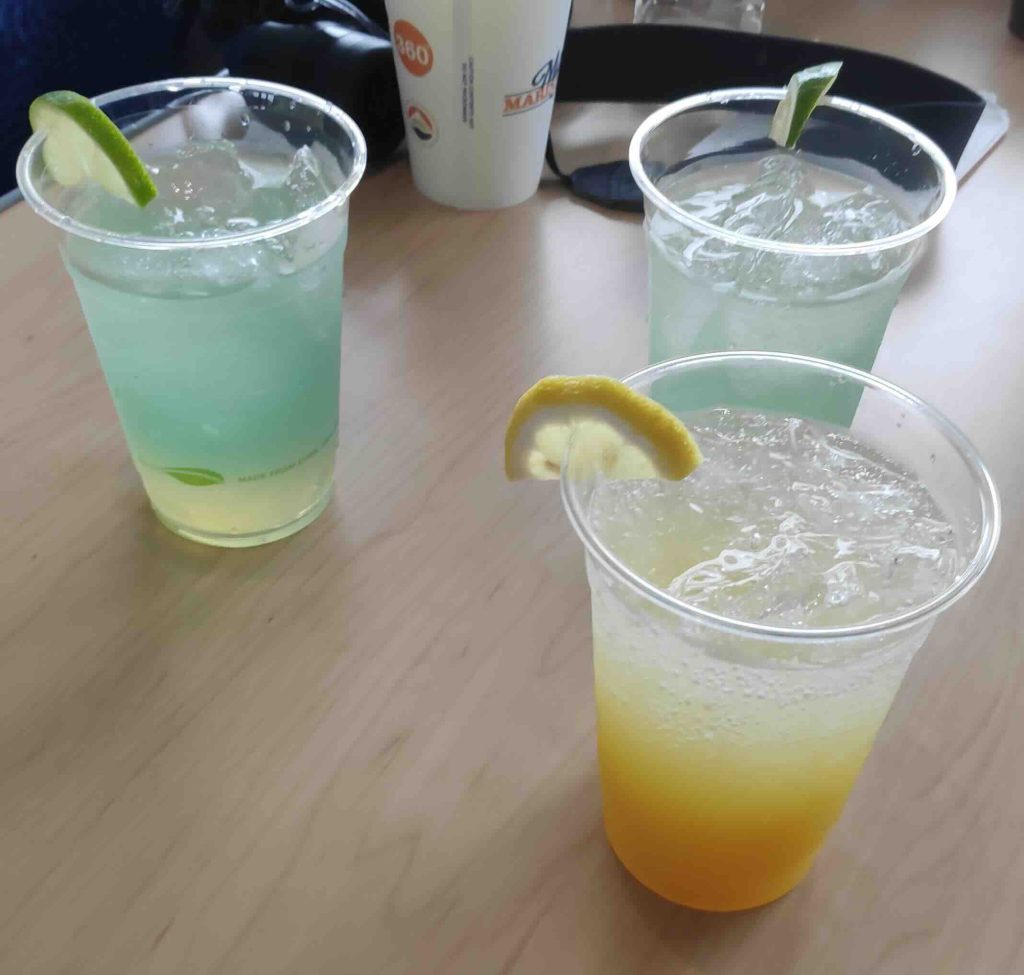
The cruise boat turned around for the return leg but took a parallel route to the first leg so that we got to see different areas. All of us sat in the upper deck seats, enjoying the view. The top deck is open with a roof, but on the front side of the boat, there is a little bit of protective glass – so if you sit in the two seats in the center of the four-seater bench, those are behind the glass, and you are shielded from the cold breeze; it is a great spot for viewing. Around 11:30 am, we heard the captain say, “If you’d like to taste the glacier, our staff has prepared a special glacier margarita using the glacier ice. Buy a glass of this unique drink from our pantry.” “Let’s go and try it out,” Moorthy said. I didn’t feel like having a cold drink in this cold, so I told them to carry on. I joined them later for a sip from the 3 glasses they bought. It was expensive – glacier ice is ice, and so, don’t expect some unique flavour from the ice!
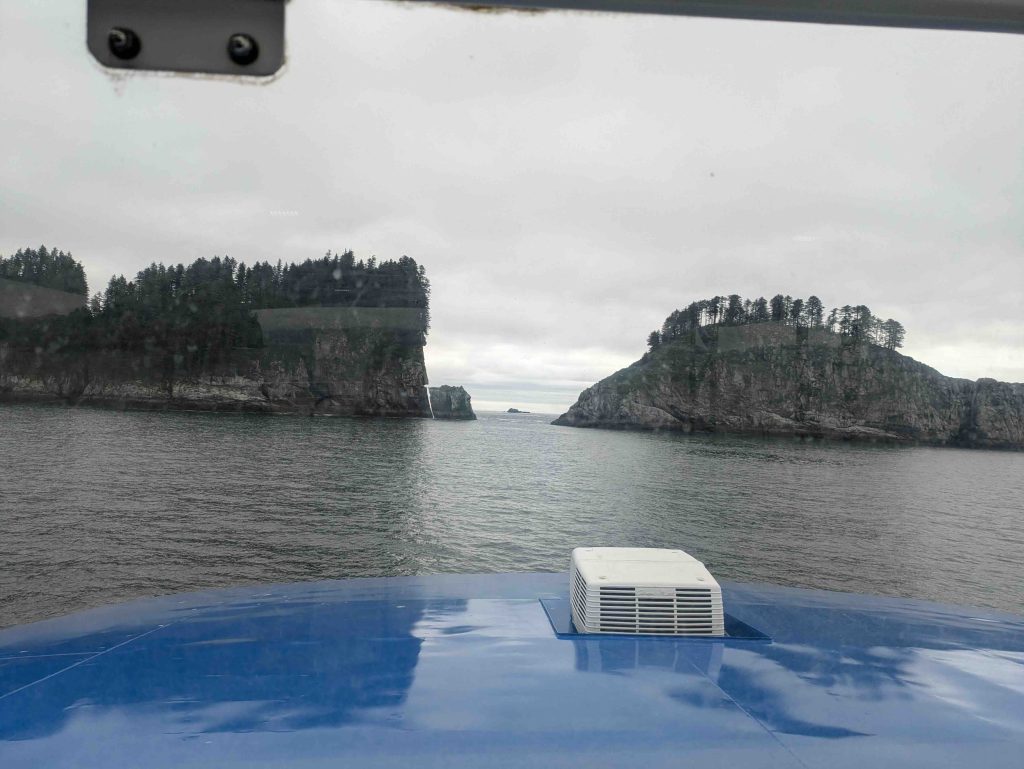
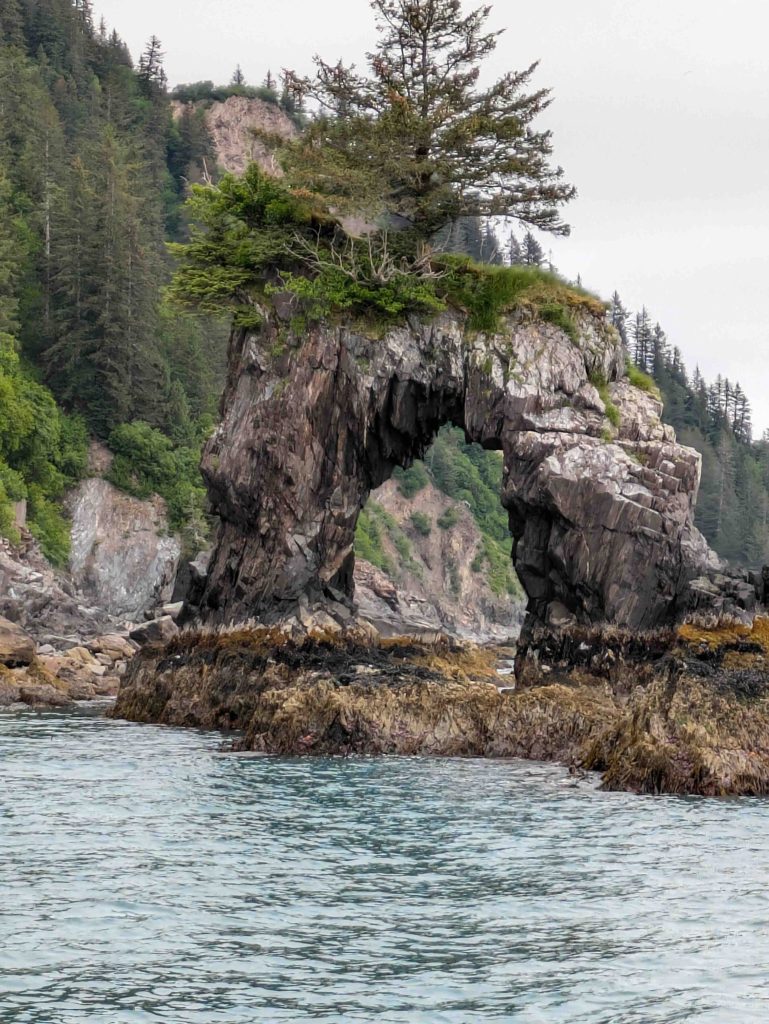
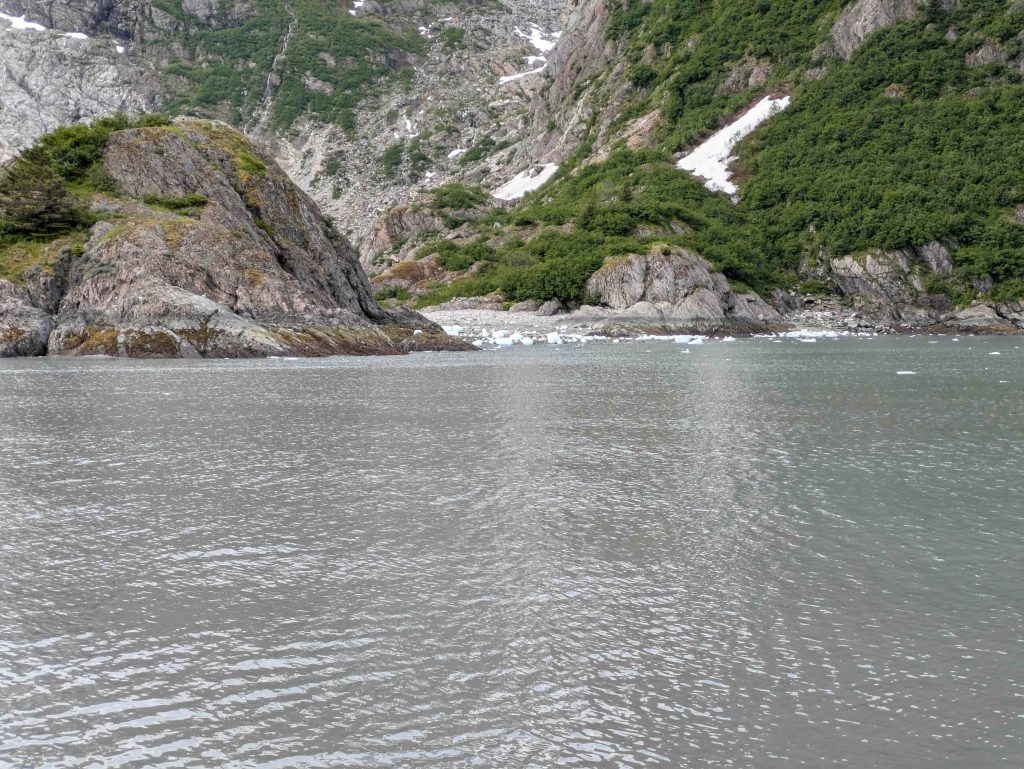
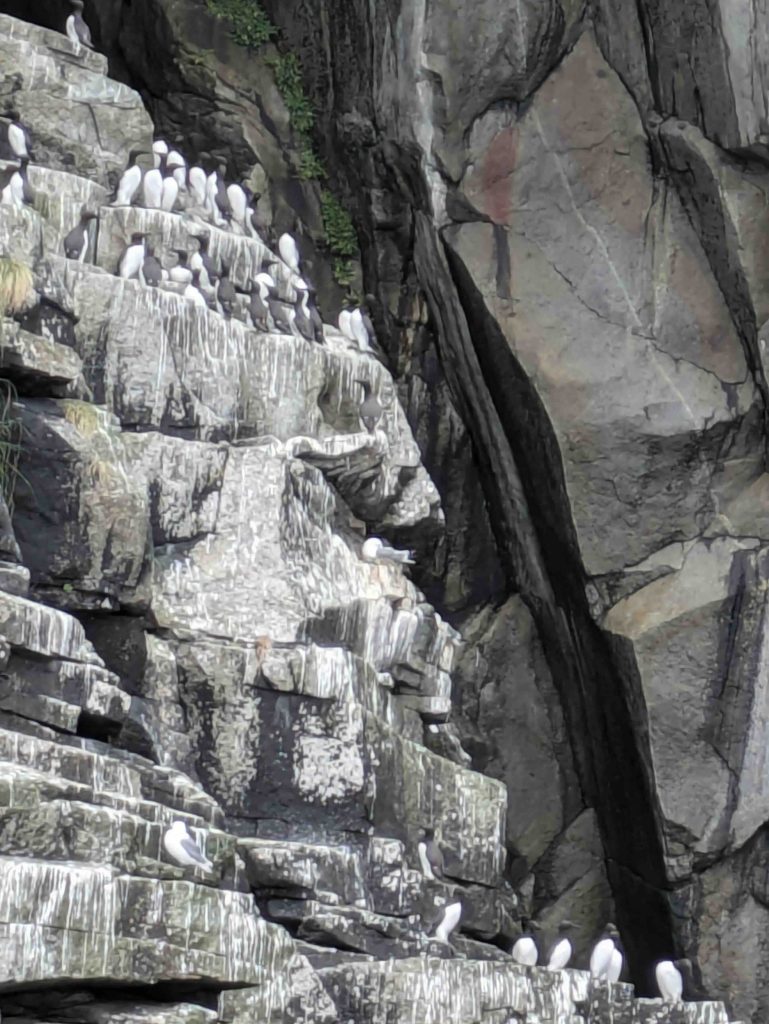
The captain on the return leg took us through some islands; this part of the cruise was to spot birds in the area. “We will stop near the Chiswell islands to give you some time to spot birds in the area.” This is a bunch of small islands. You’d think of beaches on islands, but these were more like rock formations that have popped out of the ocean – so there’s no sandy beach but rocky terrain with trees at the top. These are not inhabited by humans, and wildlife thrives here – plenty of birds nest on them. There were large groups of the ‘common murre’ that blended in the background of the rocks – with a white belly and black head and wings, it reminded me of penguins, but it isn’t related to penguins.
Can you spot them!
“These birds can dive around 500 feet into the water.” We could see this large group standing across the steep cliff – they seemed to feel at home at such a height! “They lay their eggs on a rock, which is odd because if you lay an oval egg on those rocks, they will mostly roll down the cliff. But their egg rolls in a circle rather than rolling off a cliff. In my opinion, that is one of the greatest animal adaptations on the planet – the ability to lay pear-shaped eggs so they don’t have to make a nest and can lay an egg wherever they want to.” The term for the pear shape is ‘pyriform’ – one end is pointed, and it’s not easy to roll off. Looking at the edge of the cliff where these birds seemed to be enjoying and probably living most of their time, it made sense.
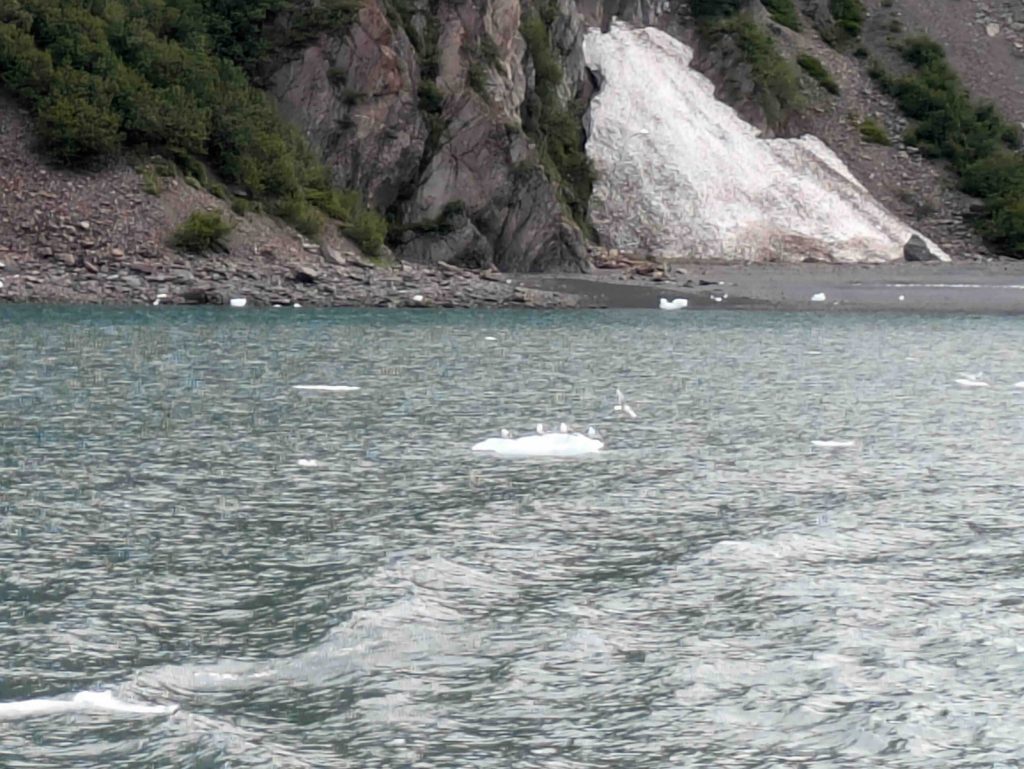
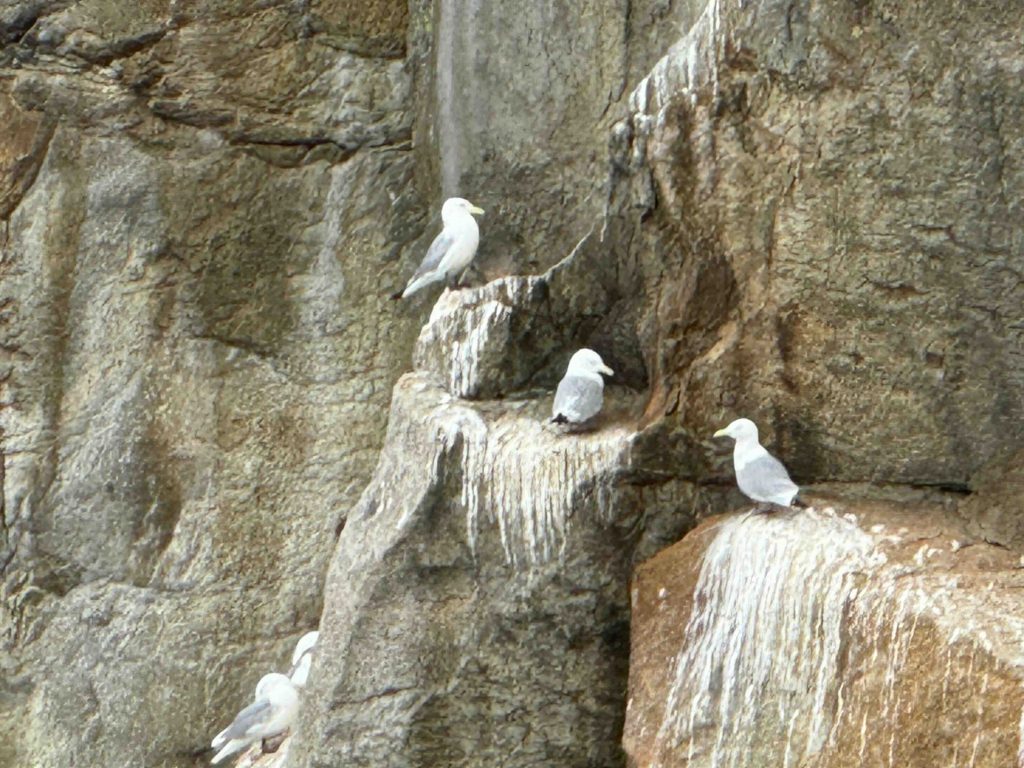
We also saw plenty of the black-legged kittiwake – they were quietly sitting on the edge of the rocks and were easy to miss unless you zoomed in on the rocks.
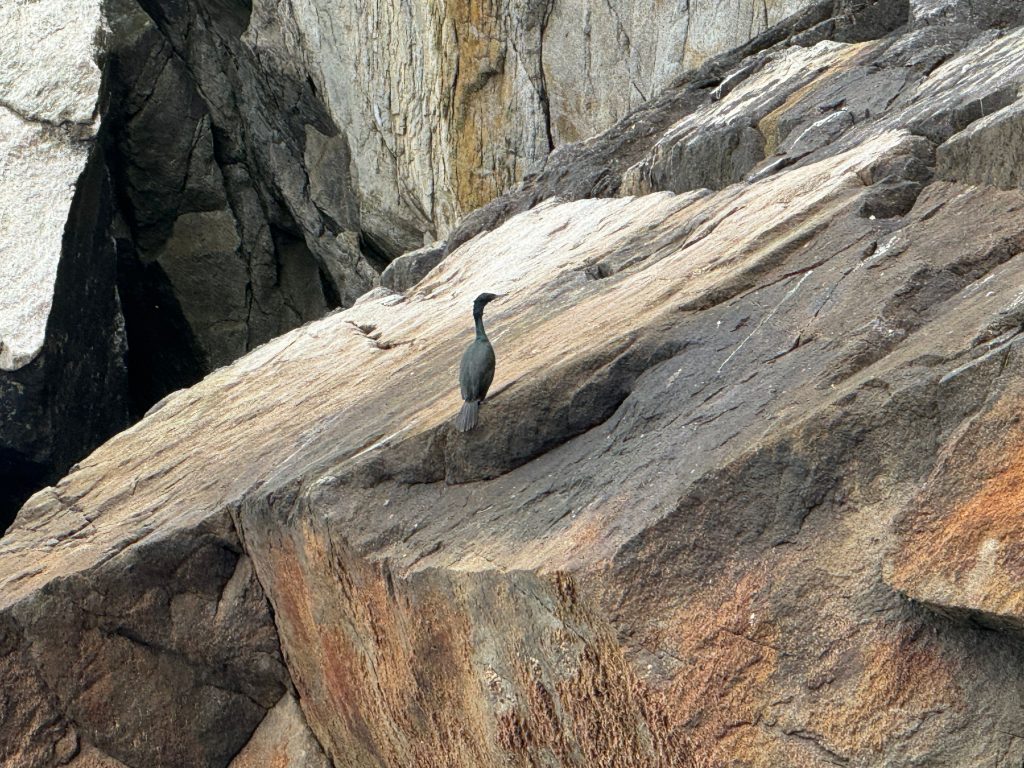
Moorthy spotted a solitary ‘coromorant’ – a bird with a long body fully in black. He also captured a nice snap of an American Robin – a distinct orange-red colour belly – this bird wasn’t even on the list of birds on the pamphlet!
When the captain announced that we could see puffins in the water, there was visible excitement among many passengers. Since these were moving, I couldn’t capture any proper shots of them – and it took me a while to figure out what a puffin was!
The birds with an orange-coloured beak. We saw some floating on the water, and some were there on the rocks.
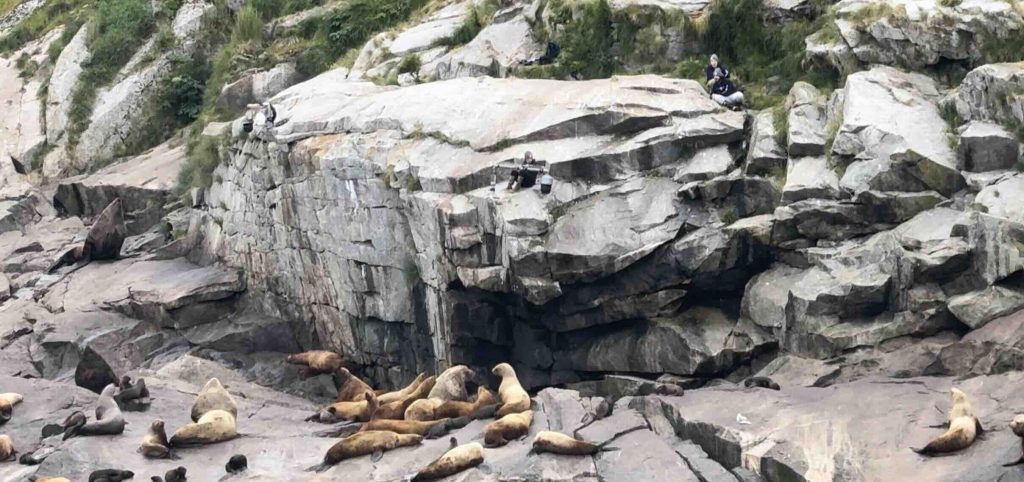
At 12:30, we heard the captain’s voice, “And over there on our right, we can see an endangered species – the stellar sea lion. Since they are endangered, there is extra monitoring in place for them. In fact, you can see some of the folks from the Alaska Sea Life Centre watching these animals from above with their monitoring equipment.” I couldn’t spot any humans out there, but Moorthy had his camera focused on them. “There.” Three men were sitting on rocks directly above the sea lions – the sea lions didn’t seem bothered by their presence.
Can you spot the humans?
“Disease, predators and excessive fishing led to their decline. They are different from harbour seals – males fight for territory and even fight to the death because territory helps them in mating. This place in Chiswell islands is a pupping ground – you can see many new pups here.” “The sea lions are branded – it is a cold branding that is done, which is painless. The letter e is for Chiswell Island, which marks their birthplace.” Branding them was part of the conservatory effort to help monitor them.
I went all over the boat to check out all the decks and viewing areas. There was something charming about being in a boat in the waters – I felt that when going out with my colleague on his boat, and felt the same over here in this much larger cruise boat as I watched us moving further away from land. Even when you aren’t spotting any wildlife, the coastal scenery was beautiful (shades of green, brown, grey, white, blue).
From insideRailings
“And we have a Dall’s porpoise near our boat. They are really fast. They can swim at 35 miles per hour, while we are currently going at 25.” We all stepped out onto the deck again. “There’s just one, it seems like.” This one was hard to get a clear glimpse of because it was like a dolphin popping to the surface, then diving back under. So you’d just have a moment to view it. “They do sometimes like to play around the boat. We’ll see if this one wants to play or not.” The captain waited a few minutes, but there was no sign of it again. “It’s probably gone in search of food. But we may see them again later.”
Around 9:30 am, Rajesh dozed off in his seat. “We are heading into Aialak Bay. The name Aialak means dangerous or eerie. Dangerous because there are 3 water currents that converge here, and so the sea is confused at this point. The natives used a kayak to travel here.”
A little while later, the captain said that there’s a whale in our neighbourhood on the starboard (right side). He brought up the topic of perspectives again. “When a humpback whale comes up to the surface, you are only seeing one-third of the animal’s body. It’s very similar to you and me when we swim, we don’t bring our whole body out.” As per the information notice I saw earlier, a humpbackwhale can be around 60 feet long.
Info on whales in the boat
He went on to describe these whales – they have something called ‘baleen’, which is like teeth but more of a filtering mechanism; it’s like plates with hairs on the end of them; they filter the water to get small bait fish, which is their food. “We need to look all around the boat. You know what we are looking for – that spout, the puff of smoke which rises above the surface of the water.” We were standing on the starboard side of the boat, but the captain said, “I still think it might come up on the port side after swimming under our boat.”
Three things you see: the spout, which I first thought was the whale blowing water out, but it’s actually the whale breathing out; and when the warm air from the whale meets the cold air outside, condensation occurs, leading to the formation of small droplets. Second, you see a part of the body, and finally, you’d see the flip of the tail.
“Oh yeah – look out at 11 o’clock.” I think the caption saw a spout. I had focused my phone cam on a patch of water that seemed to be a different colour. “Oh, look at that,” the captain said. And then I discovered it wasn’t the place I was looking at, but further ahead. We saw a part of its body coming above the water, and the captain went, “Here comes the tail, here it comes. Wow.” We could clearly see the underside of the tail, which was mostly black, but had a patch of white – later read that this is a distinct sign of a humpback whale. We were at some distance from the whale, but it was still visible to the human eye – the binoculars, of course, gave you a sharper and closer look – but one challenge is that the field of vision is limited in binoculars; so you have to be focused on the right spot, else you would miss them. “The underside of the humpback whale’s tail is unique – it’s like fingerprints for humans. And we can identify the whale using it. My staff says that the one we saw was…” I couldn’t catch the name, but it sounded like Morgan something.
That was my first whale sighting. Don’t expect to see their face – don’t think many whales will be jumping out of the water for us to get a glimpse of that! When I went down to the second-level deck, a staff member asked me if she could borrow my binoculars for a while. She went around looking at the seas and then returned it to me. The staff were probably assisting the captain by letting him know if they spotted anything. In this case, it was likely a whale.
The captain on top viewing the seas
It was 10 am, and people were crowded on the port side of the boat. The captain was describing the orca – killerwhales. Seemed like he had spotted something. “There are 3 ecotypes of the killer whale in Alaska – resident, transient and offshore. There are differences in their appearance and even in their diet. Like the offshore is known to feed on sharks.” And a little while later, we could see a fin sticking straight up above the water. “This is such a cool animal. The tall dorsal fin is a male. You will see their tail fin first. Their dorsal fin is about 5 feet.” We saw a couple of fins pop above the water – there was more than one killer whale out there. “Let’s just keep watching them.” He said that we weren’t even halfway through our trip yet, and we had already come across a bunch of whales. “Oh wow, they’ve moved further away. Everybody, come over to the port side to get some more views.” We could see the fins, and a part of their upper body came above the water for a second, then went below multiple times. Orcas actually belong to the dolphin family – we couldn’t see their full body, but if you see snaps, the black and white colour will remind you of dolphins. But these even eat whales, and that’s why their name is more like killer of whales; they are apex predators (no predator above them!) As per the length chart pasted in the cabin, these were only about 20 feet in length, a lot smaller than the humpback whales. “We saw the dall’s porpoises earlier, and they may have been avoiding the killer whales.”
A few people pointed to the boat’s rear end, thinking those were also whales. But the staff nearby clarified, “Some birds, when they expand their wings, will also look like a fin.” The staff was guiding people on where to look.
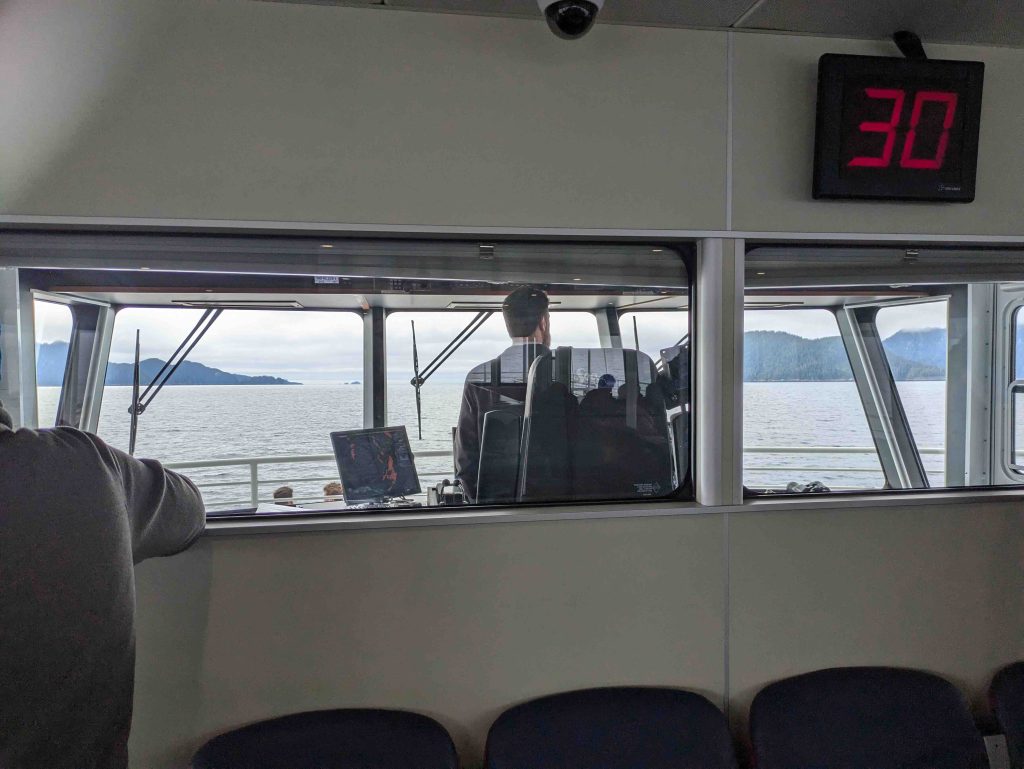
The captain continued, “As we travel over the next few hours, there will be things we spot along the way. To make it easier to reference the direction of the sighting, I’ll use clock directions. So 12 o’clock means looking straight ahead, 3 o’clock is to my right, which is also called the starboardside, 6 o’clock is behind us, and 9 o’clock is on my left or what we call the portside.” The captain was sitting in a glass-enclosed cabin on the second level (technically called seconddeck), which gave him an elevated view of the waters – the place he sits is called a wheelhouse. The perimeter of the boat on all floors had a railing – so when you stood outside, you had something to hold on to. The boat set out, taking a path to exit Resurrection Bay.
“And there we have our first sighting of the trip. The bald eagle at 1 o’clock.” It was visible from inside, and we were able to get good shots without stepping out. It was perched on top of a pipe in the harbour.
“We’ll slow down to get a good view of it.” Moorthy got a good snap on his pro cam. It had been just a couple of minutes since the boat had begun moving. “This is a glacier cruise, but along the way, if we get to see wildlife, we’ll slow down to spot them in their natural habitats.” “Now, the bald eagle is native to the US. What makes them amazing is that they have great eyesight, a lot more powerful than ours. They have two retinas in each eye. Lately, I’ve been wondering about perspective, and the bald eagle has a 340-degree field of view. Perspectives differ based on your viewpoint.” The captain went on a little philosophical note on perspectives, which I found a little odd – didn’t really gel with the narrative, and maybe, this was just a little too soon in the trip to talk philosophy. Anyway, within a minute or so, it seemed like the bald eagle was aware that many eyes were looking at it, and it took off elegantly.
A few minutes later, the captain mentioned a sea otter. “You can see it in the water. Goes in and comes up. I’ll slow down a bit, while you all can take a look.” This was not easy to spot; I stepped out and picked up a pair of binoculars on the way. The door was tight, and you really had to put a lot of force to get it open, and once open, it would snap shut quickly unless you held it. Outside, it was a little breezy, and I tried to focus the binoculars in the direction of the sea otter – it was quite a sight; it was like the sea otter was playing in the ocean! The binoculars gave an amazing view of the animal.
The binocular model was the Nikon Aculon A211. It gives you an 8x or 10x zoom. Many people stepped out; some with pro cameras trying to capture a shot. I gave up on taking snaps since there was no way my phone’s zoom would capture this. Moorthy did manage to get a decent zoom on his iPhone from inside the cabin. “You guys should get the binoculars. Check it out.”
Inside the cabin, on a wall, there were posters with details of marine life in the Seward area. Sea otters apparently eat up to 20-30% of their body weight daily!
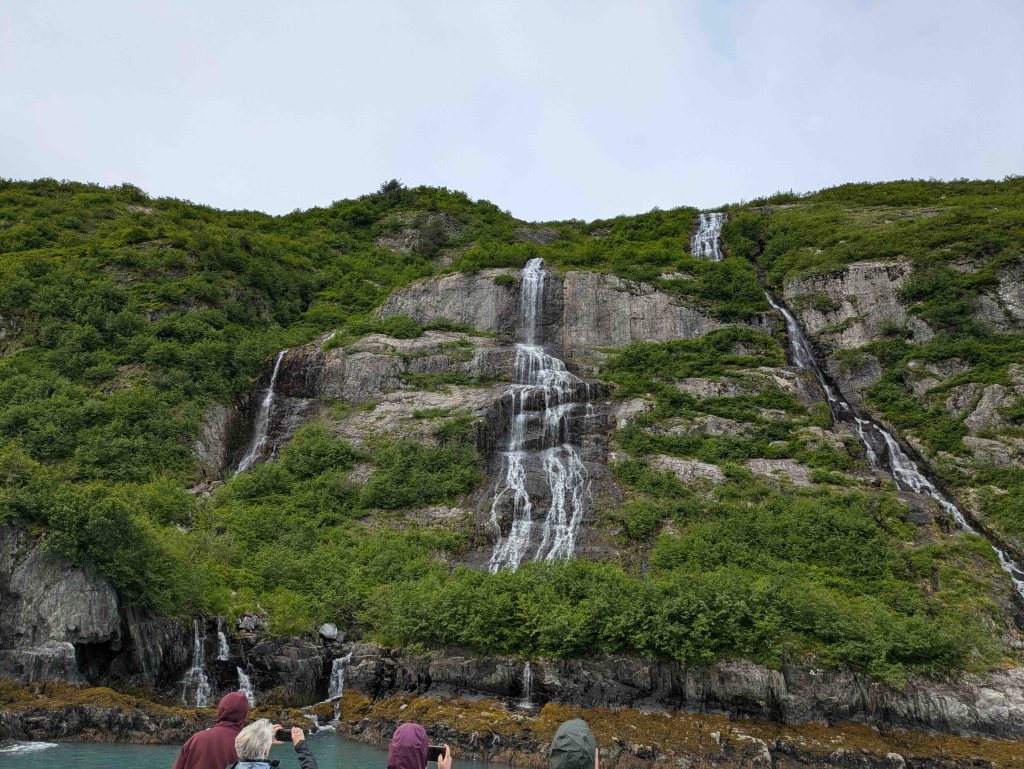
There was a scenic cliffside view along with a waterfall on it, and then, we came across a harbour seal that was stationary – in fact, it was like a white puff among the rocks. “Harbour seal on the port side.” Outside the first deck, there were extra railings to hold on to, in case you didn’t feel comfortable holding the railings on the edge of the boat.
CliffCan you spot the seal?
“Harbour seals can drop their core temperature and dive deep into the sea. They may not move elegantly on land, but they make up for it in the sea.” They can go down some 500 meters and stay underwater for 20 minutes. “They can swim through the waters pretty effortlessly.” Though the waters were fairly calm, as we motored along, you may still feel a rocky motion, and you may not feel stable without holding on to a rail or some support.
One of the seals was lying down on a solitary rock, while a couple of others were on the coastline nearby. We had a little booklet that described the route we’d take and listed some key wildlife and birds we might see along the way. “Already seen 3 listed here,” I commented. The last page of the booklet described the 4 cruise options. “The 4-hour cruise just goes around the bay.” That was the shortest one and was meant to view wildlife alone. The 6-hour one onwards were the ones going to the glaciers – there were 3 of them; in our cruise, we’d get to see one.
Wildlife to spotThe cruise options
“Starboard 2 o’clock. Mountain goats.” We ran out again to see if we could spot the goats. This was quite a struggle to spot – these are white. “The main reason I respect them is that while most of our animals migrate, these are one of the rare few that do not migrate or hibernate.” They live on the steep cliffs on the coast. Moorthy felt he saw them, but I still couldn’t; eventually, I did spot it thanks to all the other people on the deck, some of whom had powerful zoom cameras, and looking in the direction they were focusing on helped me spot them – there were a couple of goats facing each other, extremely still, and appeared like a couple of cotton balls! You’d think it was an inanimate life form unless you knew what you were looking for!
“What you see at a distance as we pull away from Resurrection Bay is the Bear Glacier. This is a massive expanse of ice. The only ways to reach Kenai Fjord are by boat, plane, or kayak. It is hard to hike to get here.”
(Note: This is a one off edition of a weekend trip in India – to continue with the Alaska travelogue, you can jump ahead to the next page)
I had entered a room that got locked while I was searching for something I had left behind. I noticed through the window that we were going down and the water level was rapidly rising. Still no water had entered the room, but just then, I heard a creaking sound as if some structure was about to cave in. Will the water rush in?
And that’s when I realised it was a dream – thanks to Ajay and Bala who arrived 15 minutes early on Sunday morning and woke me up.
Quite ridiculous our dream setting seems once we wake up – a room falling! But it did feel quite real while I was in the dream!
The trigger
It was a planned trip in terms of the date (Sunday) and the 3 folks who would travel, but everything else was unplanned – and since it was just a two-hour drive from the city, we didn’t think much about it. But on Saturday evening, while talking to Udhay, he asked, “Have you booked a boat?” “Bala planned to take one there.” “But you won’t get – it will be a hassle.” Thanks to Google, Bala found one, and they told us to arrive by 6:30 am. Since Udhay was free on Sunday morning, he also decided to join us. And then Udhay mentioned, “There was a boating accident there, and 20 people died.” Bala said that the lake is shallow and we can wade through it – so we shouldn’t need life jackets. But he also said he remembered there was a news item about this accident ago. Udhay showed us an online news article from more than a decade ago. We checked with the operator if they had life jackets, and they did, but the guy said we won’t need them. At least it was comforting to know they had it.
At night, I was reading about the lake and found the list of incidents that happened – the major disaster was in the early 2010s; a boat with 25 people capsized and 22 drowned – the reason cited was that too many people were on the boat, and also that on the return journey, many members went to one side of the boat, causing it to topple. Boating was banned after that incident. Following that, there were a few incidents in the late 2010s, one being a boat ramming into another boat, leading to the tourist drowning. But if you research about the depth of Pulicat lake, Google said a lot of areas are only 5 to 6 feet deep, but some spots go to 30 feet – specifically near the estuaries. Maybe we’d just be in the shallow waters, and that’s why the operator said there’s no need to worry about a life jacket? From what I read, it seemed like boating may still be banned – wasn’t sure if this was old or still in place. Oh well, will have to find out tomorrow because there were also many videos posted by folks in 2020s about their trip to the lake. It was 11pm, and I had to sleep now, or else wouldn’t be able to get up at 4:15.
Early start
Though they came early, I still took time to get ready, and we picked Udhay up by 4:45am, and off we went. Google said we’d reach by 6:16am; Ajay wanted to make a quick pit stop for coffee since his day doesn’t start till then. “We can take 10 minutes, and we’d still make it in time,” he said. We missed a large local coffee outlet (though with this outlet, it’s hard to know which one is real and which ones are a copy). But the next one we saw was a small joint called “Lord of the drinks”! A stray dog outside the joint caught my attention. It was patiently trying hard to lap up the little leftover coffee from the small white paper cup lying on the mud. After that, since it couldn’t get to the inner edge where there was coffee decoction, it managed to tear the cup and then lick off whatever was inside. Very often, we don’t worry about the last few morsels or the last sip that’s left.
We resumed the ride – the roads were great for the most part; this was the northern side of Chennai I had never been to before. We reached the place ahead of schedule and parked our car – there were already many cars parked there; perhaps they were folks who had come in earlier than us today.
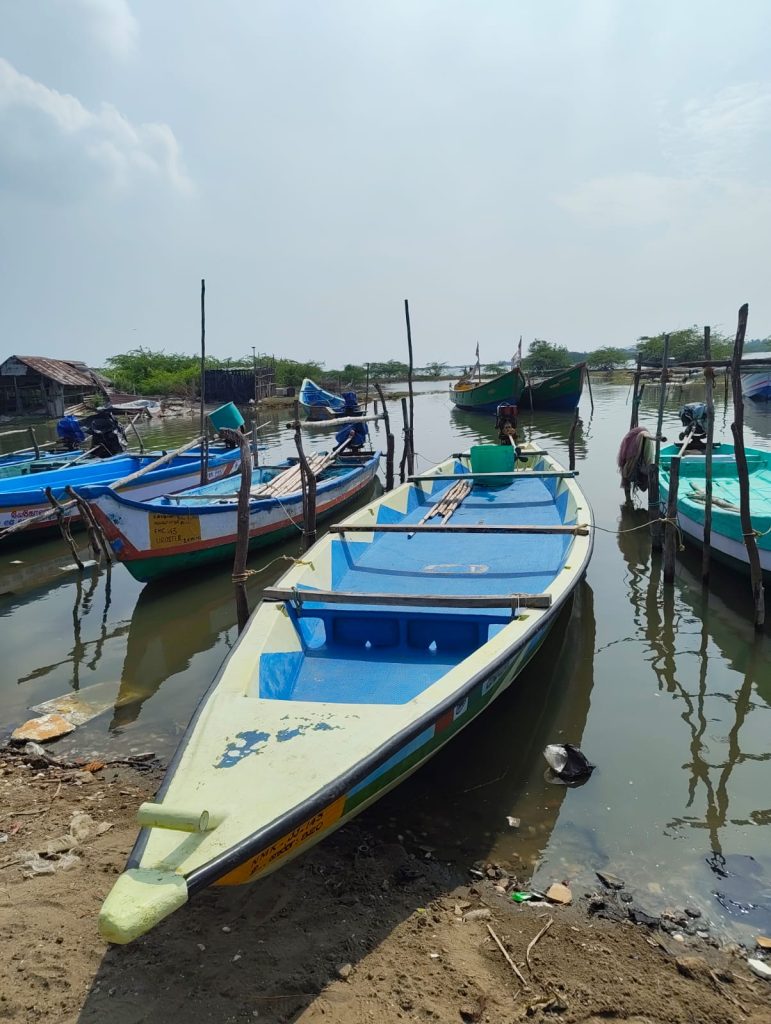
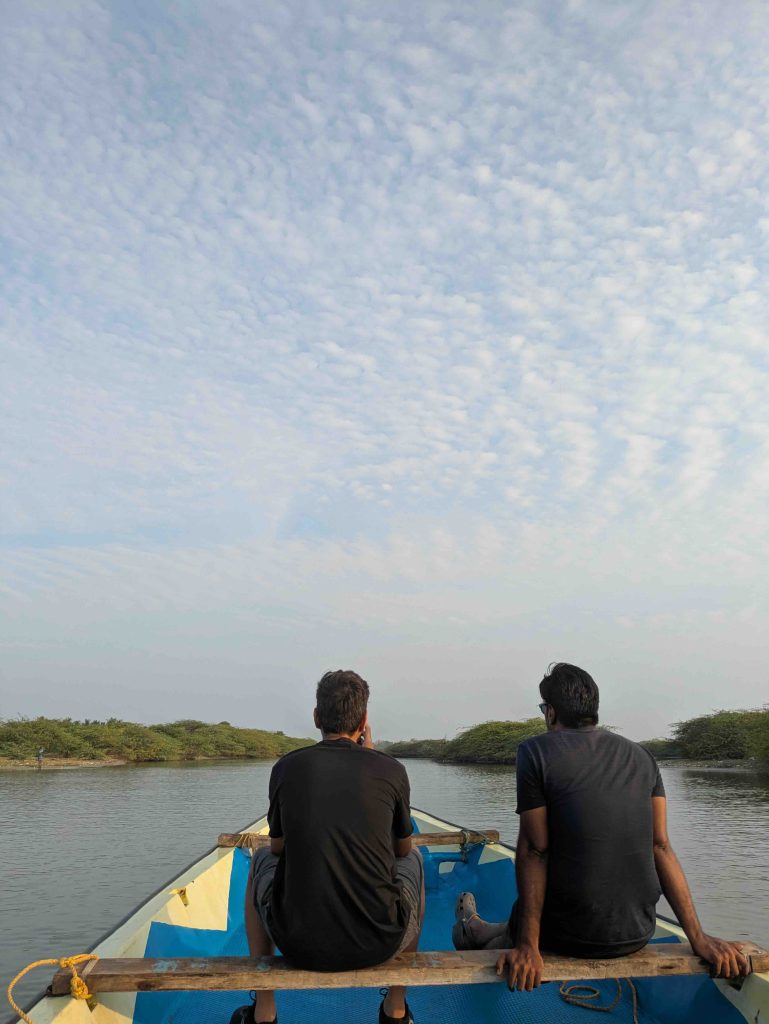
Our boatman took us to the dockyard via narrow streets after stopping at his house on the way to grab a couple of his items. His was a long fishing boat with a diesel motor on one end; from here, there was a long metallic rod which had a small propeller. This boat is a typical fishing boat you see in India – there are planks placed on the boat on which you could sit. “We won’t go into the deep waters, right?” I asked. “Deep waters are everywhere,” he replied. Alright, Google was then wrong! He loosened the ropes tied to the anchoring sticks and then tugged on a cable to get the engine roaring. As we started out, we saw a couple of boats filled with people returning, and their faces did look a little glum. We wondered if they found the ride disappointing, perhaps?
(click on the images to enlarge)
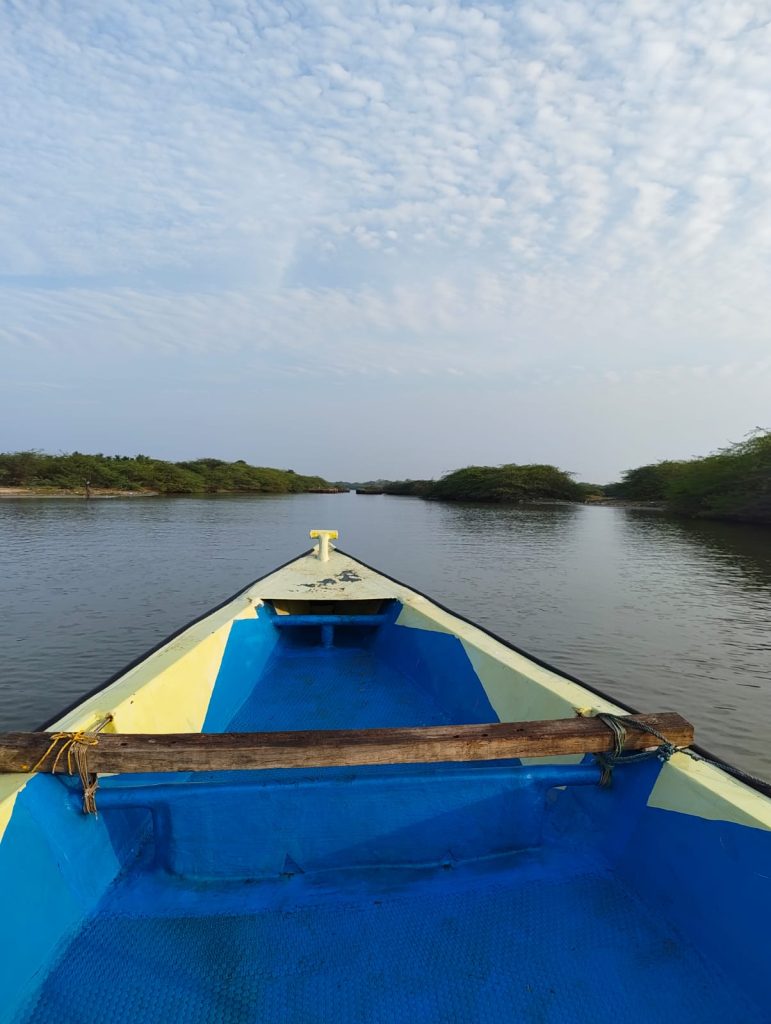
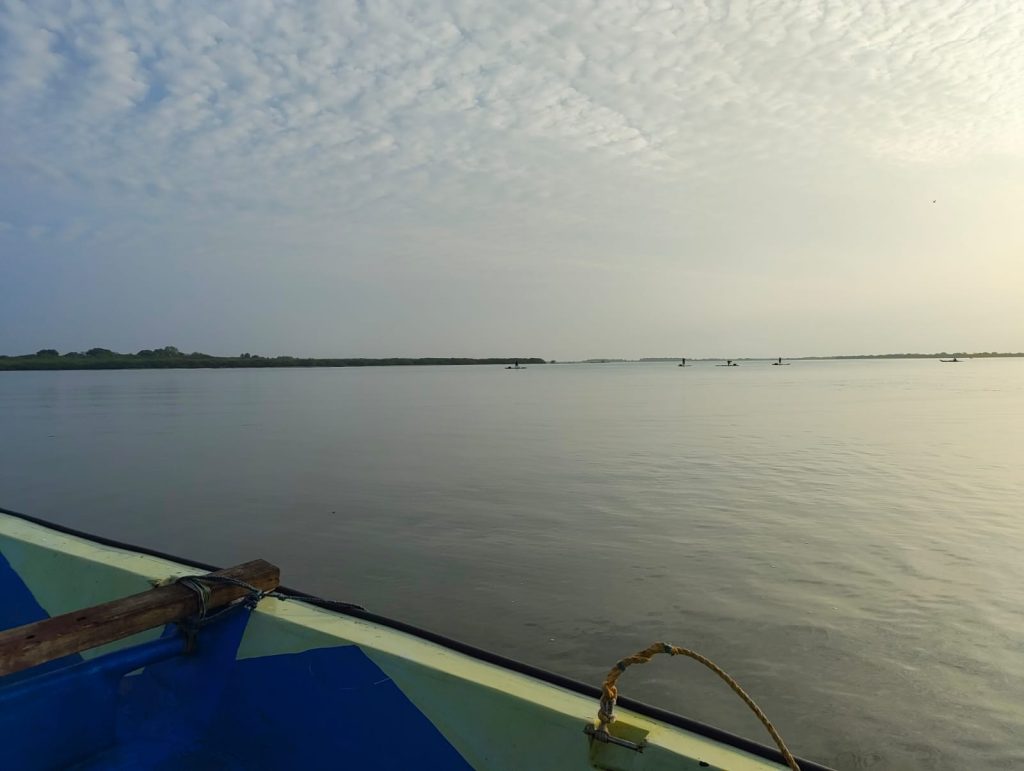
BoatHorizonThe seats
The seats on the boat are the wooden planks. Bala did find this a little painful on his bottom and our boatman added a second plank to make it easier. You can adjust the way you sit and you shouldn’t have much problem; you could also sit on the floor of the boat too. In some of the boats returning we saw people sitting on the edges of the boat as well – need to keep it balanced at all times though.
We went and went and went deep into the backwaters – the sound of the motor making it hard to have a conversation. Bala had told the boatman that we had come for the birds, and so, in between when Bala wasn’t looking to his right, the boatman signalled to a greenish bird perched on top of a stump rising above the water. “With this noise, the birds won’t come,” Bala said.
There were plenty of small white buoys floating, which I thought were perhaps some navigation aid?
The gang
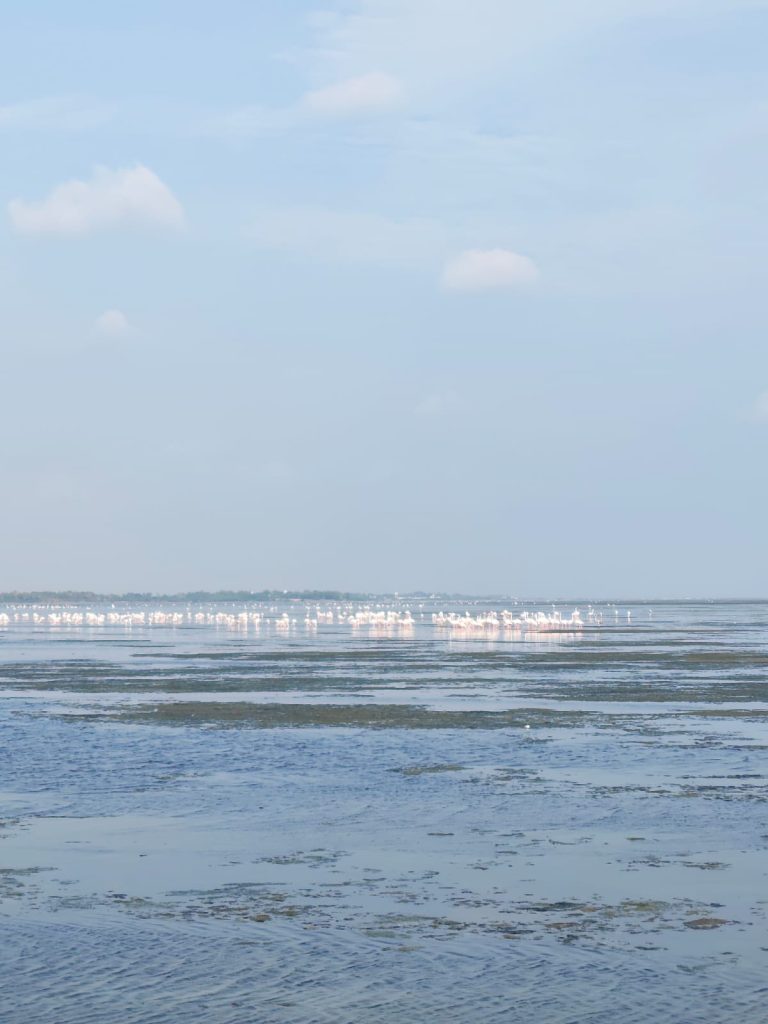
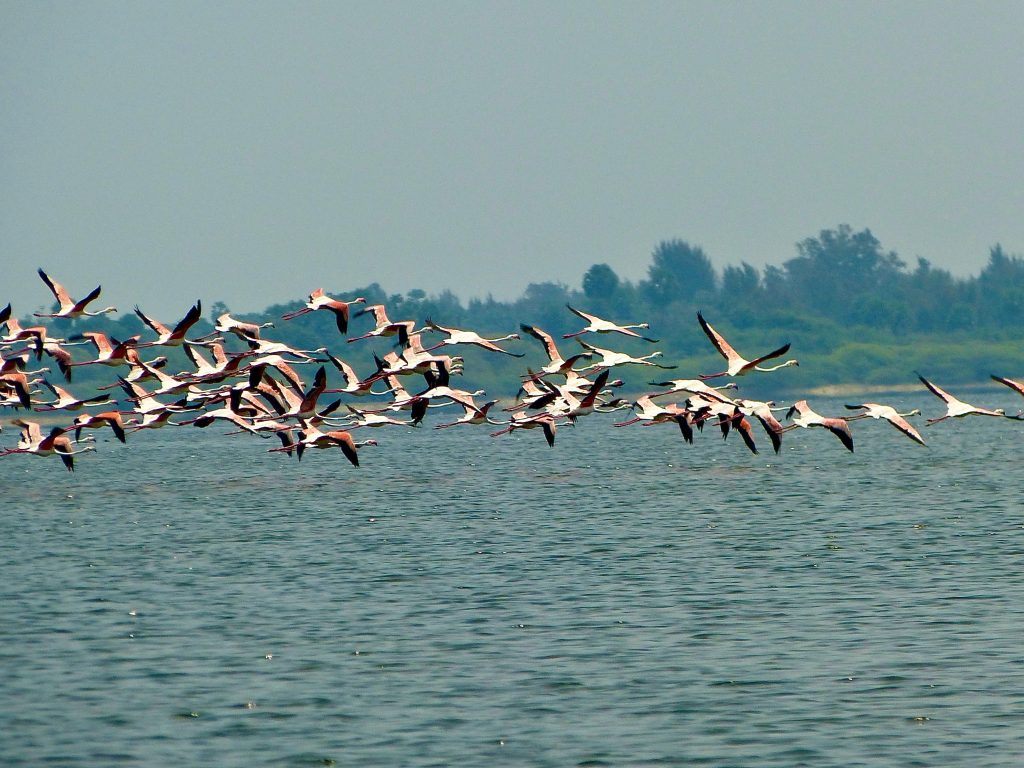
After a few minutes, Bala spotted something miles away. He passed me his heavy Canon camera with the lenses, asking me to take a look. “The flamingoes are there.” I could see that he had captured shots of them on the viewfinder screen, but when I looked through the lens, I couldn’t see anything. I tried a couple of times and then figured that it was out of focus for me – I played with the zoom lens, and lo and behold, there they were – a large gathering of flamingoes.
After travelling further, the boatman switched off the motor. We must have travelled for more than an hour. “The water is very shallow,” Udhay said. We could see the floor just about a foot under, covered with algae.
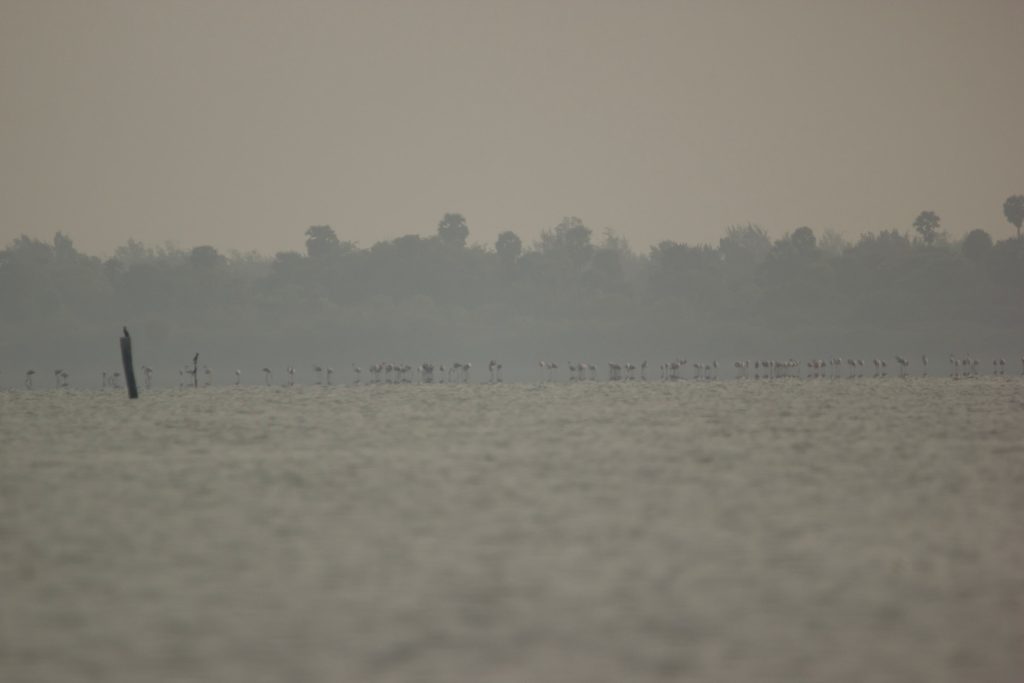
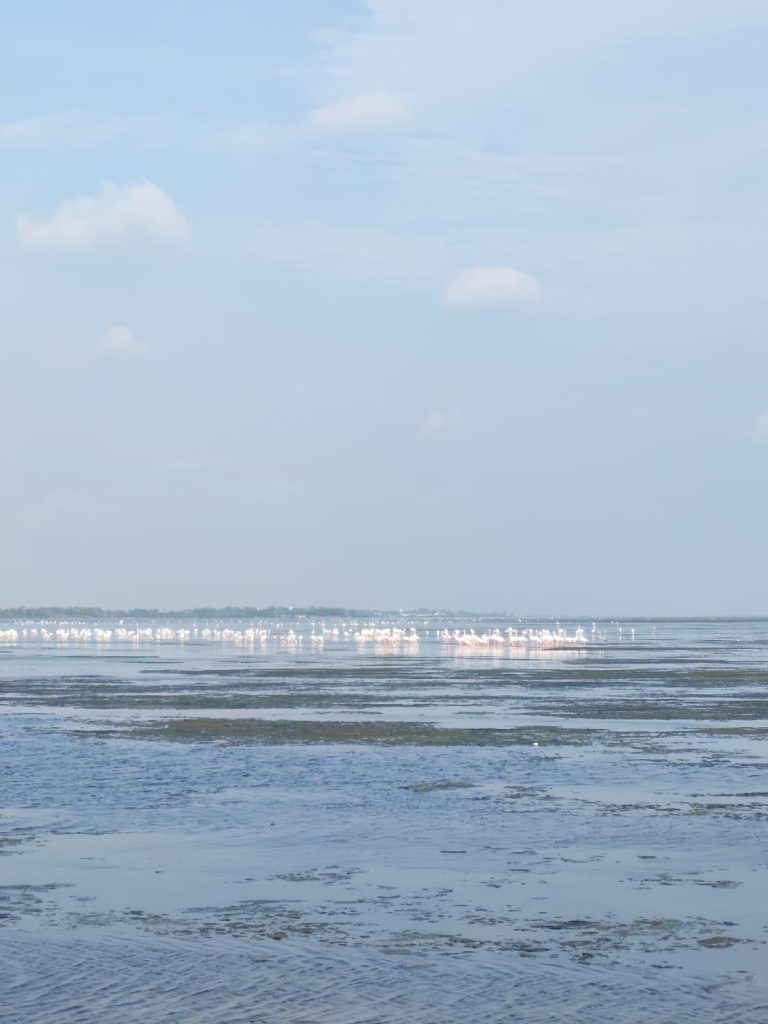
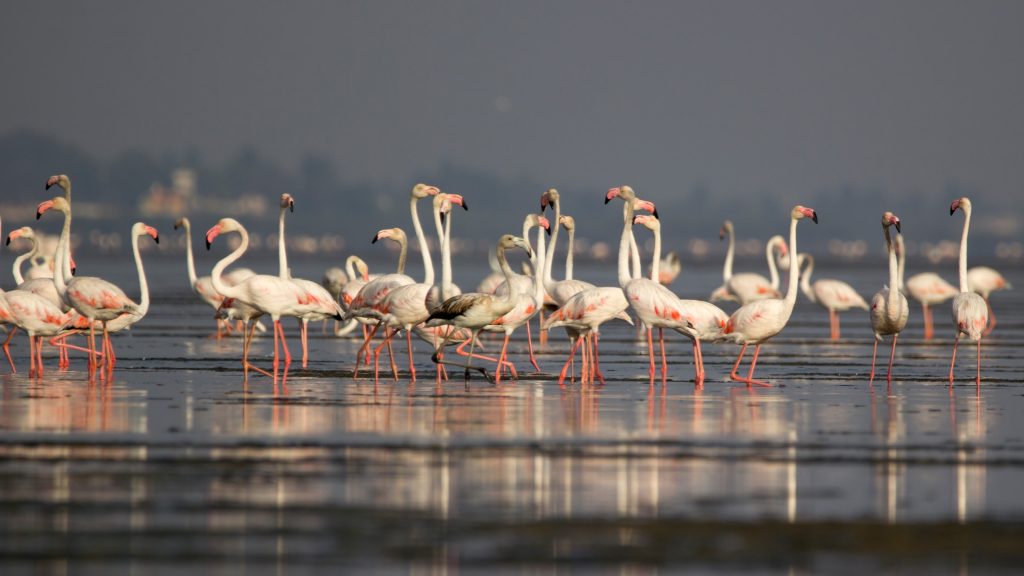
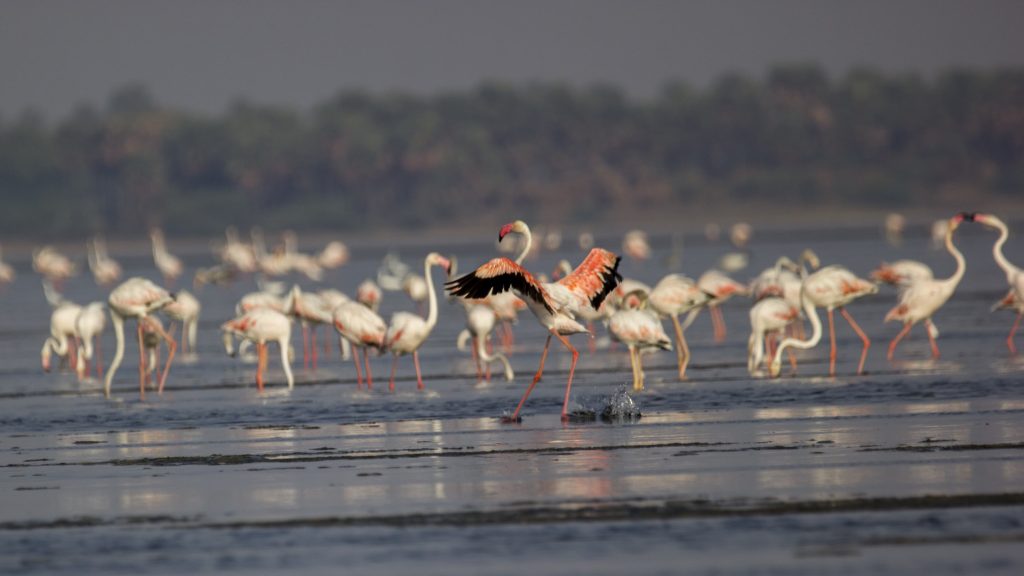
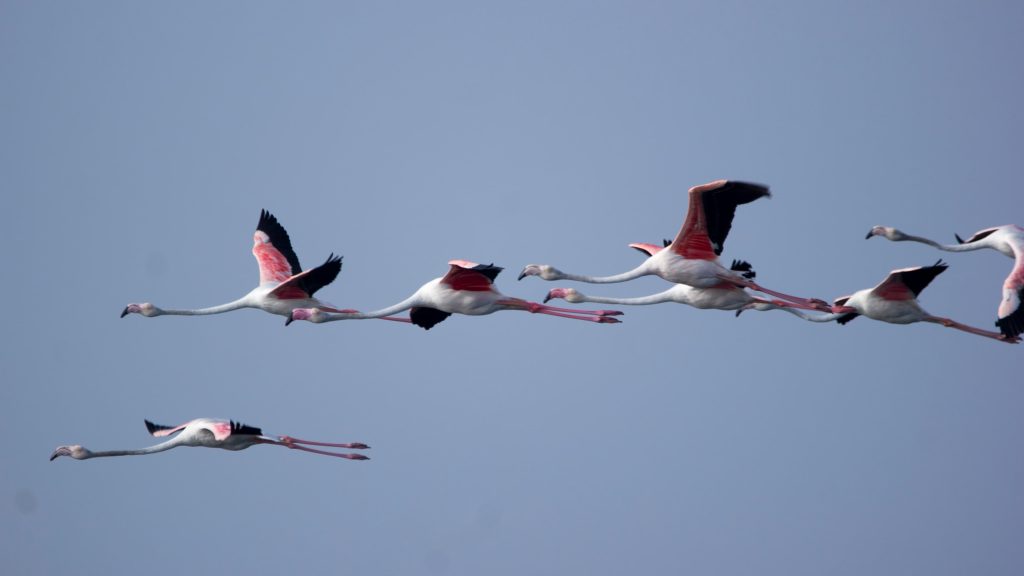
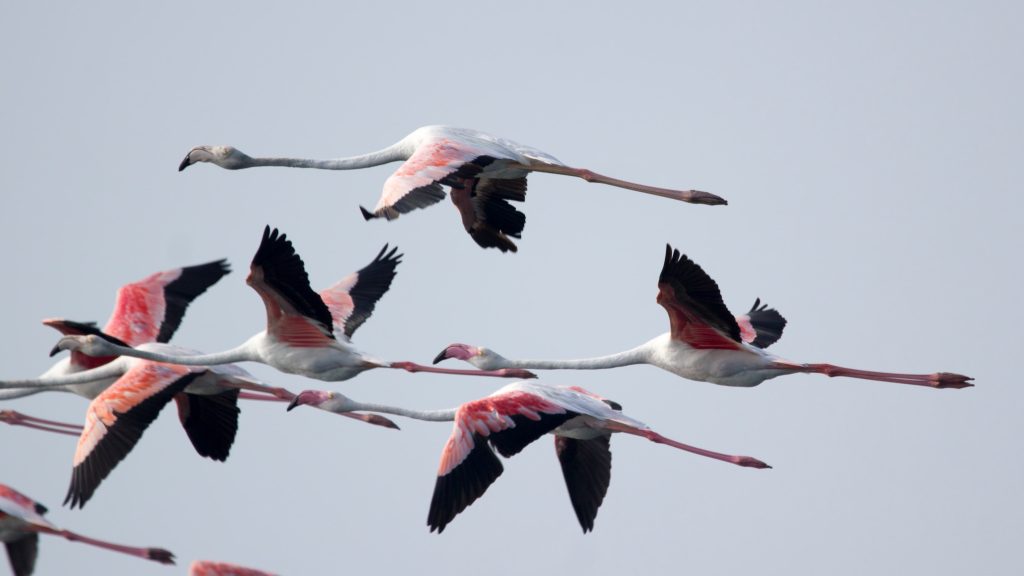
There was silence – just the sound of water flowing slowly around us. And up ahead, we could clearly see the flamingos without the camera – there were plenty. Using the camera, we could see them even better.
From far awayFrom a distanceSlightly closerThe flockOpening up
Udhay and I had a conversation with the boatman while Bala was trying different angles to get good shots. “Have you been here for long?” “All my life I’ve been here. Was born here.” “Do you do fishing or just the boat trips?” “We do fishing, but now is not the season – best time is late in the year when there are rains, and that time there are a lot of fish. Now it’s hard. So we do this boating guide work to help with our income.” So the operators have different customisations that you can do – just bird watching, or you have a boat ride and then a cooked seafood lunch in one of the islands, or even night camping. There are some 36 villages around this lake.
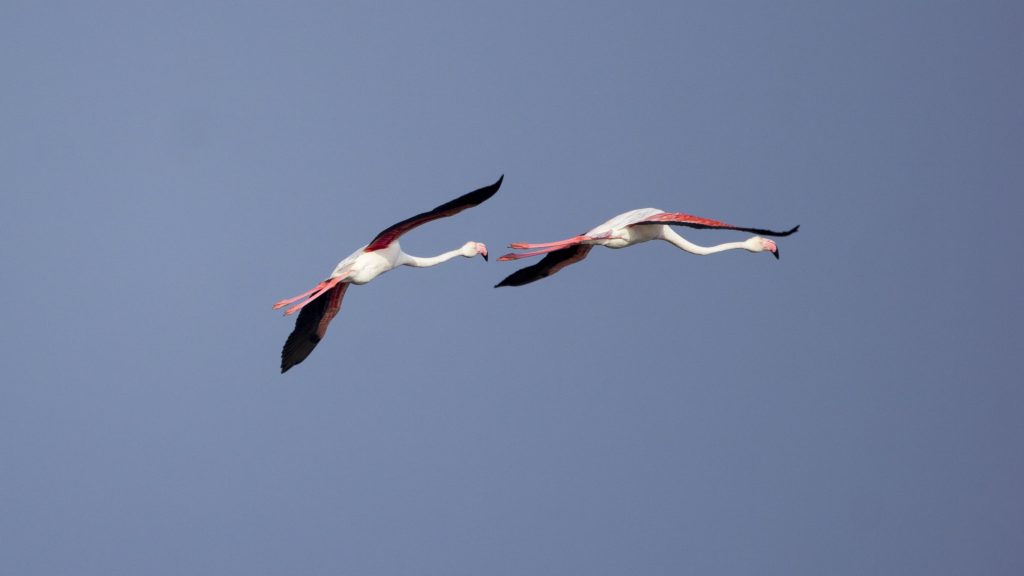
Udhay got into the types of fish they catch – we discussed freshwater shrimps and backwater shrimps; people pick freshwater shrimps since they look brighter, but the backwater ones taste better. He described how fishermen shine a bright light on the water, which freezes the shrimp, and then easily trap them. “You can go to the front of the boat,” the boatman advised Bala, for getting better shots. Just then, there were a couple flying as well, and you could see their black wings.
Enjoying the silence
He explained about the nets used in fishing – the natural fibre ones vs the plastic ones. The community doesn’t like folks using the plastic ones since they can bring a large catch in one haul vs needing multiple hauls over a few days with the natural ones – what this does is also deplete the fish quicker, and that in turn forces them to go further out to fish. And the large haul will end up depressing the market price, and that impacts all the fishermen on that day, just because of the few that use the artificial nets. In fact, he said there was once when the prices went down to Rs. 20 per kg because of someone who pulled in a huge haul; but he knew that selling at that rate was a significant loss for him (just the diesel cost spent on his boat ride was more), and he dumped his catch back in the waters vs selling. The reason for the higher haul? Likely because the plastic ones are a lot thinner and maybe harder for fish to spot.
“End of February to October is the season for spotting flamingoes,” the boatman replied to Udhay. Bala mentioned, “The flamingos come from Gujarat to here for the summer.” “Since a lot of the shrimp catching is done closer to land, this area of the flamingos is undisturbed. Otherwise, if there is noise, they will fly away. That’s why even when we come this side, we speak in a soft tone.”
After quite a while, we decided to move, but after starting the motor, Udhay asked, “Can we stay here for a little more time?” We were all ok and so was the boatman. “Shall I anchor it here or just leave it?” “You can leave it.”
We enjoyed the silence of the sea. With the elections just having concluded, it was natural for the topic of politics to come up. How people he knew were upset with some schemes that were withdrawn or modified by the prior government, which negatively impacted women in their communities. We hadn’t heard of this in the city, but it was an interesting observation. It also seemed like perhaps there was more done in the city vs these areas. The locals refer to the town as Pazhaverkadu and not Pulicat
Displaced fishermen
“We have to go in that direction for our return,” I said. And Bala said, “No – it’s that way.” The boatman corrected us – we were definitely lost with the direction. “Do you know how far we’ve come from where we stopped?” he asked us. “We moved?” “Yes – we stopped there. About one kilometre we’ve drifted.” None of us realised that we were even moving slowly with the waves!
“If we go one hour in that direction, we’ll reach Sriharikota,” an island belonging to Andhra Pradesh that is famous for rocket launches. Andhra Pradesh is located above Pulicat.
“From here you see land at a distance. The further we go, on all sides there will only be water.” He narrated a story of 3 folks who went to the sea for 3 days to fish, carrying with them even a small stove so that they could cook. “It’s riskier, but you can get more fish. Over here, if there’s a storm, then if we traveled only one hour from land to fish, we can get back home. In the sea, you have to manage dealing with the storm.” He talked about the strategy with anchoring and having to run the motor at a low speed to deal with the storm. “Those people got stuck in a storm. And after a while they had to use the heat from the motor to cook the fish for eating. They waited in the boat for a few days. After the storm settled, they thought they would have drifted to Andhra Pradesh.”
“They got off the coast and discovered they were in Bangladesh!” With no money in hand and having to come back all the way south, they had to sell some of their nets (these do fetch a good amount of money) and made the return trip with their boat on a truck via a couple of transfers on the way. “When they came home, they saw that people did the last rites for them!” It was natural for people to search nearby areas like till Andhra after the storm to see if they were seen, but no one would have imagined Bangladesh, and so people thought they had died at sea.
We often hear stories of fishermen from one country ending up in another one, and we could appreciate why these things can happen without the person even being aware. And these are very basic boats which don’t have any add-ons – no sophisticated equipment or communication lines to be able to figure out where they were. “Miracle that they survived and back it back.”
Don’t sleep
The boatman suddenly said, “Look there.” There were about 10 flamingos or so flying in formation and passing near us. Bala mentioned that you should never put away the camera till the end, since you never know when an opportunity might arise – but he had gone against his own advice and put it in his backpack a little earlier! He quickly pulled out the camera, attached the lens, and managed to snap pics of them.
On the return, I realised what the white buoys were. The buoy was attached to a rope, which was attached to a fishing net where fish got trapped. The fishermen would take out the catch, and then toss back the buoy with the empty net back into the water – periodically, they went around checking the nets.
The boatman said, “We had a few youth partying, celebrating, and creating a lot of noise recently. Some of them were high, and one person fell into the water. Unfortunately, the propeller struck his head, and he died instantly.”
This wasn’t a news item that cropped up when searching about Pulicat lake; so potentially there have been others which weren’t reported widely. The topic of death led Udhay to ask about the 22 people tragedy. “It wasn’t a fisherman who drove the boat that day, but instead a person who used to unload fish from the boat,” and then he went on to explain some of the mistakes that happened. And the sad tragedy of having to carry a 3-year-old kid’s corpse.
Remembering the incident, I tried to stay awake on the return drive. But I still dozed off very briefly a few times. The clouds had parted, and the sun was blazing down on us for about 30 minutes. In an hour, we were back where we started.
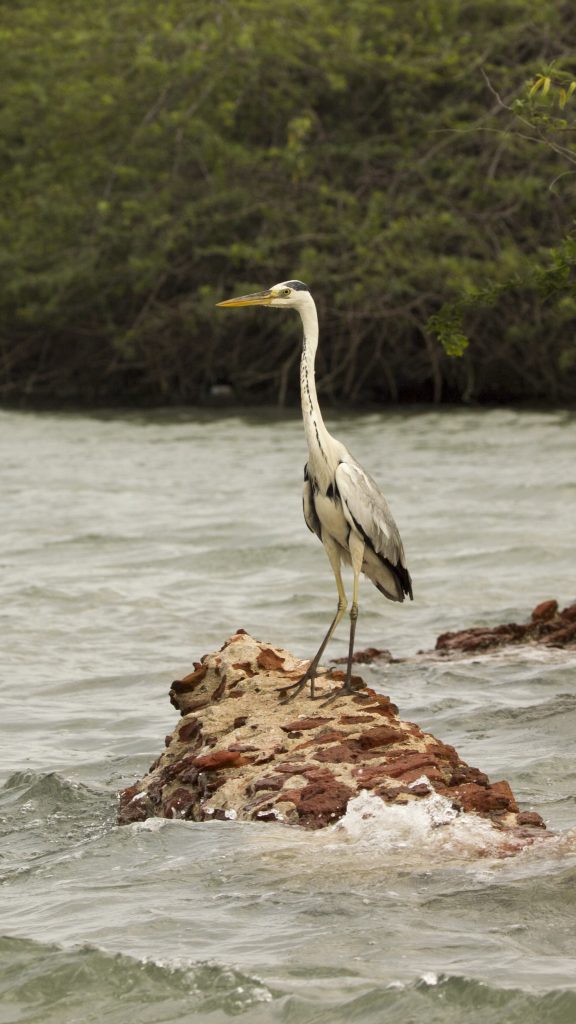
Some of the other birds that we spotted as per Bala – terns, pelicans, egrets and cormorants.
This is an area that could have been developed into a proper tourism spot with controls to ensure the birds aren’t disturbed, enforcing safety requirements, facilities like restrooms that tourists would need, but the boatman said that some 3 departments were fighting it out regarding who was responsible for the lake. So is boating banned? Not really sure – there were some old news articles that said there are boards saying it is banned, but we didn’t spot any.
If you like going out to the middle of the sea and enjoying the silence, you’ll definitely love this boat ride. It’s not the typical short ones we see in many places in India.
Added to it, if you have a local boatman, it’s interesting to hear about their life stories; stories from the fishing community that many of us would never know about. We discussed details of fishes, how the fisherman get paid a tiny fraction of the price the fish sells for in Chennai, families living around the lake, how they manage during the off-season, environment, how the communities need to stand together so that they can all get benefits vs independent folks going against the others, how other groups who weren’t fishermen also started to enter the business, that there is an official registration for boats, how they got covered during the year-end hurricanes for damage and how the community pooled in the money they got and redistributed it among the families to ensure everyone got something etc.
If you do plan to go, some pointers:
– Book the boat at least a day earlier after doing some research; do insist on life jackets. From Chennai, this is a nice half day trip (if you do lunch over there, it will become a nearly full day trip) – Based on your interest, customize the schedule when booking with the operator – there are a few things which you can mix: boating, bird watching, camping, seafood lunch. – It helps if you carry a pair of binoculars on these trips if interested in wildlife – there’s a lot that you can spot with clarity. – Carry some food and water on the boat (especially if you are doing the long ride) – The restroom we used was in the boatman’s home – no restrooms on the boat. – Early in the morning is better; you don’t want to be out there in the middle of the heat.
Morning was a bit of a rush with all of us getting through our bathroom routine and preparing to leave. There was only 1 bathroom, so we had to take turns.
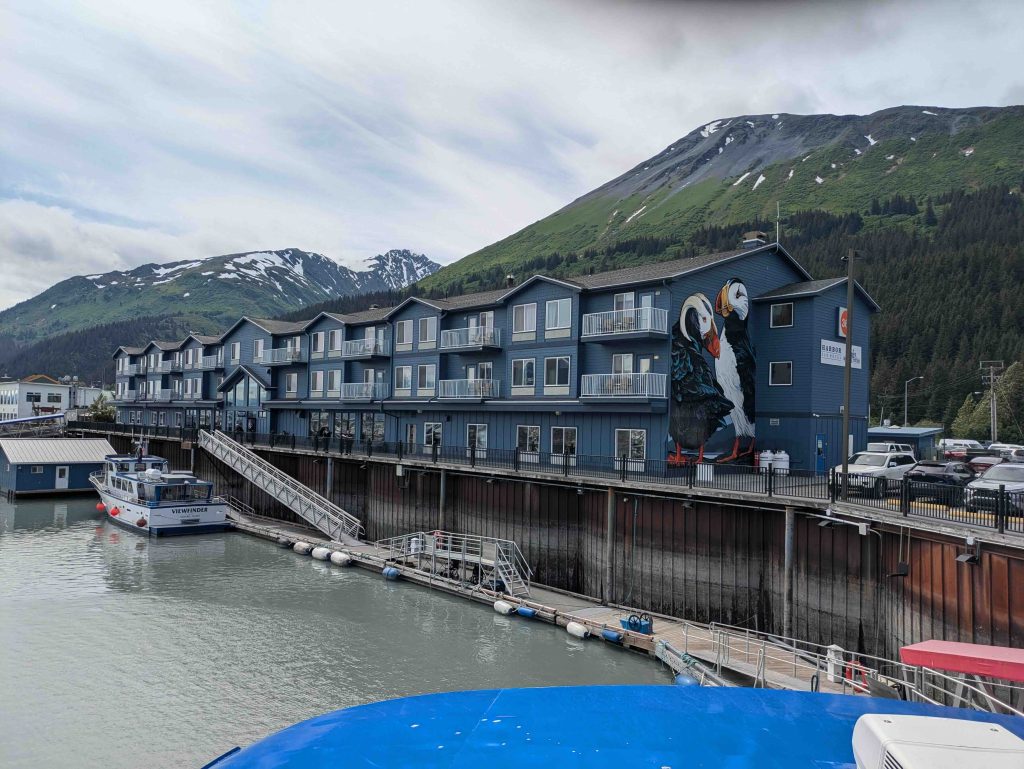
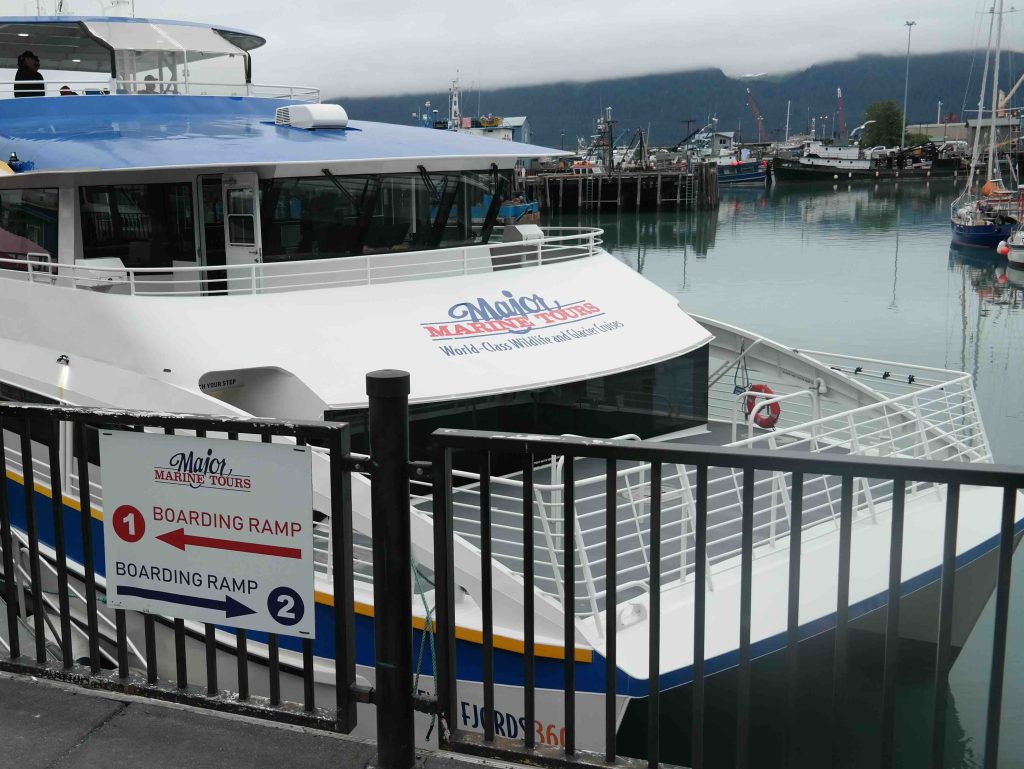
We arrived at the Harbour 360 Hotel at 7:35 am; this was the check-in location. While Moorthy and I were checking in, Rakesh and Raghav wandered around the area to pick up coffee. The staff directed us to the exit door. Basically, the backside of the hotel led to the harbour area. We were allowed to bring our own snacks on the boat – so I had a bag with our onion rings and chocolate chip cookies. There were signs directing us to the “Major Marine boarding ramp.” We could see people in the hotel having breakfast; later, I found that the Harbour 360 hotel is owned by the same tour operating company. “You can go to the ramp number 1,” the staff had told us. There are some 4 cruise choices – variation was the route they took and the time duration. We had booked the 6-hour cruise. There are also 4-, 7.5-, and 8.5-hour cruises. As we got to the ramp, we could see our boat – it had 2 levels for indoor seating and a third level that was like a terrace with a roof on top. We were also given a table number on check-in.
Official pic of our boat
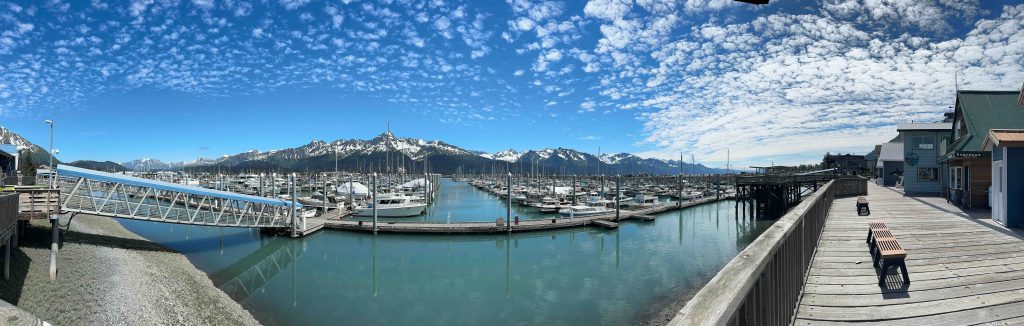
Moorthy and I took some snaps of the dock. There were so many boats in the still water. It was a cloudy morning. We saw people boarding the boat – there was a lady staff member at the entry point, validating tickets against a list before letting people through.
The dock
It was 7:45 am, and our boys were still not back. Moorthy gave Rakesh a ring, and he said they’ve placed the order and should get it soon. He gave instructions on where to come to, so that they could get here quickly. 5 minutes passed, and still no signs. “Let’s check on the time.” We went to the staff and showed our ticket. “There are 4 of us. 2 of them have gone to get coffee.” “That’s ok.” The staff found our names on the list. “How many people are on the cruise today?” I asked. “We have 102.” “Everyone has come?” “Not yet – right now we are at 94.” This sort of reminded me of the airport check-in; you check in, and then at the boarding gate, they keep an eye on how many people are yet to board. As the flight nears take-off time, the staff go around checking if there’s anyone else waiting to board. I was trying to make some small talk with the staff till our boys arrived, but still no signs. And then I saw a family of 4 heading our way. “Now I think we are the only ones left.” The family boarded, and that meant the count was 98 – the last 4 were us. “What if they start the cruise?” I asked Moorthy. “Oh man, we’ll get in. We shouldn’t miss the cruise.” Would be quite a fun tale to tell people that we missed a cruise because of coffee! “We have coffee on the cruise as well,” the lady mentioned. “Oh okie.” “But it’s nothing fancy like what you’d get in cafes. You want to call again and check.” Moorthy gave a ring, and this time Rakesh didn’t pick. Raghav’s phone was typically unreachable in the US unless he was on wifi, and it was unlikely he was connected to any wifi in this area right now. “I think they may be on the way.”
Closer look of our boat
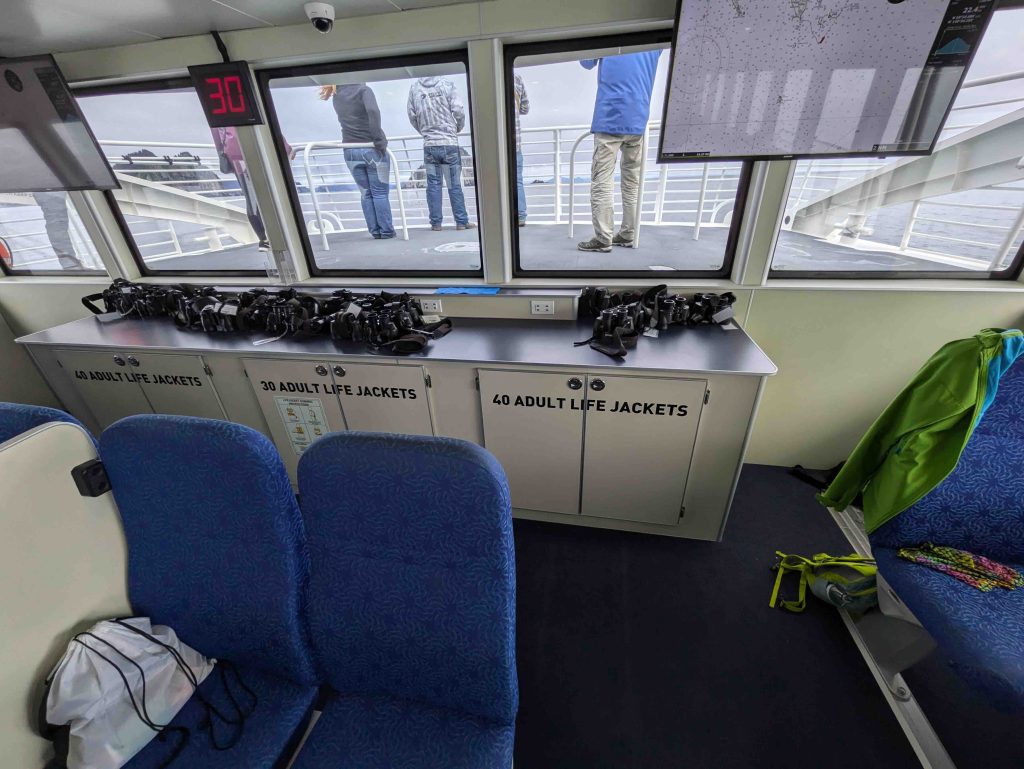
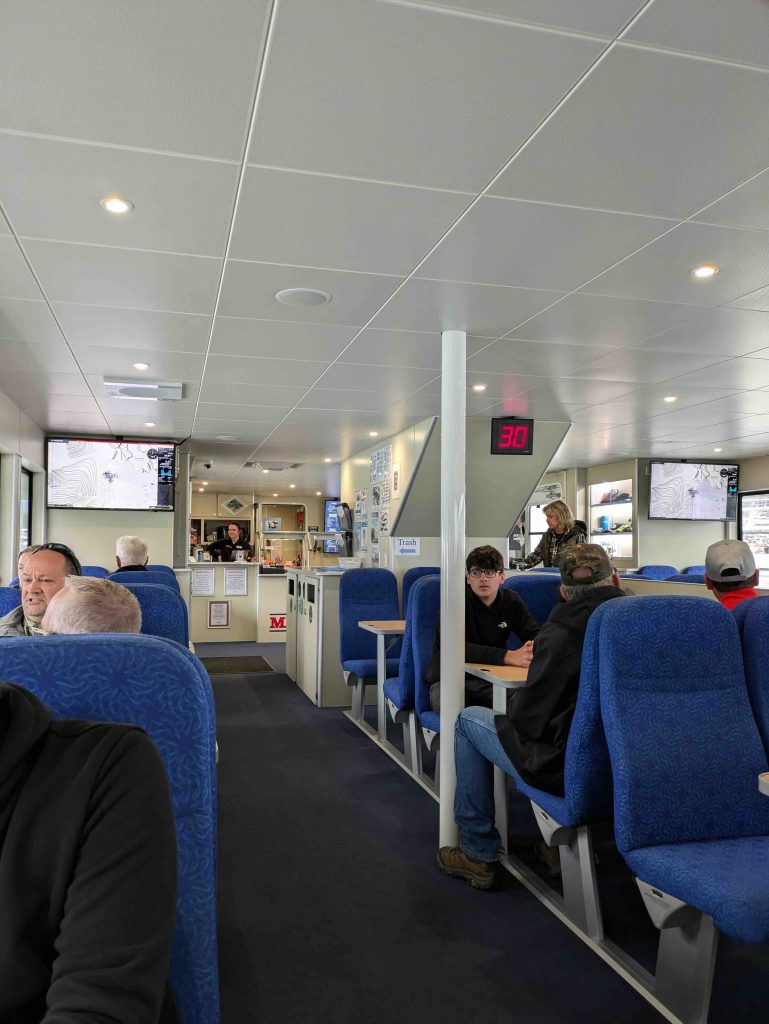
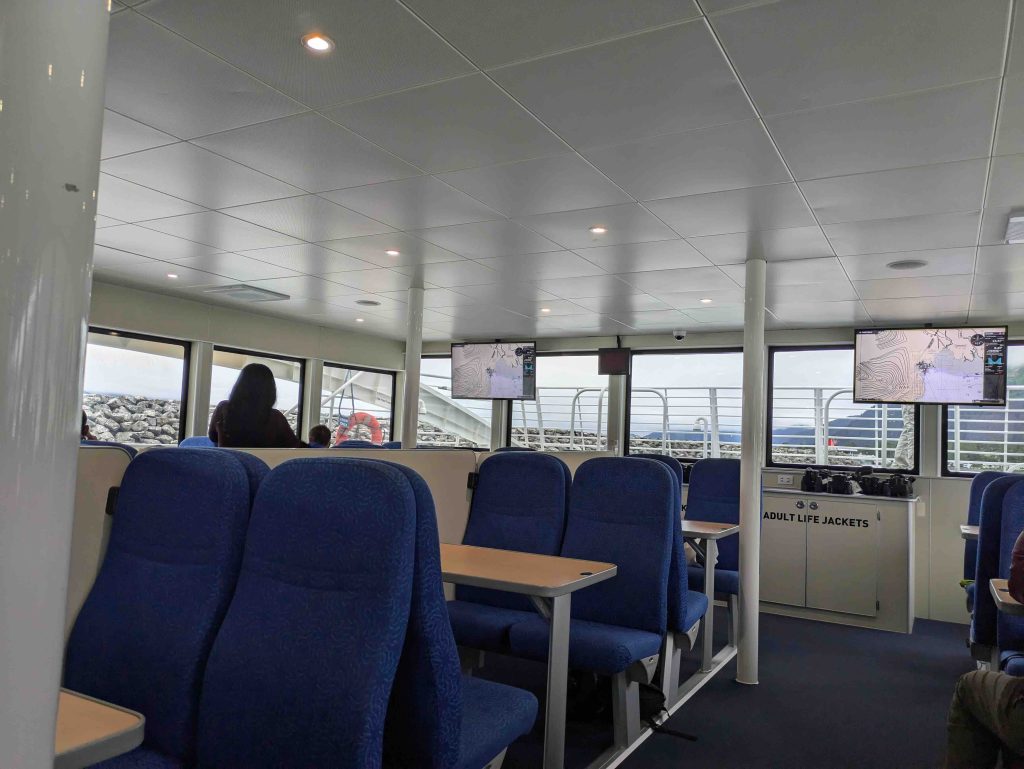
Moorthy managed to get Rakesh on the line, and he said they are on the way. “How many people can the cruise accommodate?” we continued making small talk as if that might help our cause. “Around 150 to 200 on a cruise.” The clock had touched 8am. Right now, the 4 of us were holding up the whole cruise. The staff were still patient and polite – I had the feeling they had a 5-minute cut-off. Fortunately, we didn’t have to test whether they did or not, because just before 8:05 am, we saw Rakesh and Raghav fast walking towards us with 3 cups of coffee in their hands. “There they are – the two of them.” “Ok.” And quickly boarded the cruise boat and got onto the deck on the first level – there is an outdoor area along the perimeter of the deck, while the central section is fully covered. The tables with seating areas are within the indoor space. We located table number 27 and settled into our seats. The set-up was the 4-seater set-up; seats on either side of the table facing each other. And since everyone had a designated table, there was one place where you could just leave your stuff while moving around. “We didn’t think it would take that long. We even said that we had to get to the cruise, but they still took their time.” “Oh, it’s the Kaladi Brothers coffee here also.” “Yeah.” There were a few tables free near us, and I left my backpack on the neighbouring table. There was a loudspeaker system through which we could hear the captain and staff making announcements. They started with the safety briefing. A couple of interesting ones: always ensure that you have 3 points of contact when on the boat; so if you are standing outside on the deck, then both feet on the ground count as 2 points of contact, and in addition to this, holding a rail with one hand would be the 3rd point of contact. They added that you shouldn’t count holding a person as a contact point! “In case you get sea sickness and feel like throwing up, then aim for the farthest point.” They had a few cabinets in the boat where life jackets were stored. “We also have binoculars that you can use for viewing. There are only limited numbers available. So do share them and return them when you are not using them so that someone else can use them.”
The frontThe back
The binoculars were stacked above the life jacket cabinets. There were 4 TV screens at the 4 corners of our deck, so no matter which table you were sitting at, you could see at least one screen. The windows were large and ensured that, even if one had difficulty stepping outside, one could still get good views from inside. On one end, inside, were the life jacket cabinets, while on the other end was the pantry. There was also a restroom. A staircase near the pantry led to the second level, which also had indoor seating but was smaller than the first level. And, as with the first level, you had the open area lining the perimeter of the deck. To get to the 3rd level, you had stairs outside – the third level was fully outdoors with a few seats. But to protect passengers from rain, it did have a roof – just that the sides weren’t closed.
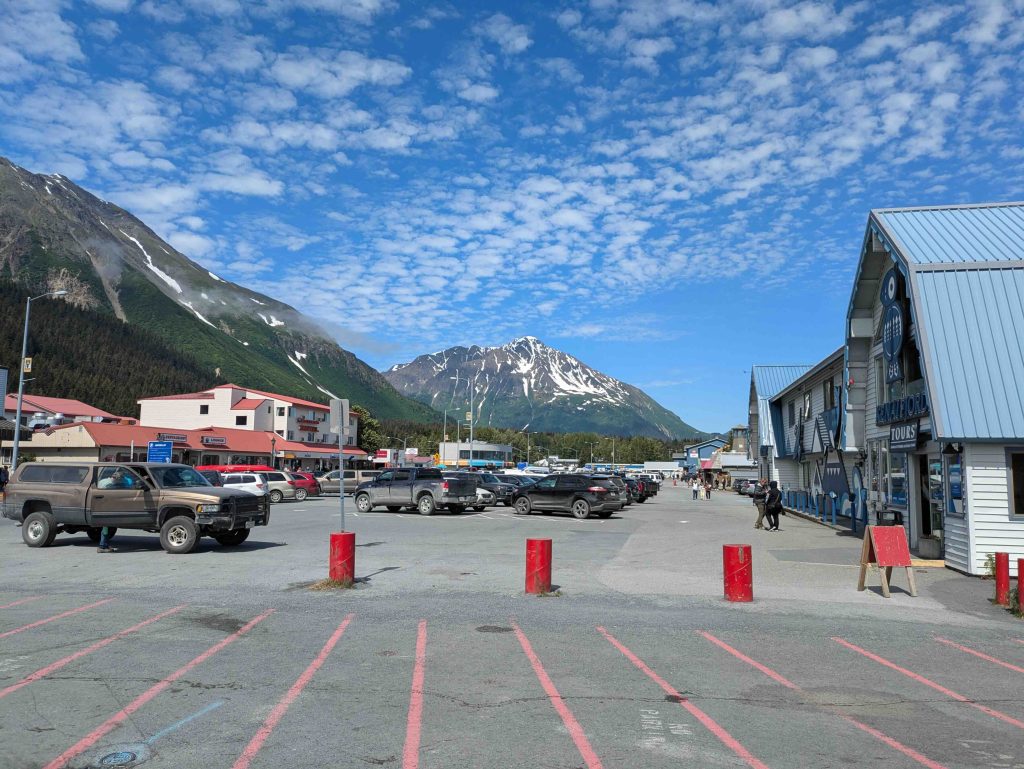
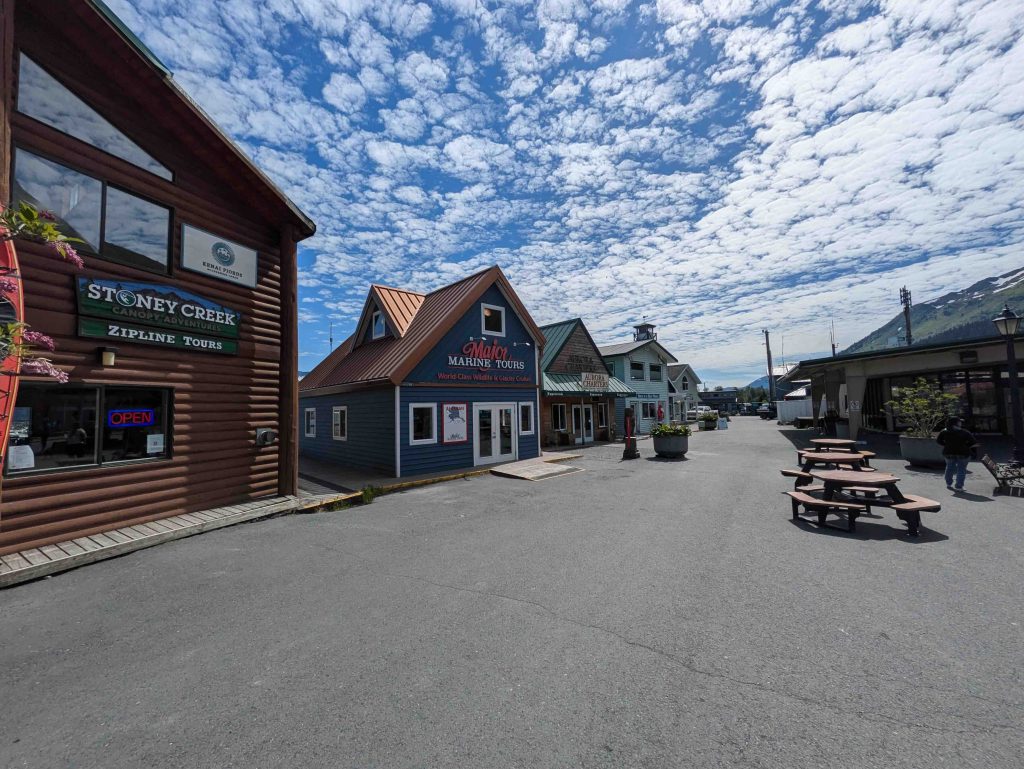
Before heading for lunch, we thought of checking out some tour operators to see if there were any other activities we could try today. The area we landed in was just beside Resurrection Bay – the water body beside Seward that connects to the North Pacific Ocean. We went in search of a zipline operator but found that this area had many activity operators – zipline, cruises, kayaking, and dog sledging. Each operator had a nice hut where they had their office – I even saw our cruise operator’s office, the major Marine Tours. We checked out a few, but the only one with a suitable timing was the dog sledge (dogs pulling you in a cart), which we decided to skip.
Our cruise operator
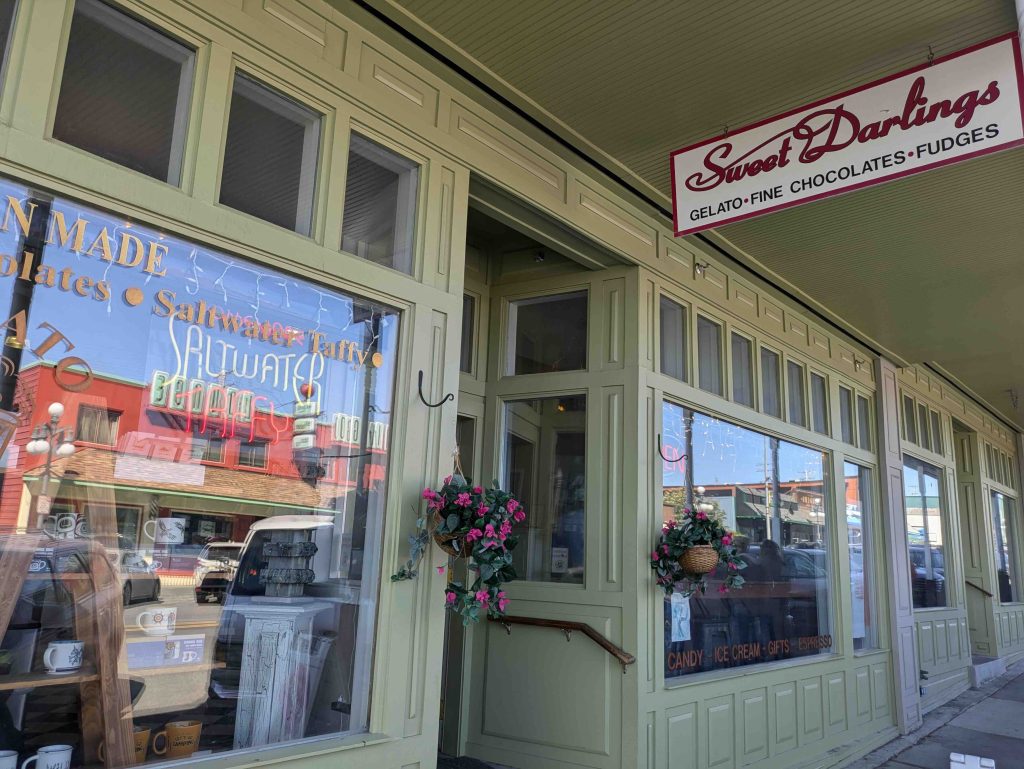
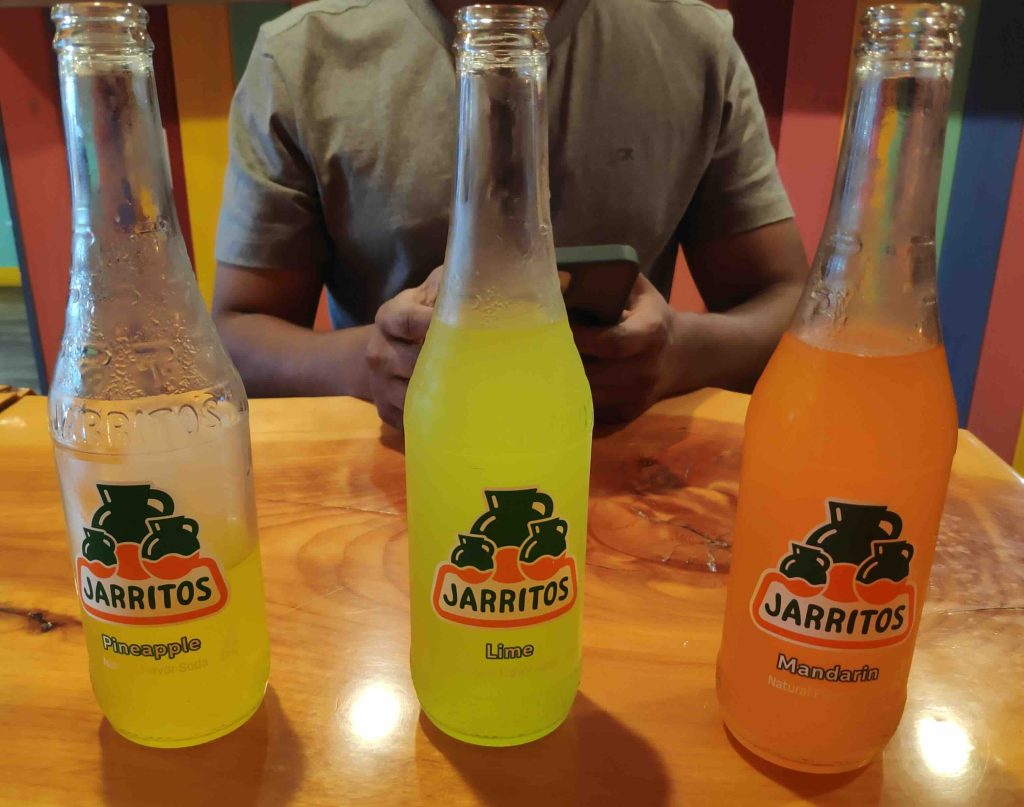
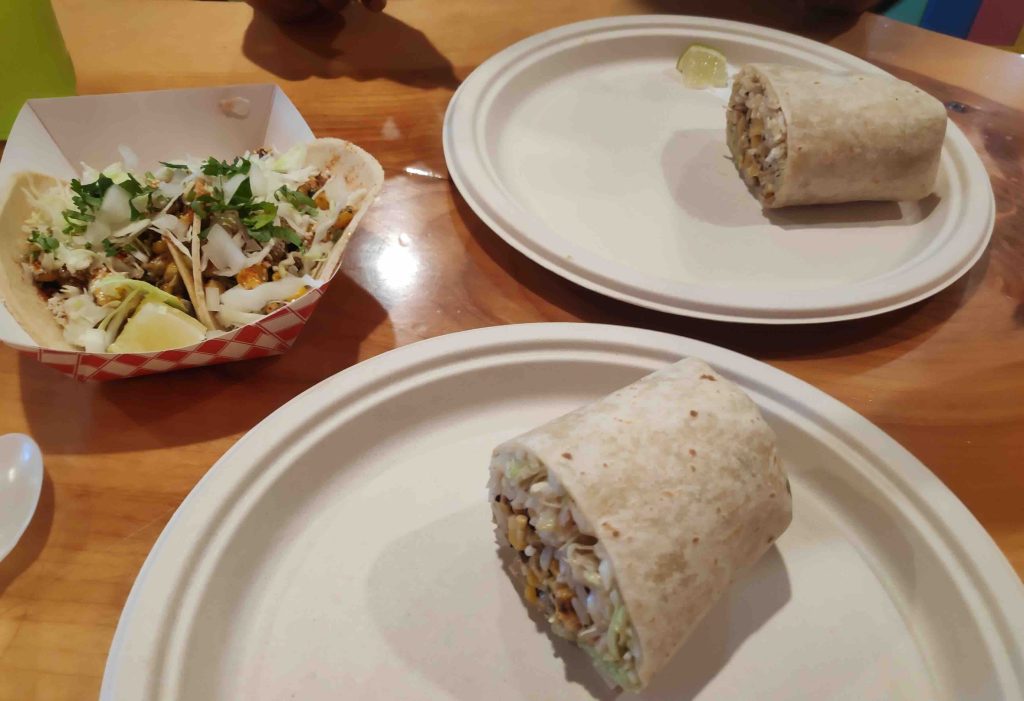
Most restaurants were in the downtown area (same place where we had dinner yesterday and breakfast today) – and so we were back there to a Mexican restaurant that Raghav and Rakesh had picked – the Lone Chicharron Taqueria. We ordered some burritos and tacos along with Jarritos (Mexican soda brand). On the table next to us was an American lady with 2 of her grandkids; their parents had gone somewhere nearby – Rakesh struck up a conversation with the kids and even told them a few words in Tamil since they were curious about our native language. After lunch, a couple of blocks away, Raghav noticed a board saying ‘Sweet Darlings’ – it was a dessert shop and not something that we’d give up. I looked up their online reviews, which seemed ok. They were packed with customers – not overflowing, but all tables occupied, and even at the counter for their gelatos, there was a queue of 6. I tasted a couple of flavours, and Raghav bought a scoop of gelato – it was ok; I didn’t find it unique. On the same stretch, we saw a fairly large gift shop that had plenty of small souvenir-type items as well as larger gifts – a great place to pick up items to distribute to friends and family.
DessertsDrinkBurritos
“Anything we want to do today?” “Want to go to the Alaska Sealife centre?” “What’s in there?” “Sort of like an aquarium.” “If there’s a polar bear, we can go. That’s the only thing we’ve not seen.” “Na – they surely won’t have polar bears.” It’s a place to see the types of local fish and animals that inhabit the waters in the area. “There are some trails further down – it seems to be in a park. We can check out the park.” We drove south from the Downtown area, as Google advised us to – it led us into shady, deserted side roads – even though there was daylight, it felt like we were on the wrong route. “Are we on some private roads?” We got out of what seemed like private property and landed in an area that seemed like the edge of a forest – this was one end of the park, but there didn’t seem to be any entrance. “We can’t leave the car anywhere here on the road, either.” We spotted a couple of trail boards, and I guess the trails would take you through the park; one of the trails, per my research, would take you to a fort. But that was a longer hike. “Want to do the trail?” “Na. It will take time, and I’m not sure of the elevation. I was thinking we could enter the park.” Considering Moorthy’s knee, we decided to return. Near the waterfront, there were signs of life – few lodging cabins; some had kayaking activity; it was a nice short return ride where we drove just near the water of Resurrection Bay – we were driving beside the Pacific Ocean! This was the beachfront, but it was rocky.
Junk food
It was around 5:30 pm when we were back home. Moorthy was having a back-and-forth conversation with the owner of our cabin regarding the internet connection – it was patchy, the speed was terrible, and he couldn’t watch the cricket games. The owner’s replies were also fairly inconsiderate – he messaged in the morning, and she said she would look at it in the evening! “I thought these places would care about the reviews that people posted. Seems like she doesn’t care about it.” Finally, Moorthy found where the wireless device was placed – it was like a treasure hunt to locate that! And then we played around, positioning it in different places to see where the speeds would be good. “Try keeping it outside.” I placed it just outside our door, and that’s where we found the signal strength and speeds were the best. The cabin next door was still unoccupied, and so there was no one else in these woods except us.
One issue when you travel in groups is that you’ll tend to buy these large packs of snacks – and we had chips and some crunchy flavoured onion rings that we kept munching on through the evening, along with cookies. “We should go for dinner and buy dinner and come so that we don’t end up getting stuck like yesterday.” Raghav was searching for restaurants. “We can get food and do a campfire. There was wood in that supermarket.” We had seen cut logs for sale at Safeway in the morning. So fuel wasn’t an issue, and there was an outdoor fireplace just in front of our cabin to start a campfire.
A feast
At 7 pm, we were in Safeway, and everyone wandered off to different aisles. When Raghav and I saw Rakesh a while later, we were surprised to see veggies in his shopping cart. “Why?” “Moorthy said we’ll cook dinner.” “But why cook here?” “He is insisting.” A few minutes later, we spotted Moorthy while Rakesh was wandering around the veggies section. “Rakesh is eating very little. I think he wants Indian food.” “But Rakesh usually eats only a little. He likes Thai food, and even that he eats less only. He is not particular about Indian food.” “No man, he will eat more. He is eating very little in the restaurants.” When we saw Rakesh picking Indian spices, both of us burst out laughing. With family or kids or having issues with finding suitable food, it would have been normal to cook while travelling – but with the four of us, it just felt ironic. “We’ve come all the way to Alaska to cook Indian food!” It wasn’t like we weren’t finding anything to eat, and there was just one more day to go. “Moorthy says that since you are not eating well, we should cook.” “I don’t need Indian food.” “He says it’s for you.” “I think it’s because he wants Indian food,” Rakesh quipped. “They even have some of the Indian masalas in this shop.” “You both are certainly very serious about this.” There was no way to talk them out of it. And anyway, since we didn’t have anything else planned for tonight, it was fine. And we joined in to help them pick items for the dinner feast and campfire. We even bought some fancy salt and pepper bottles. And at last we picked a bundle of fuel logs – they were already chopped into smaller blocks to make it easy to handle.
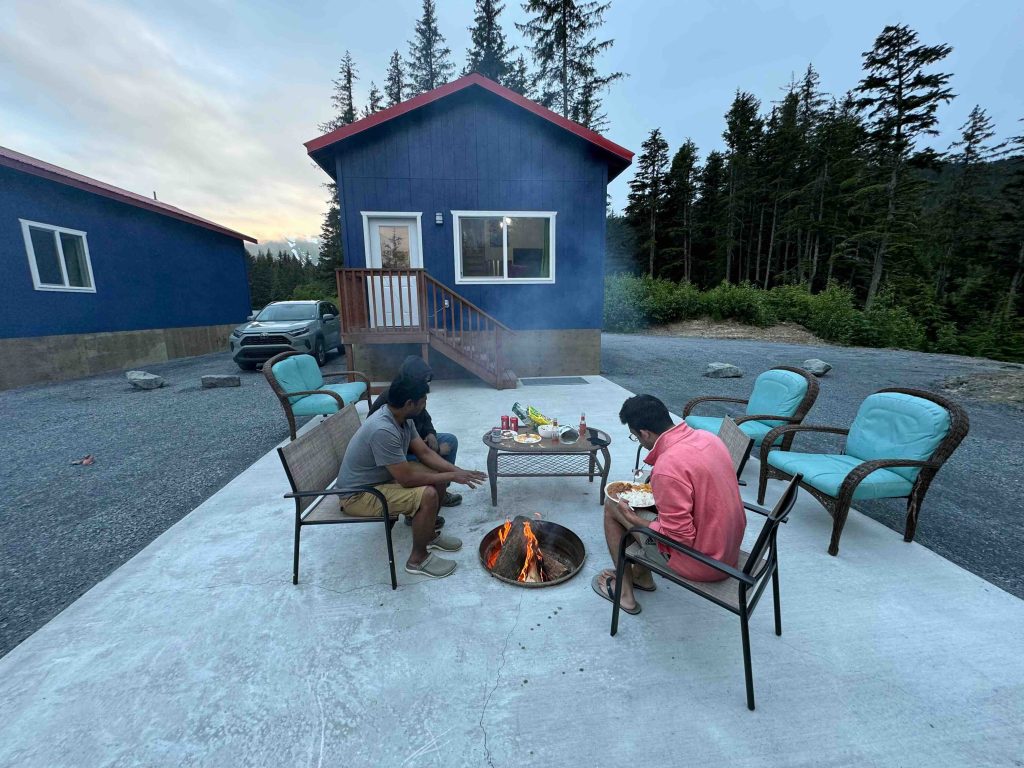
By 8 pm, cooking had started; Moorthy helped chop the vegetables, and Raghav helped Rakesh prepare the dishes. Fortunately, just like the first place where we stayed in Anchorage, this one also had all the utensils that you’d need for cooking. “Rakesh is the chef. And Raghav is the sous chef,” we commented. They kept rice, gobi-65 (cauliflower starters) and a cauliflower gravy. Add to that some potato chips we had and some drinks, and that was our dinner by the campfire. “What’s that?” I asked Moorthy as he pulled something out of a small box. “It’s a fire starter kit. Helps start the fire.” He sure had thought of everything when we were at the supermarket! It was 9:30 pm, and we still had daylight – but it was cold outside. I had to wear a couple of layers: a sweatshirt and full-length pants. And I still felt cold. Rakesh, on the other hand, was wearing just one layer – a thin t-shirt and shorts! We spent some time sitting around the fire, warming ourselves, enjoying the food, and chatting.
We wrapped up at around 11 pm. “Keep everything packed since we’ll have to check out in the morning.” “Let’s start at 7.” Check-in time was 7am, but the staff had said today that if we came by 7:30am, it would be ok.
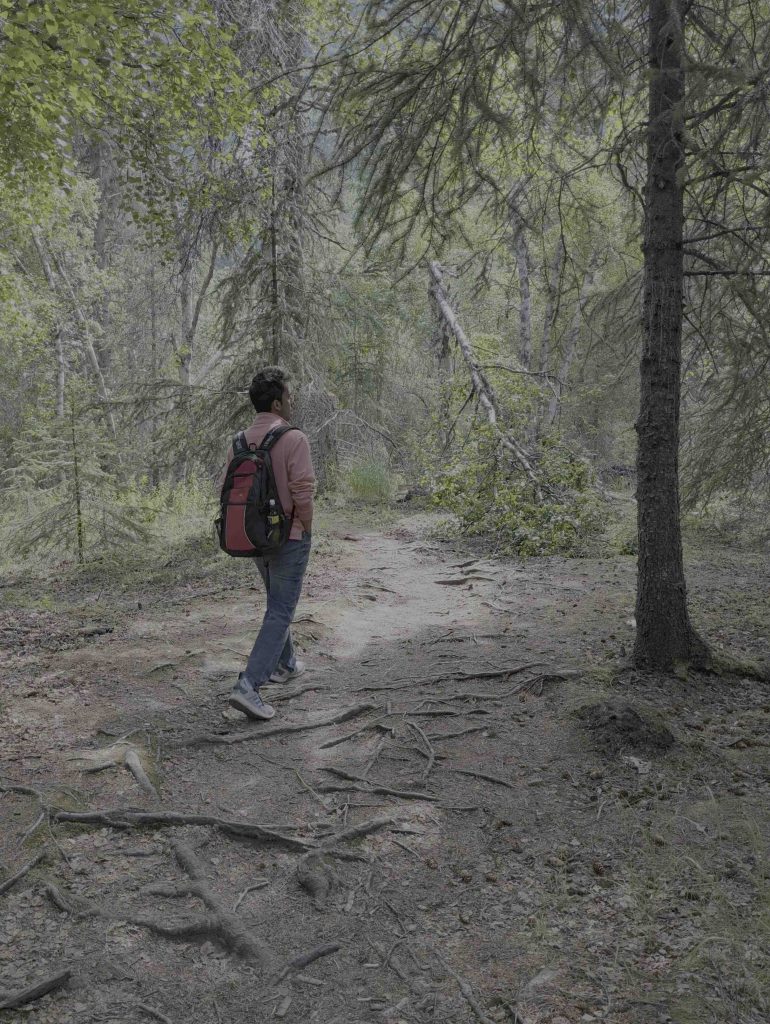
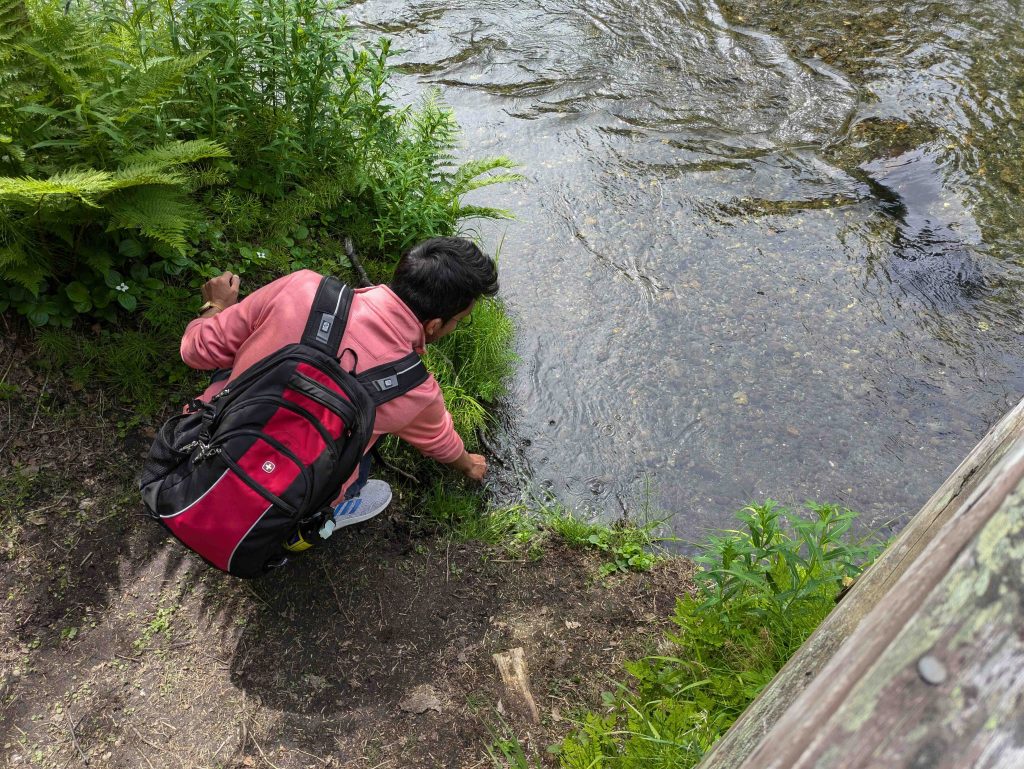
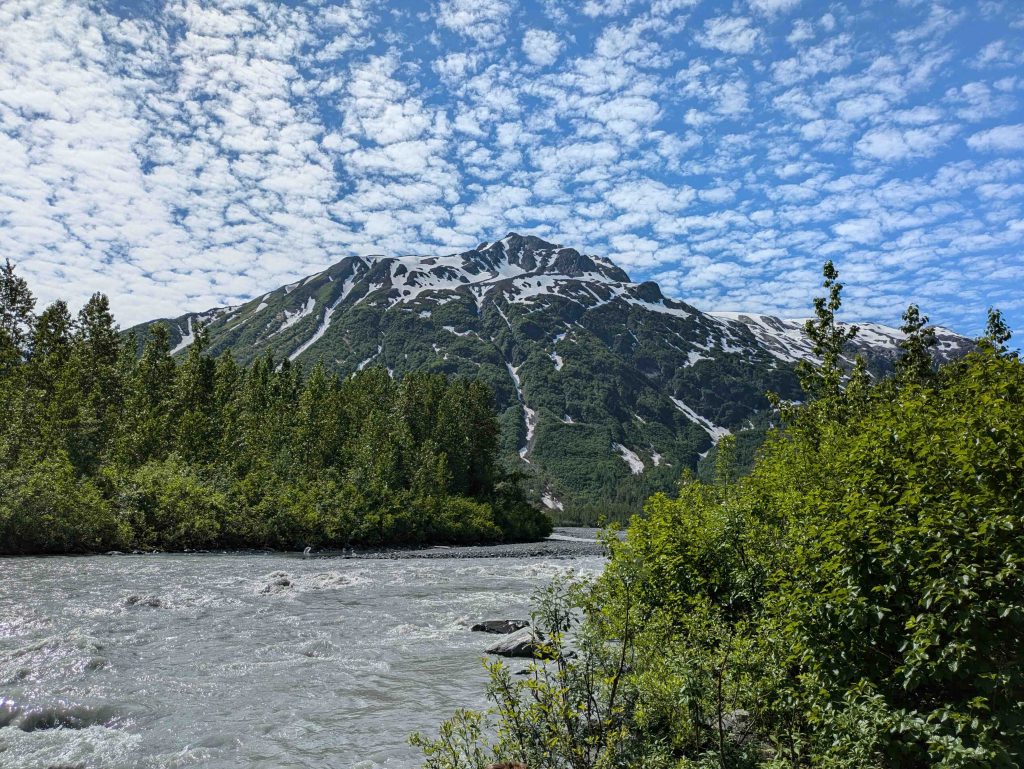
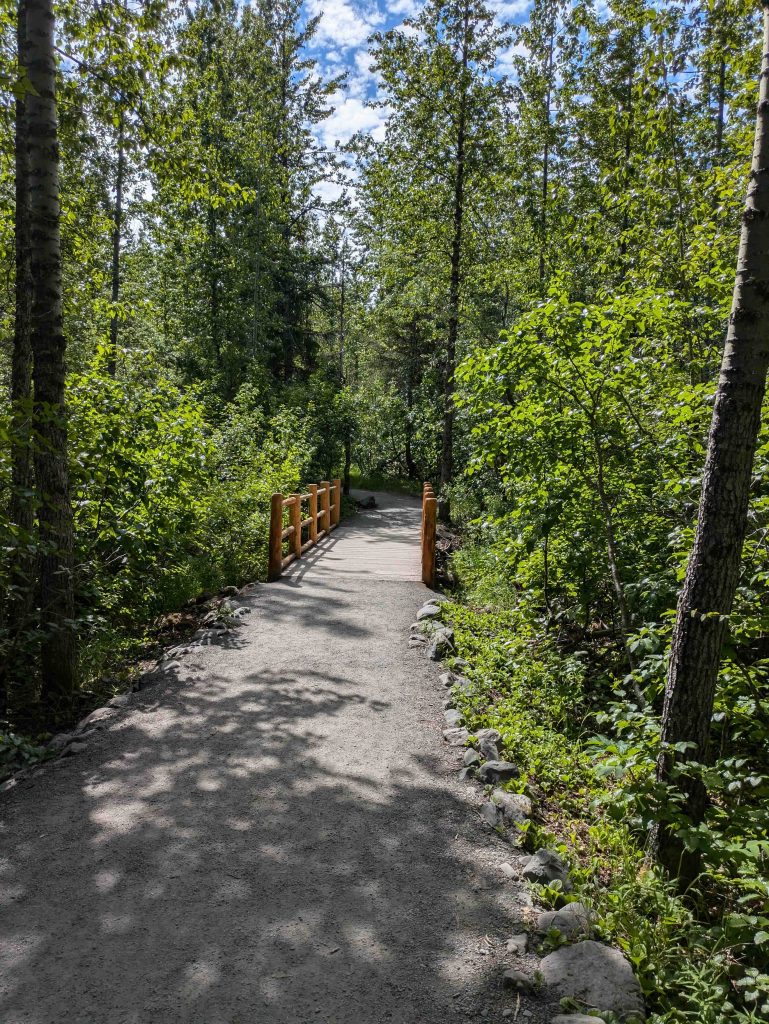
As we ventured on, it seemed like we were alone – there was no crowd around us, and for a few minutes, it was just the 4 of us walking through paths surrounded by trees on either side. “Maybe we will see a bear.” “You have the bear spray to handle it.” “Yeah, but it’s inside my backpack. Not the place where it should be if we have to use it.” We kept talking as we went along – that is also one of the recommendations in bear territory! To make noise while walking so that bears don’t come near. The path led us to a water stream – it was Raghav’s practice and became my practice as well that when we encountered water bodies, we’d test their temperature – we dipped our hands in, and it was cold.
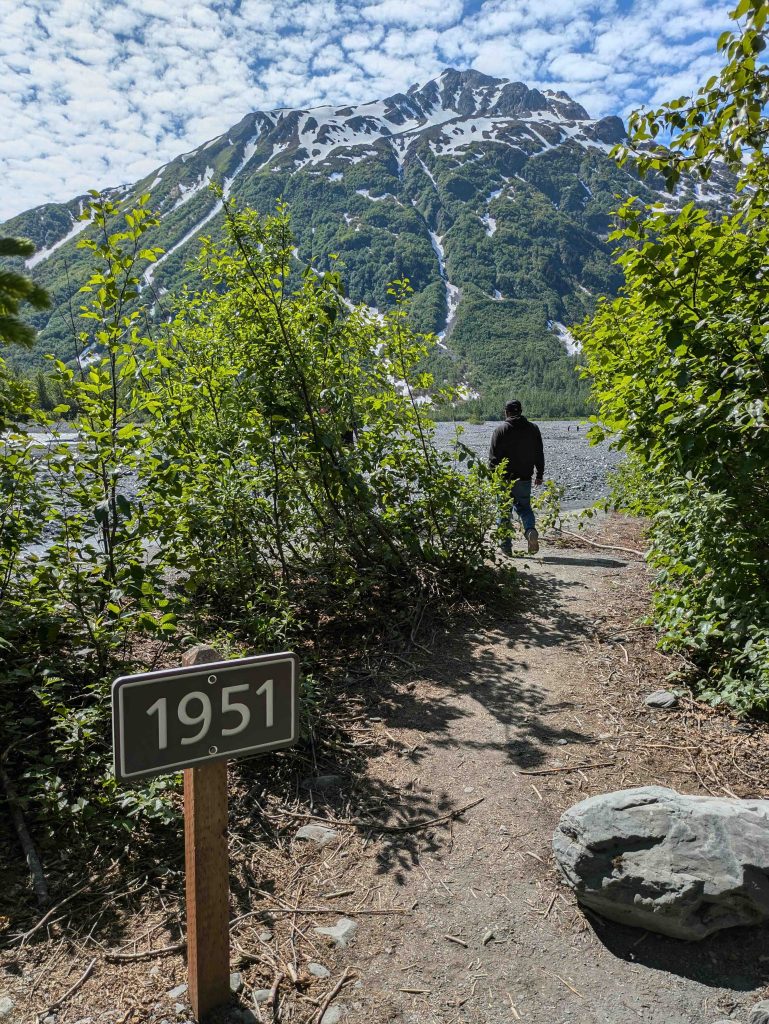
Some interesting tidbits – like we don’t pay much attention to the ground that we are walking on – that we can spot moose and bear scat around. As you walk on the trail, you see certain milestone-type markers with a number on them – first 1917, then came 1926 and so on. At first, we thought it might be the elevation, but later learned that it was the year the glacier was present on that spot.
These spots were now solid land with the glacier not even close by – so fast has been the retreat/shrinking of the glacier. It also explained why in certain random places near the trees there would be a large rock – seemed a little out of place, but these were boulders that were carried by the glacier – glacier is moving ice, and as it moves, it carries things along with it.
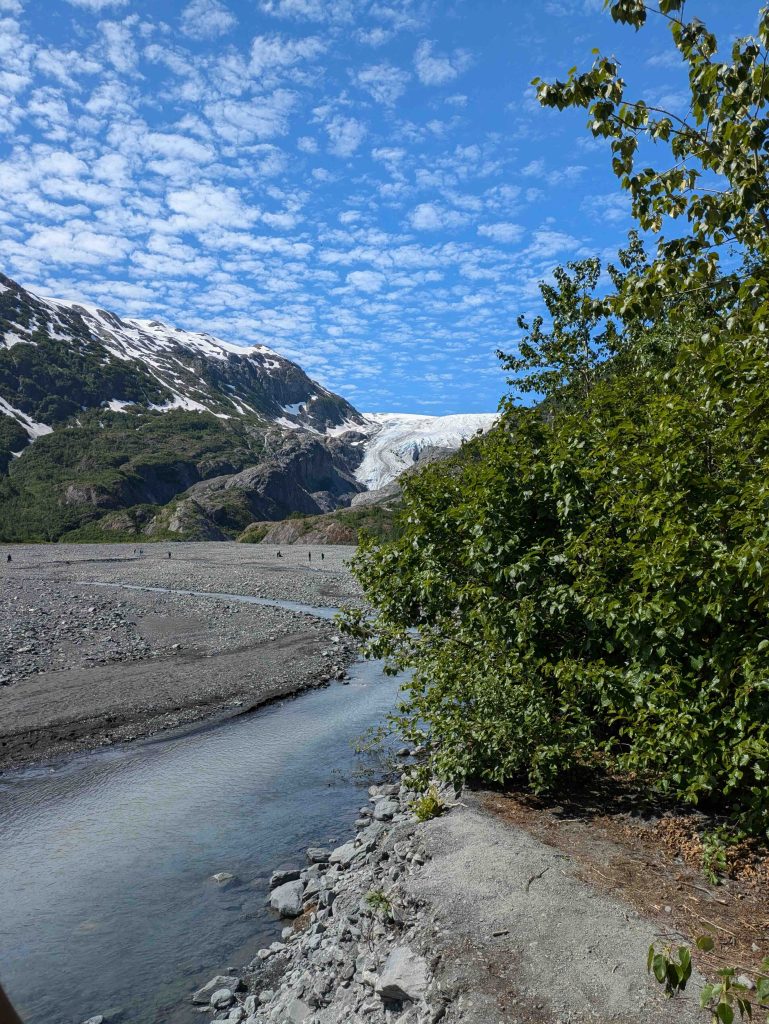
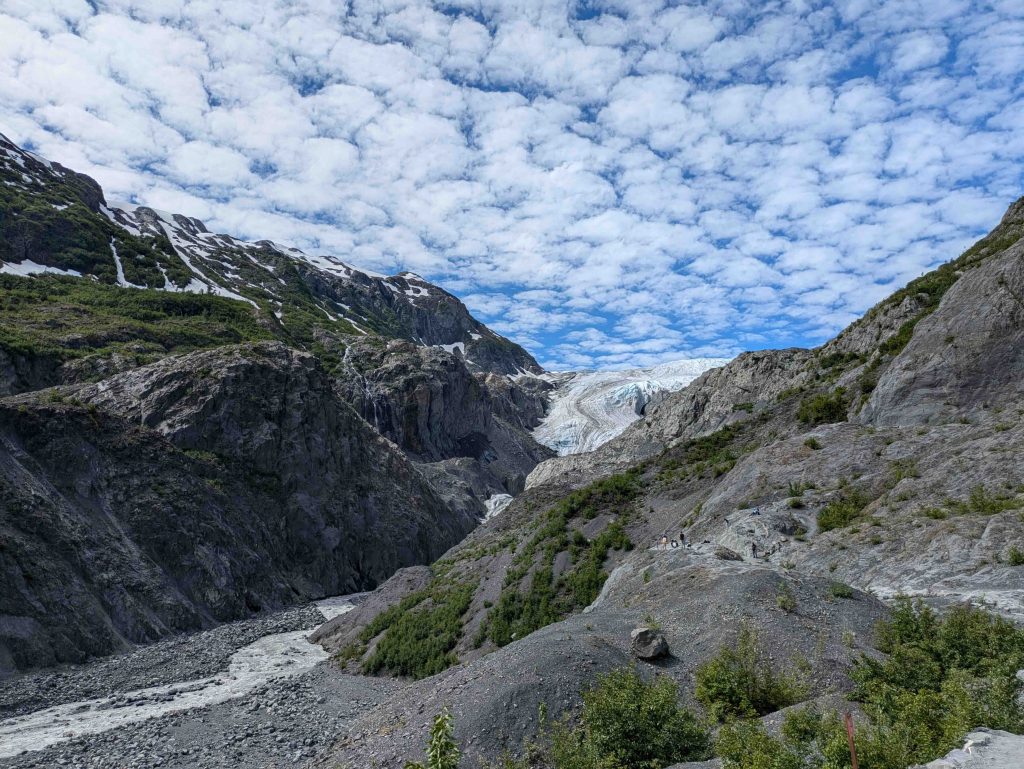
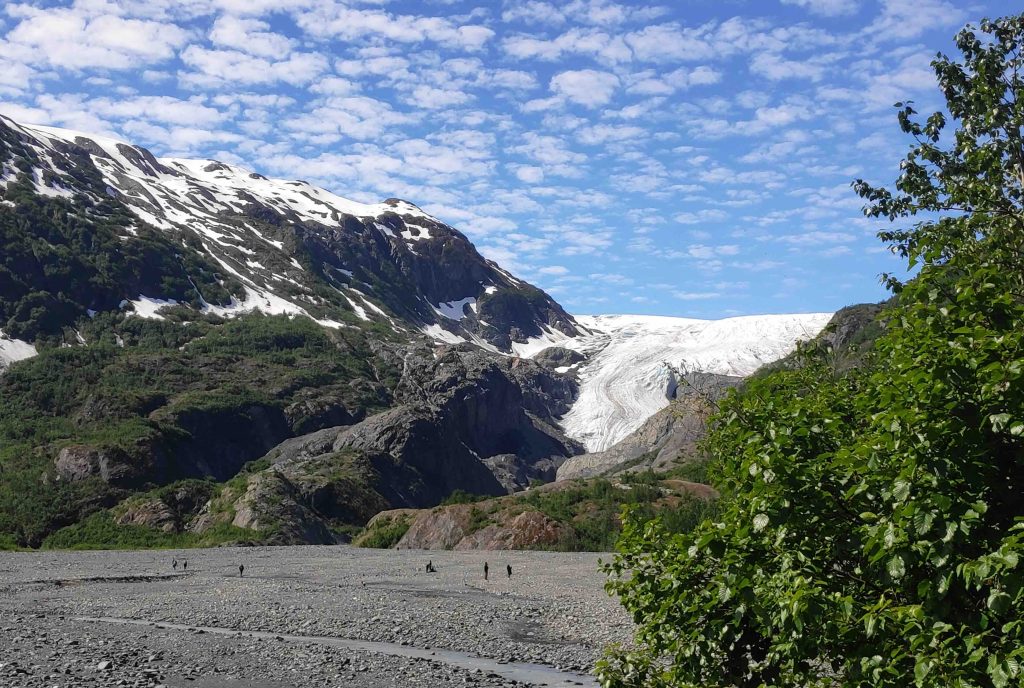
There was a nice bench carved in a log to provide a resting point on the trail; we finally saw a few other people ahead of us. “Moorthy, your knee ok? Or you want to sit here?” “I’m fine, man.” I saw a board which said we were at the end of the ‘Glacier View Trail’. At this point, we had a good view of the Exit Glacier. The glacier was this stretch of ice between the sides of two mountains, seeming to flow through a valley. Some glaciers start carving the mountainside of the valley walls, and that’s how Fjords are created. Exit glacier is moving at 20 inches a day or so, but it’s losing about 24 inches a day – Exit Glacier is a ‘retreating glacier’ meaning it is losing more than what it is gaining (and for a glacier to form, it’s not the amount of snow in winter that matters, but how much of that snow stays till the end of the summer that matters – and over decades the glacier forms; this is called an ‘advancing glacier’).
The glacier at a distance
Rakesh and Moorthy didn’t see the board signalling the end of the trail. We just kept walking along the trail, and I didn’t bring anyone’s attention to the board. The alternative was that we could have stepped down to walk on the plain (called outwash plain) that was at the base of Exit glacier – the stream of water was narrow at this point, and people were walking onto the plain – from here it felt like we could walk on the plain and hike up to the base of the exit glacier. “It’s flat but rocky. And there’s a long distance to walk to get near the glacier.” Rocky surface wouldn’t be good for Moorthy’s knee. “Let’s just continue on this trail path.”
Unknown to both of them, we were now on the longer and moderate difficulty trail – the Glacier Overlook Trail.
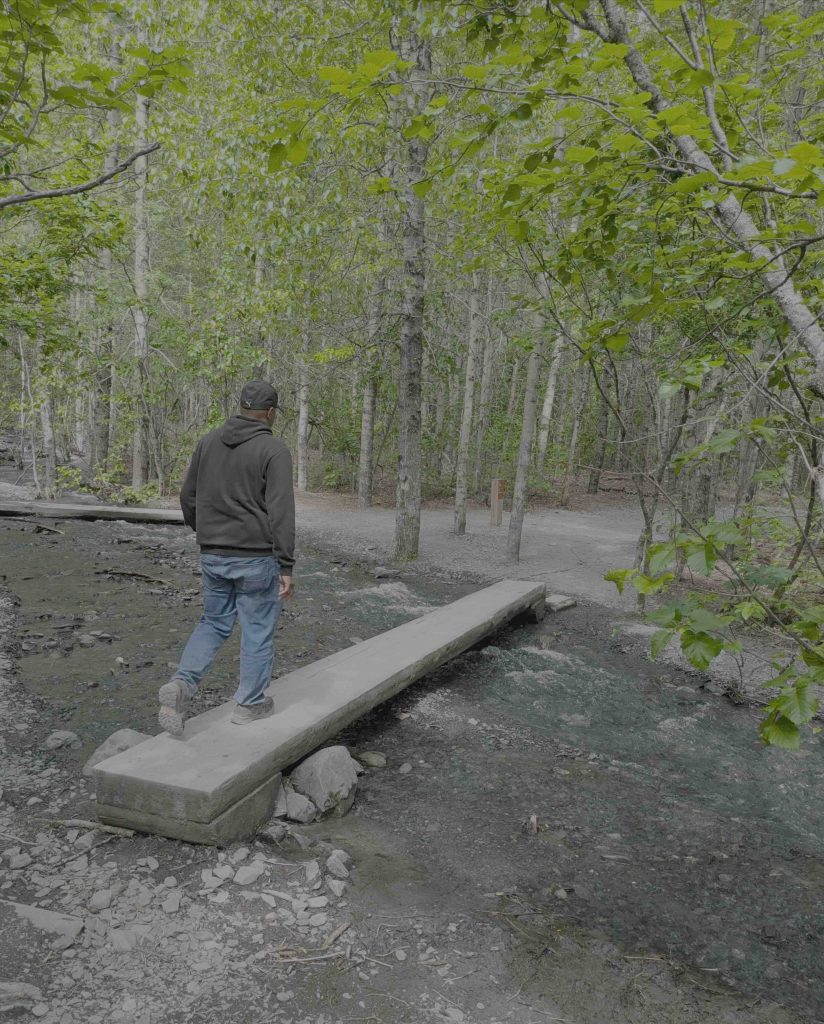
Why do glaciers move? A board had the answer – the Harding ice field gets some 70 feet of snow each year, and the weight of the snow powers the glaciers. We couldn’t see the ice field from down below – need to get more elevation for that. We did have a thought about walking up to the edge of the glacier, but saw a board that talked about “Chasing a glacier” – a receding glacier uncovers terrain that can be unstable and hence even if it seems that you can get close, it may not be safe to do so – projections from the glacier could collapse without warning. There was a place where we had to cross a small stream – on one side was a slightly wobbly plank to get across. Raghav and I gingerly walked on it. “Moorthy, be careful on this.” But he found a more stable board a few feet away!
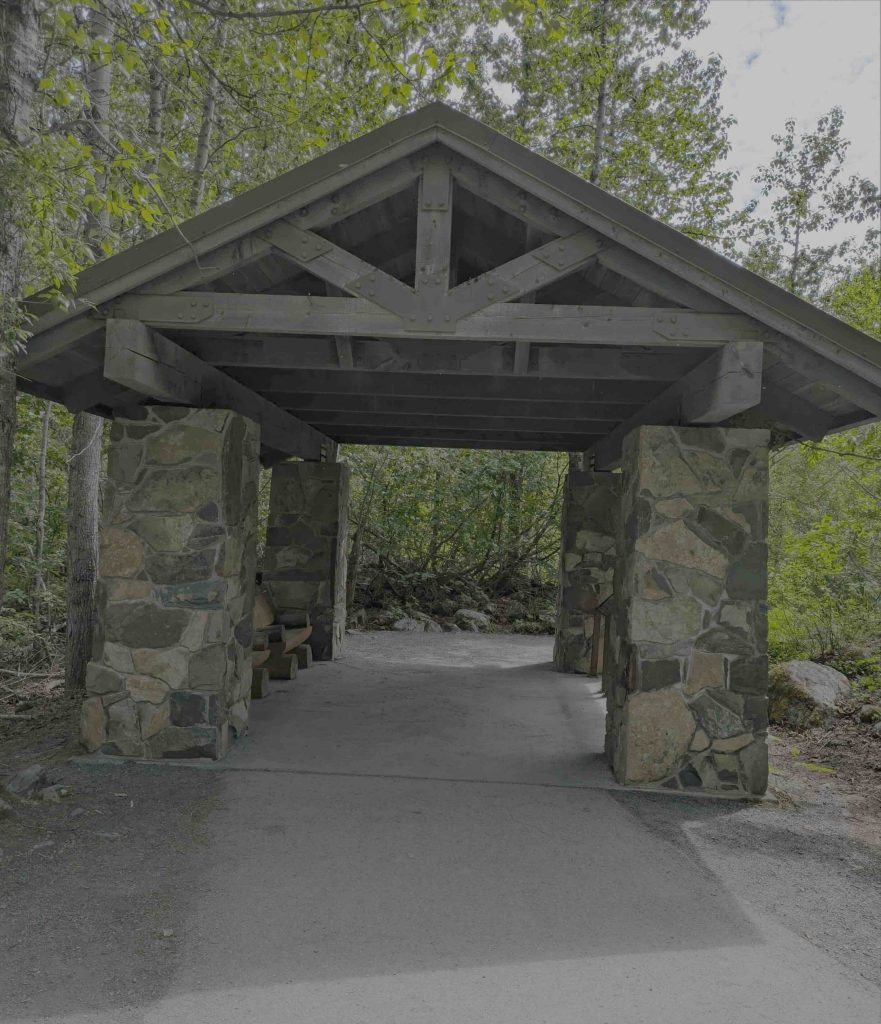
We reached another rest area, where they had built a hut-like shelter. We paused to sip water before continuing. Further along, we hit upon a steep climb. “Hey, this is not the first trail,” Rakesh said when he noticed a board that mentioned the name of the trail. “Yeah, we are on the longer one.” Rakesh probably wasn’t too happy about this, but he wasn’t surprised either – Raghav and I had the habit of pulling along people on long walks without them even realising how long it would be (another 5 mins or another 10 mins we’d keep saying and soon it would be an extra 45-minute walk!)
Path on the trailA resting placeSmall streamThe plain and the glacierClose up
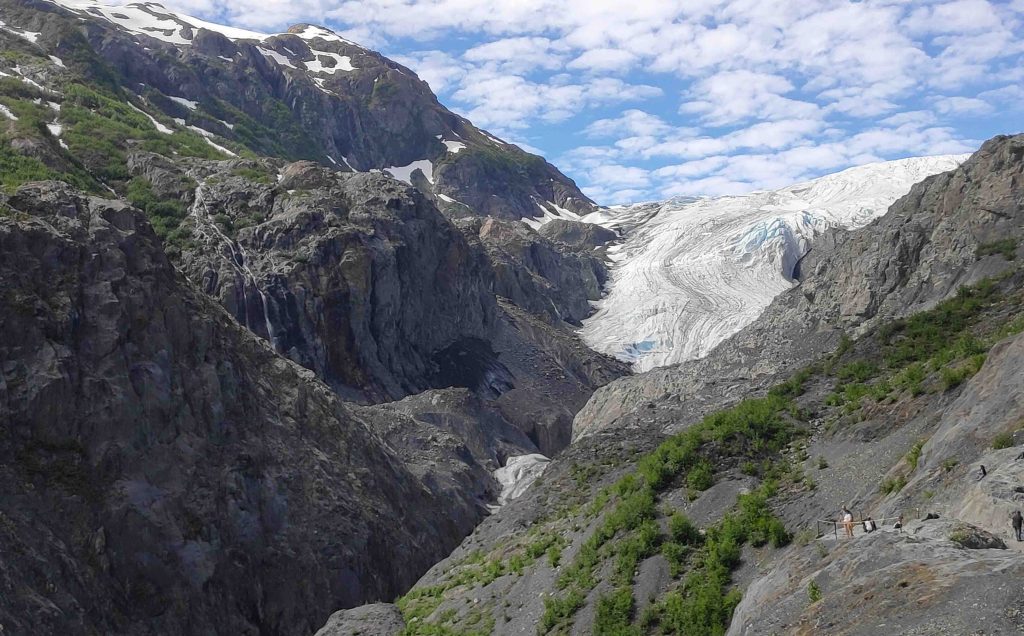
“Moorthy ok with going up? If not, we can make a dash up and come back here.” “That side seems a little less steep,” and he went a few feet away to climb up the rocks. There was a larger crowd here, and a person was leading a guided walking tour. We weren’t in hiking shoes, but we were able to manage this longer trail. It takes you closer to the exit glacier and to a higher viewpoint. The milestone board said 2005. We sat on the rocks for a while, then made our way back. There was a point at which the board said “Harding Icefield Trail” – the longest trail, which was certainly tempting, but we skipped it.
We left the place at around 1:45 pm; no bear or moose encounters!
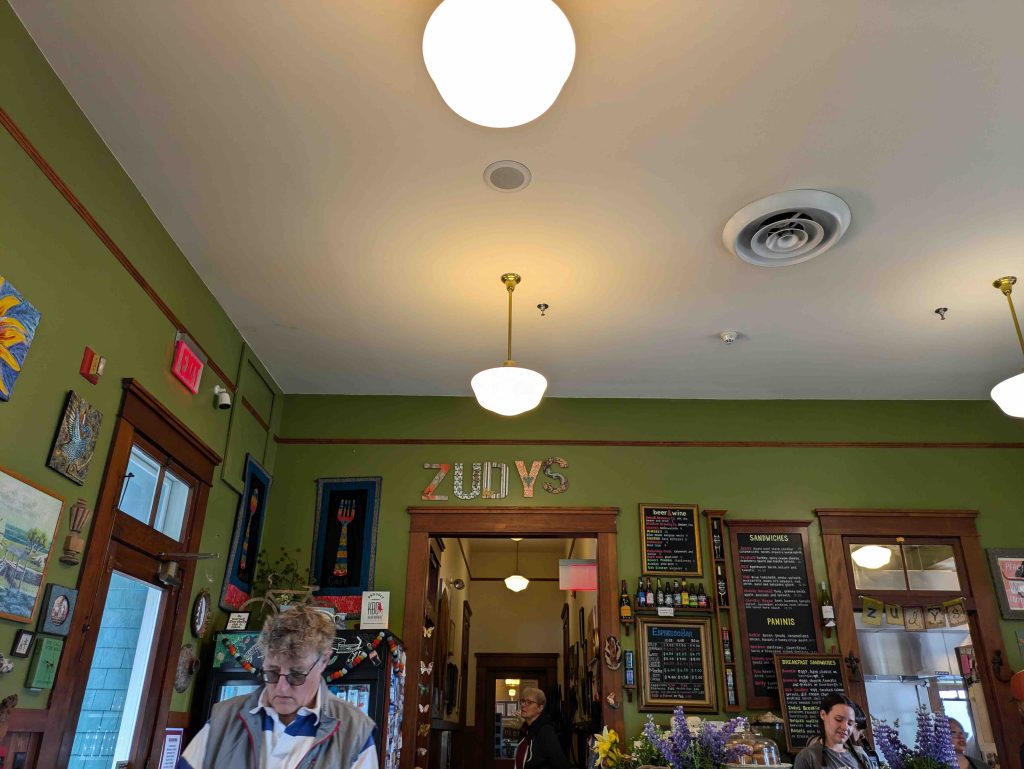
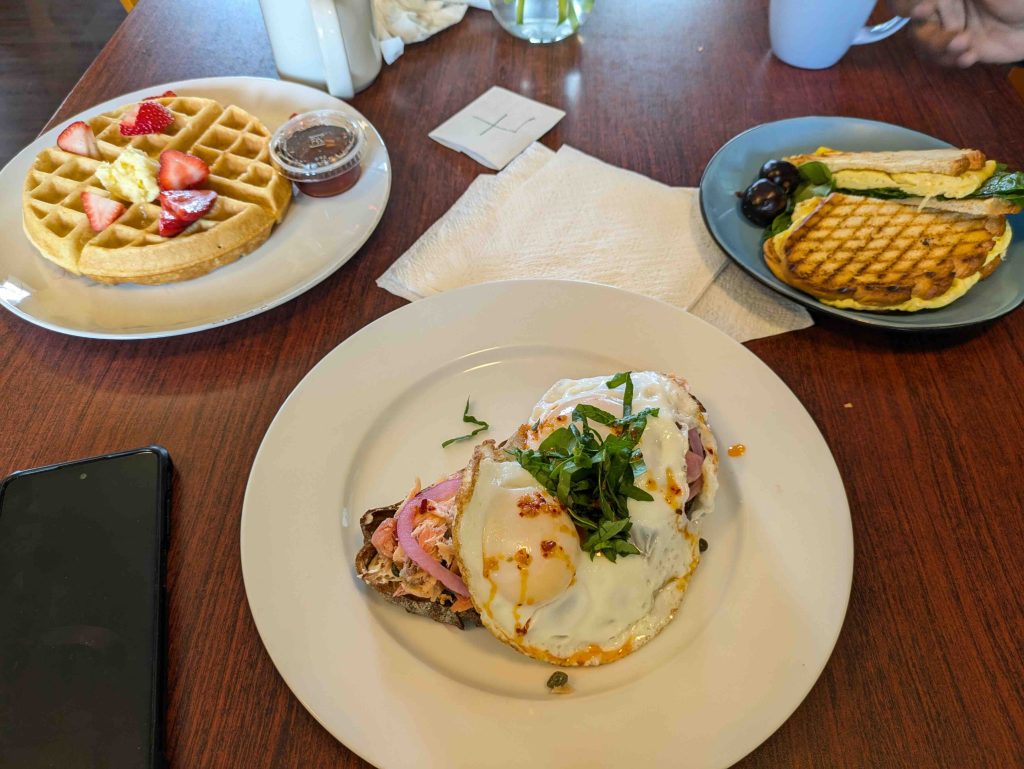
Around 10 am, we were supposed to be at the ice hiking office. Moorthy and I were up by 8. “Man, this pain has got worse,” Moorthy said. “What happened? You fell at night?” “No. Yesterday I tripped in Whittier.” I recalled the incident when he tripped over a cable protruding from the ground. It seemed like an innocuous incident back then! “I didn’t have much pain yesterday, but today it’s bad. Can walk but steps may be hard.” Rakesh came down the stairs. “We’ll get something for breakfast?” Since Raghav wouldn’t have breakfast, the three of us decided to eat something and be back. “Let me test walking on the steps.” And he was wincing in pain the minute he put his weight. “Let’s have breakfast, and then we can take a call.” Rakesh drove the car so that Moorthy could rest his knee; we drove back to the downtown area we were in last night and parked over there. There was a restaurant called Zudy’s Cafe that was open, and on the way, we crossed the Alaska Sea Life Centre. I ordered a salmon breakfast sandwich; Rakesh had Belgian waffles, and Moorthy had egg and cheese. There were quite a lot of diners in the place, and some large groups as well. Seemed like a popular morning spot. This setting also had that old-school feeling of the 1980s – nice, quaint cafe.
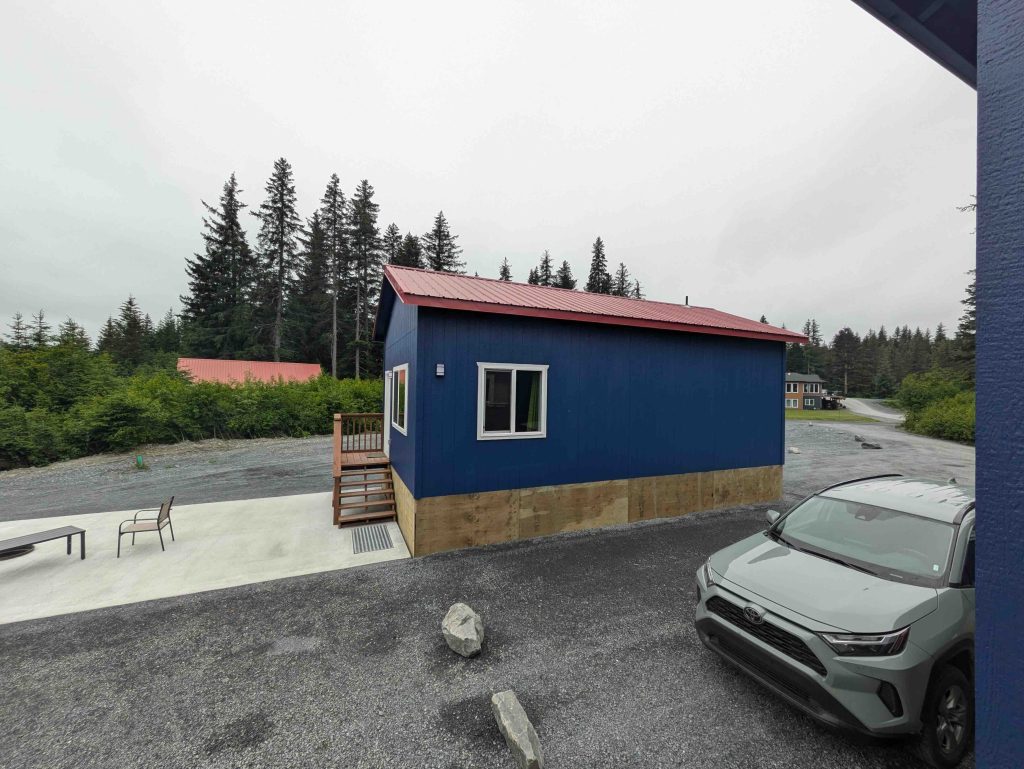
Our cabinZudysBreakfast
At 10 am, we were back in our cabin. Moorthy was still in pain, and so we abandoned the hiking plan. Raghav talked to the operator, but they said nothing could be done. “Is there some wheelchair assistance available?” We knew we were pushing our luck, but no harm in asking. This was meant to be a hike. “Wheelchair will be available, but can’t be used for the hike.” “Is there anything else that we could do?” “There is a flat trail that we can have a guide for you.” I guessed that it was one of the initial hikes that were listed in Exit Glacier – just that they’d have a person along with us providing commentary. We opted out of that. “Can you provide a refund?” “Unfortunately, since there is no time for someone else to fill up the position, we won’t be able to do a refund. And there are no names on the waiting list. But if someone does come, then we’d be able to refund.” They took only a small group on the hike each day. If no one is already on the waiting list, it is unlikely that anyone will sign up within the next hour.
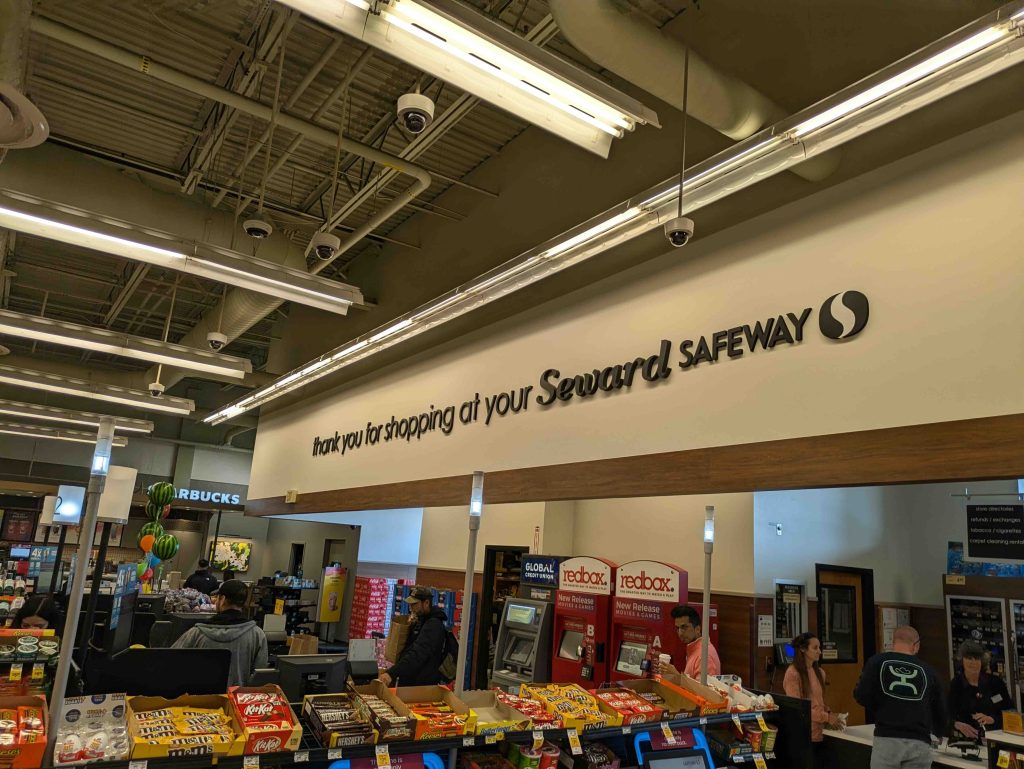
“I can just wait down while you guys go and come,” Moorthy said. “But it will be around 5 hours or more, and you’d just be waiting.” We decided it wouldn’t be right – if it were an hour or two, it would have been ok, but 6 hours alone would just be extremely boring. “We’ll figure out some other alternative.” “Maybe can get a knee brace. Might help to some extent in reducing the pain and giving support.” “Any medical shop nearby?” “I saw Safeway. Surely they’ll have.” I knew Safeway was a popular supermarket in Canada; I hadn’t seen one during my US trips so far. But then Alaska is bordered by Canada. Moorthy had to return the brace because the size wasn’t right; instead, he got a crepe bandage and tied it around his knee in the car.
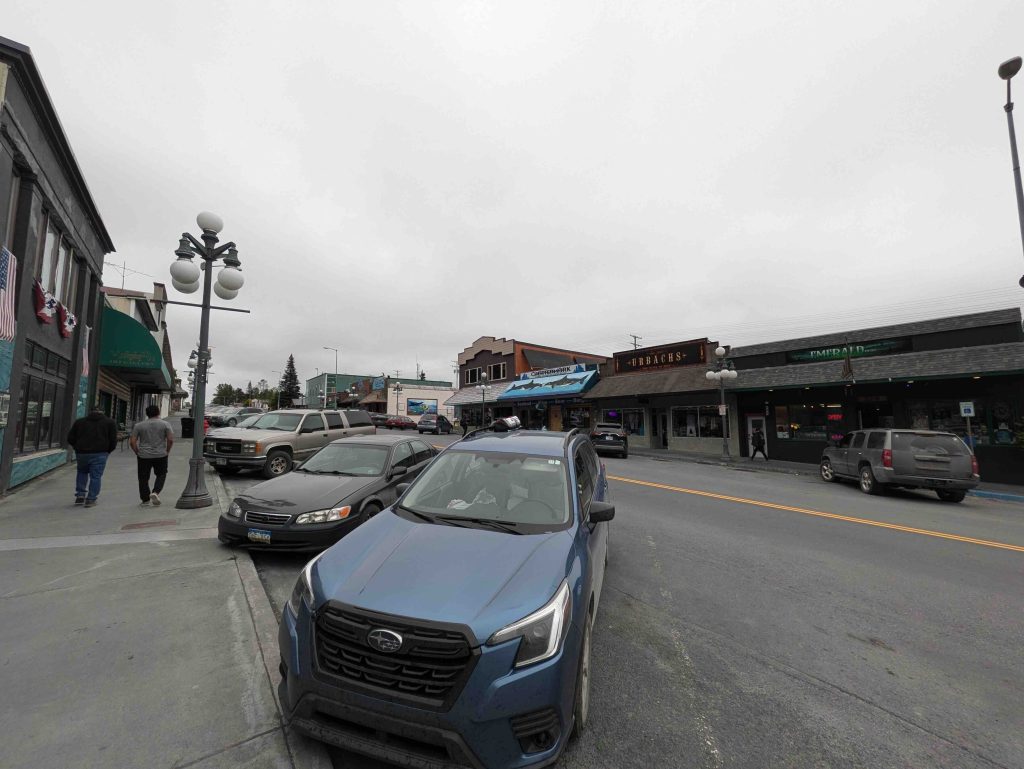
The citySafeway
We then headed to the Exit glacier hiking operator’s office since it was nearby. The place also doubled as a store, and they had a lot of hiking-related gear available for purchase. We enquired at the front desk about any options we had, but it was pretty much the same as what Raghav had heard on the phone. “Let’s just go to the exit glacier and see what’s there.”
It was a 20-minute drive to the place – the road runs parallel to the Resurrection river and as you drive down this road you can see what is called ‘exit glacier’ – we had seen some pics online and we could get a glimpse of it from the road itself; the Exit Glacier is part of the Kenai Fjords National Park (it’s a park of some 600k acres – not the type of parks we tend to think of – these are massive areas of the state that are designated as park areas). Exit Glacier is one of the glaciers on the ‘Harding Icefield’ – a large ice sheet that covers a significant part of Alaska, and from this sheet, 40 glaciers flow out (called Harding after the name of the US president who visited it in the 1920s).
And if you are wondering what a glacier is, it is a large accumulation of ice/snow that originates on land and moves down (moving ice). Happening over multiple decades, this leads to glacier ice (with more snow accumulating than melting over these decades). https://www.usgs.gov/faqs/what-glacier
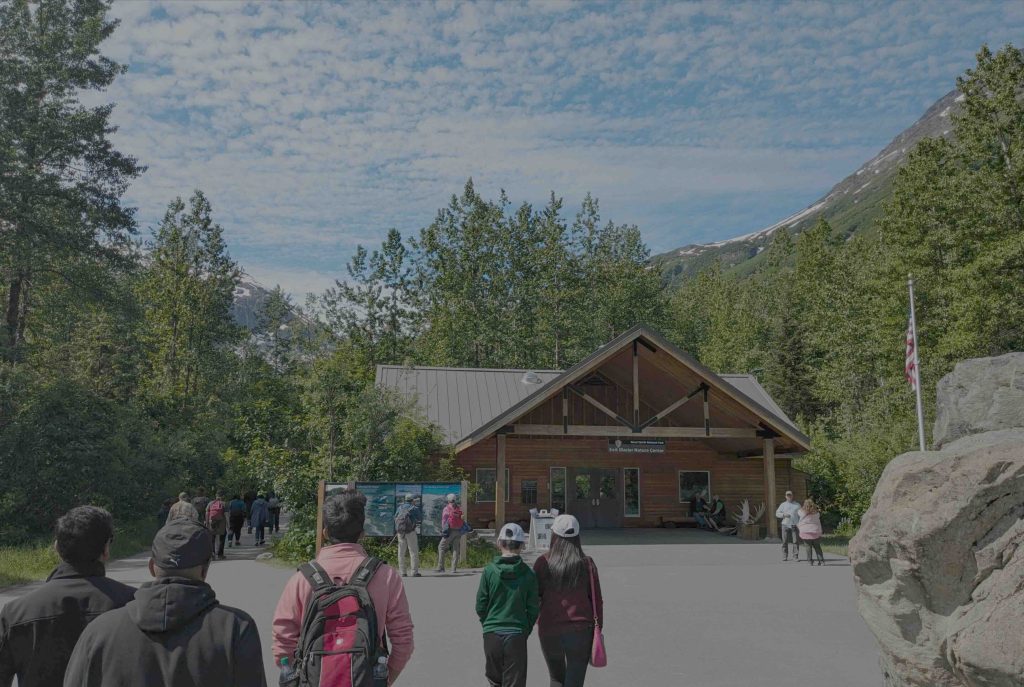
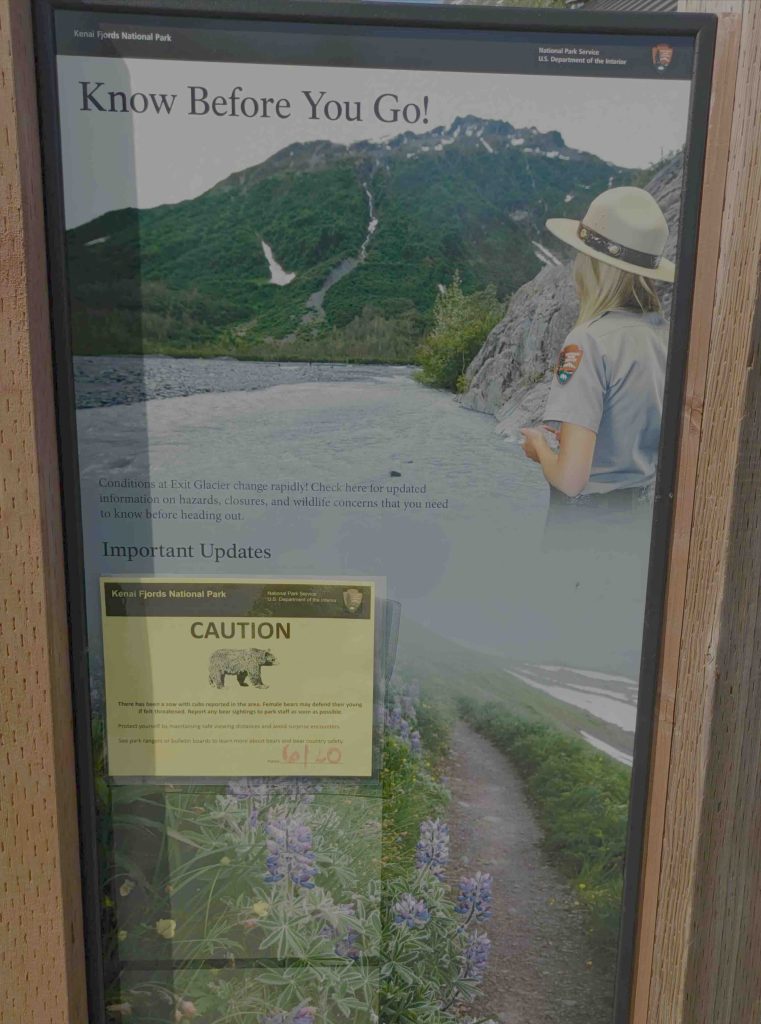
It was 12:30 pm when we landed outside the Exit Glacier Nature Centre. There were ranger-led walks, but we decided to skip that since we didn’t know how far Moorthy’s knee would hold up. The notice board had a post-it note from 5 days ago about a female bear and her cubs spotted in the area! “There are 3 trails – the Glacier View Trail looks ok.” “Yeah, it says wheelchair accessible as well. Should be flat terrain then.”
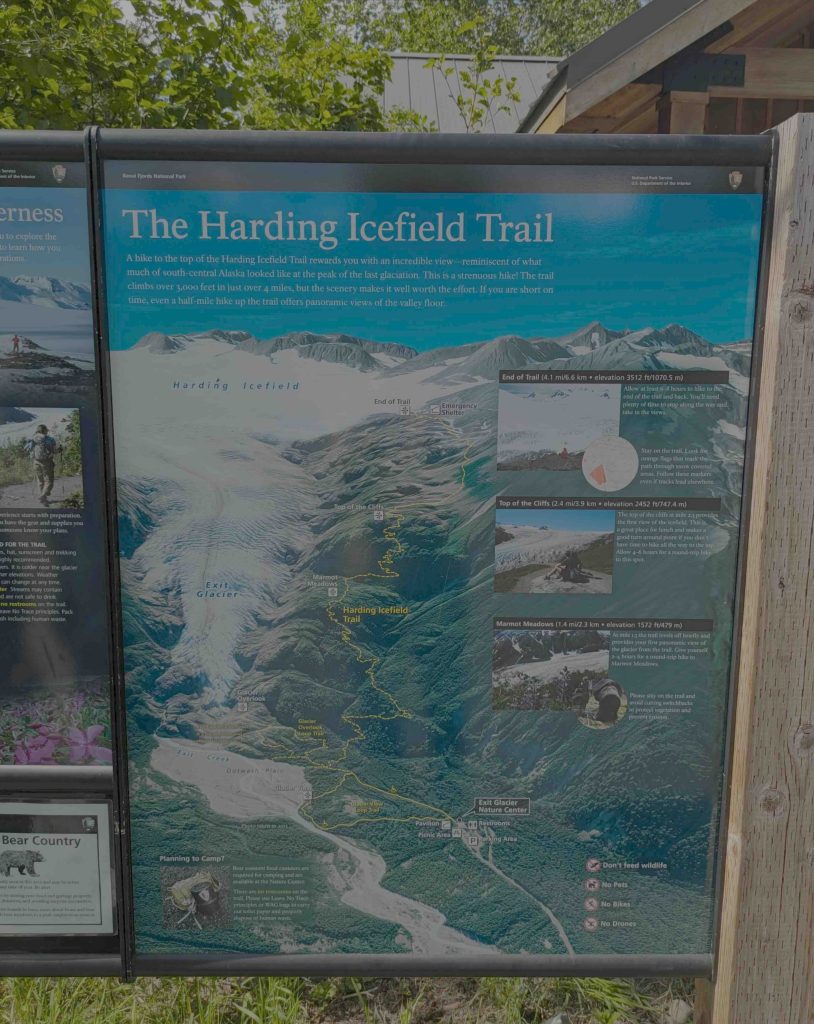
Visitor’s centerIcefield and the glacierWarning
Another trail was the Harding Icefield Trail – the board said it was a strenuous, steep hike one way for 4 miles (6.5 kms) with an elevation of 1km. It said plan for 6 to 8 hours! They did mark a couple of points earlier on the trail that could also be used as turnaround points. Seemed an interesting route – you’d get to see what an ice field looks like – from the pic it seemed like you’d see an endless cover of ice under the blue skies on a sunny day.